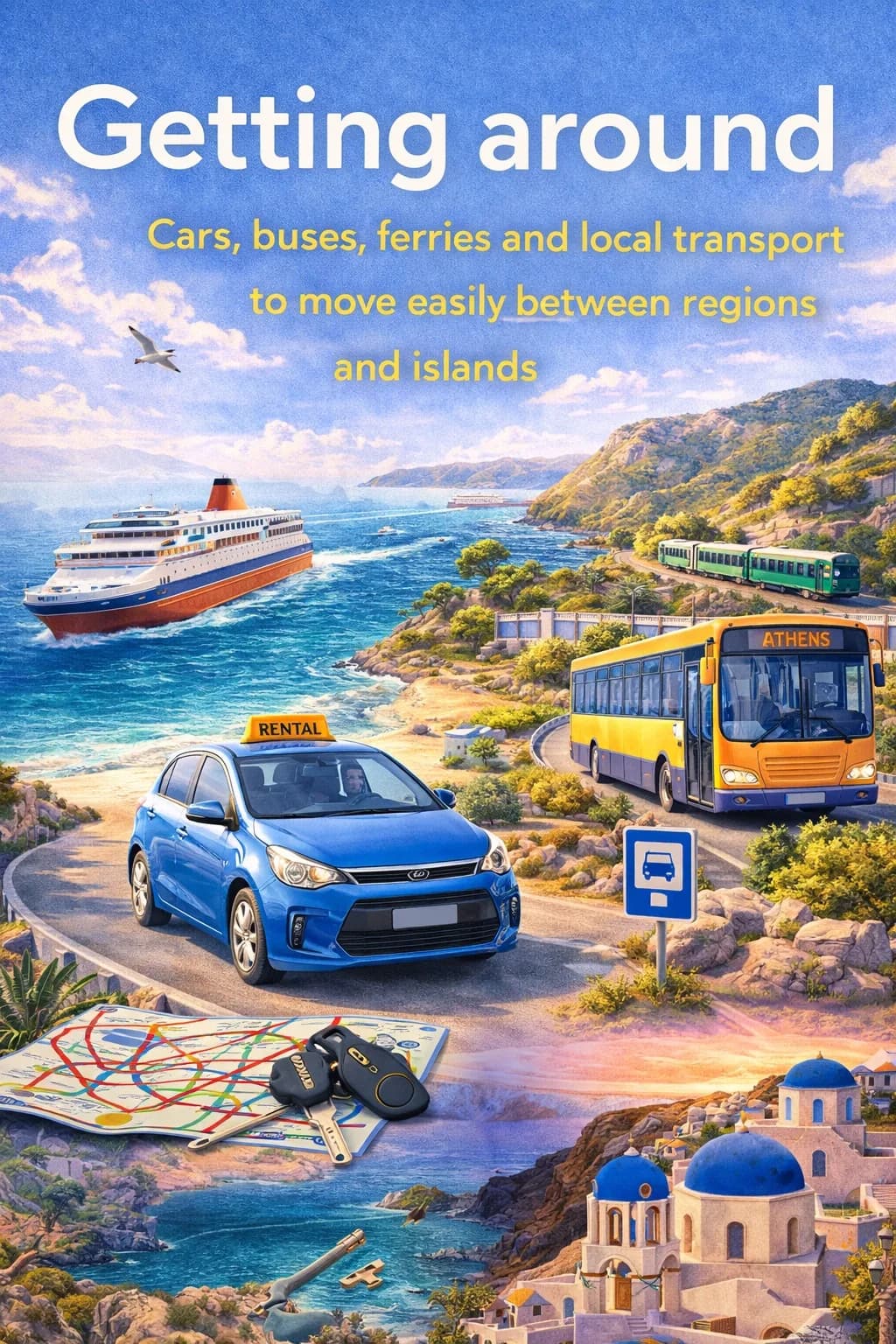
Getting around Greece
Travel Guide

Getting around Greece

From domestic flights and fast ferries to local buses and car rentals, navigate the diverse Greek landscape efficiently and comfortably.

Overview

Navigating Greece means learning two different transport systems: the intricate web of Aegean and Ionian ferries, and the extensive mainland road and bus network. With a bit of strategic planning, you can easily combine flights, ferries, and cars to craft the ultimate itinerary across mountains and islands.

1

Mastering the Ferry System

The ferry network is expansive. You have standard car ferries (slower, cheaper, open decks) and high-speed catamarans (seajets, hydrofoils) which cut travel time by half but can be bumpy on windy days. Ferry logistics dictate that you should group islands within the same cluster (e.g., sticking to the Cyclades, or exploring the Dodecanese) rather than jumping between completely different island chains, which often requires routing back through Athens.

2

Car Rentals and Driving

On small islands (like Hydra where cars are banned, or central Cyclades), public buses or scooters are enough. But for mainland excursions like the Peloponnese or massively scaled islands (Crete, Rhodes, Kefalonia), a rental car opens up secret beaches and mountain villages you’d never otherwise see. Greek roads are generally good, but mountain passes can be winding and very narrow. An international driving permit is required for most non-EU drivers.

3

The KTEL Bus Network

Forget trains for most of Greece; the true public transport network is the KTEL bus system. It’s highly reliable, relatively cheap, and connects Athens/Thessaloniki to virtually every town, port, and village in the country. Buses even roll onto ferries for island connections. For budget travelers or those wary of driving mountain roads, the KTEL system is a superb, comfortable option to cross regions easily.

4

Taxis and Local Transfers

Taxis are a very common and affordable way to get around in Greece, actively used by locals as well as tourists. You can find taxi stands in almost every town, port, and airport, or use ride-hailing apps like FreeNow or Uber in major cities.

5

Greek Islands Without a Car

One of the best things about Greece is that not every island trip requires a car. Some islands are easy to enjoy on foot, others have compact main towns, and some are simply better for short, slow travel. Greece’s ferry network also makes it easy to reach many islands without needing to drive there yourself.

6

Hydra

Hydra is one of the most classic no-car island choices in Greece. It is perfect for a short stylish break, walking, harbor views and a relaxed rhythm.

7

Spetses

Spetses also works well for travelers who want a polished island atmosphere without depending heavily on a car.

8

Schinoussa

Schinoussa is one of the strongest examples of a small Greek island where a car is often unnecessary. Official destination information even notes that you do not need a car there because the island is very small.

9

Naxos Town-based stay

While Naxos is larger overall, a traveler staying strategically near town and key beaches can still enjoy part of the island without renting a car.

10

Best Car-Free Trips Summary

For couples: Hydra or Santorini town-based stay. For slow travel: Schinoussa. For a short trip from Athens: Hydra or Spetses. For first-timers: a compact island with a walkable base.

11

Car-Free Conclusion

The best Greek islands without a car are not always the biggest or most famous. They are the ones where distances stay manageable, the main base is walkable and the whole trip feels simple. For many travelers, that simplicity is part of the charm.