
Chios
North Aegean

Chios

Chios is a large island in the North Aegean — the only place on earth where mastic resin is commercially produced, home to the geometrically painted village of Pyrgi, the fortified medieval village of Mesta, the UNESCO World Heritage monastery of Nea Moni, and the abandoned ghost village of Anavatos. Its volcanic black-pebble beaches and an island that operates for its own population rather than for tourists make it one of the most distinctive destinations in the Aegean.

Pyrgi painted village & xysta art

Mesta fortress village

Nea Moni UNESCO monastery

Anavatos ghost village

Mastic — found nowhere else

Travel Guide

Where to Stay in Chios

Beach Guide

Best Beaches in Chios

Activities

Things to Do in Chios

Destination Overview

Chios

Chios operates on its own terms — it does not model itself on the whitewashed Cycladic ideal, does not depend on tourism for survival, and does not particularly care whether visitors arrive with expectations formed by Instagram. What it offers instead is something unexpectedly rare in the Aegean: a place that feels genuinely lived-in, where 50,000 permanent residents go about a real economy — shipping, mastic agriculture, a university — and where the medieval villages, Byzantine monasteries and volcanic beaches are woven into a working landscape rather than curated for tourist consumption. The island's most famous product, mastic, is produced commercially nowhere else on earth. The resin tapped from the lentisk trees of the Mastichohoria — the collection of southern villages including Pyrgi, Mesta and Olympi — has been recognised by UNESCO as Intangible Cultural Heritage and has shaped the landscape, architecture and economy of southern Chios for a millennium. Pyrgi with its extraordinary black-and-white geometric xysta decoration on every facade, Mesta built as a single defensive fortress with no exterior windows at ground level, and Olympi perched on a rocky outcrop represent a concentration of living medieval architecture found nowhere else in Greece. Beyond the mastic villages, Chios rewards exploration with the 11th-century Byzantine mosaics of Nea Moni (a UNESCO World Heritage Site), the abandoned clifftop settlement of Anavatos frozen since 1822, the walled citrus orchards of Kampos, and a coastline of volcanic black-pebble beaches like Mavra Volia whose turquoise-water contrast is among the most visually striking in the Aegean. The island even has its own Easter Rocket War — the Rouketopolemos — in which two parish churches in Vrontados fire tens of thousands of home-made rockets at each other's bell towers on Holy Saturday night.
Chios

Why visit Chios

1

Mastic — an agricultural product that exists nowhere else on earth

The southern villages of Chios — collectively the Mastichohoria — are the only place in the world where mastic is produced commercially. The resin, tapped from a specific cultivar of the lentisk tree using a technique that has remained essentially unchanged since Byzantine times, is harvested by around 5,000 local producers and has been recognised by UNESCO as Intangible Cultural Heritage. It is used in chewing gum, liqueur, pastries, traditional medicine and cosmetics. The Chios Mastic Museum near Pyrgi explains the science and the history; visiting during harvest season (July–September) lets you watch the process being performed in the groves.

2

Pyrgi: a village wearing geometric art on every wall

Pyrgi is known across Greece as the 'painted village' — every building facade, archway, window frame and church wall decorated in xysta, a sgraffito technique introduced by the Genoese in which a layer of dark plaster is applied beneath white lime wash, then scratched away in precise geometric patterns. The effect, repeated across an entire inhabited village, is unlike anything else in the Mediterranean.

3

Mesta: the best-preserved fortress village in the Aegean

Mesta was built as a single defensive structure — the outer ring of houses forms an unbroken wall with no exterior windows at ground level, designed to repel pirate raids. Inside, a shaded maze of stone alleys, low archways and small squares creates a microclimate that stays notably cooler than the open coast in summer. Walking through Mesta is walking through a piece of functioning medieval military architecture that nobody had to restore.

4

Nea Moni: a Byzantine monastery of imperial ambition

Founded in the 11th century with funding from Byzantine Emperor Constantine IX Monomachos, Nea Moni is a UNESCO World Heritage Site and one of the most important surviving examples of middle Byzantine architecture and mosaic art in Greece. The katholikon's interior preserves extraordinary gold-ground mosaics depicting biblical scenes, executed by craftsmen sent directly from Constantinople.

5

Anavatos: a ghost village that was never rebuilt

Perched dramatically on a sheer cliff face in the island's mountainous interior, Anavatos was once a thriving fortified settlement. During the Greek War of Independence in 1822, Ottoman forces massacred much of its population and the village was never resettled. What remains is a complete medieval settlement, abandoned and crumbling, its stone houses stacked up the cliff exactly as they were left.

6

An island that operates for itself, not for tourists

Chios has its own substantial permanent population, a university, a working shipping economy, and an agricultural export industry. Tourism is present but does not dominate the island's identity. This produces tangible benefits for the visitor: restaurant prices reflect a local economy, villages function on their own schedule, and the welcome you receive feels like genuine hospitality rather than a transaction.

Chios

Best time to visit

April – May

Wildflowers across the island, comfortable temperatures for walking the mastic villages and Anavatos, and (dates permitting) the Easter Rocket War in Vrontados. Swimming is weather-dependent but the landscape is at its most vivid green.

June

Warm, settled weather, the sea reaching comfortable swimming temperature, and the citrus groves of Kampos still showing the last of their blossom. A genuinely excellent month before the July heat sets in.

July – August

Hot and busy with Greek domestic visitors rather than international crowds. Mastic harvest is underway in the south; the process can be observed in the groves around Pyrgi and Mesta.

September

Many residents' favourite month — warm sea, the mastic harvest reaching its final stages, and the tourist presence thinning further. The light on the medieval villages in late September is particularly fine for photography.

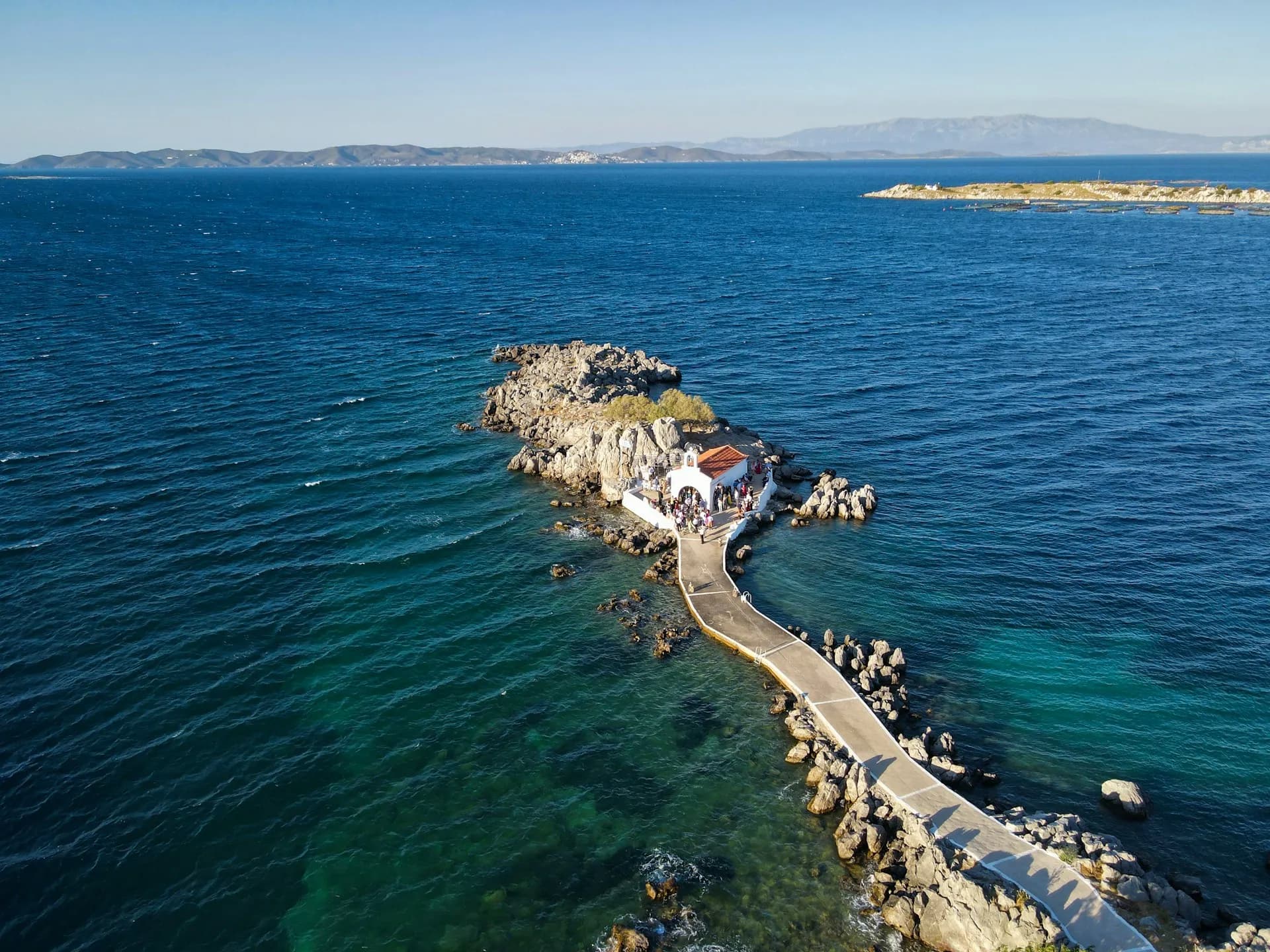
Drone shot taken above Agios Isidoros chapel in Chios island, Greece.

Chios

How to get there

💡 💡 Transport tip: Chios has its own airport (JKH), a genuine advantage over many smaller Greek islands. Domestic flights from Athens take approximately 45 minutes; there are also seasonal connections from Thessaloniki. International charter flights are limited, which is precisely why the island has retained its character.

By air from Athens

Domestic flights operate daily year-round from Athens International Airport to Chios (JKH), taking approximately 45 minutes. This is the fastest and most reliable route.

Overnight ferry from Piraeus

Conventional ferries depart Piraeus for Chios overnight, taking approximately 8 hours. A comfortable, economical option for those with time, and a popular choice for visitors bringing a car.

From Lesvos & Samos

Regular ferry connections link Chios with its North Aegean neighbours — Lesvos (approximately 2.5–3 hours) and Samos. These make a North Aegean island-hopping circuit straightforward.

Getting around the island

A rental car is strongly recommended and, for the mastic villages and Anavatos circuit in particular, close to essential. Chios is large — roughly 50km north to south. Car rental is available at the airport and in Chios Town.

Chios

Top attractions & experiences

1

Pyrgi — the painted village

Wander the lanes of Pyrgi slowly; the xysta decoration rewards close looking — no two patterns are quite identical. The central square, the church of Agioi Apostoloi with its 17th-century frescoes, and the Chios Mastic Museum round out a visit that takes a leisurely half-day.

2

Mesta — the fortress village

Enter Mesta through one of its narrow original gateways and the defensive logic becomes immediately physical: the outer walls form an unbroken perimeter, the interior lanes are deliberately narrow and shaded. The twin churches of the Old and New Taxiarches sit at its heart.

3

Nea Moni Monastery

The katholikon's interior mosaics — gold-ground depictions of the Crucifixion, the Washing of the Feet and other biblical scenes — represent some of the finest surviving Byzantine art in Greece, executed by master craftsmen from Constantinople in the 11th century.

4

Anavatos — the ghost village

Stone houses, some still structurally intact, stack up the cliff face exactly as they were left after 1822. There is no entry fee, no gift shop, no interpretive panel — just the physical fact of an abandoned settlement. Wear sturdy shoes.

5

Chios Town & the Kastro

The island's capital is a working port town rather than a tourist set-piece. Its old Kastro quarter, with remnants of Byzantine and Genoese fortifications, narrow lanes and the Giustiniani Palace Museum, rewards an afternoon's exploration.

6

Kampos & the citrus estates

South of Chios Town, Kampos was once home to wealthy merchant families who built elaborate stone mansions surrounded by walled citrus orchards — a unique agricultural-aristocratic landscape comparable to nothing else in the Aegean.

Chios

Best beaches

💡 💡 Beach note: Chios beaches are genuinely different from the postcard Cycladic image. Many are volcanic pebble or black sand rather than white sand — a direct result of the island's geology. The black-stone-and-turquoise-water combination at beaches like Mavra Volia is among the most visually striking in the Aegean.

Mavra Volia

The island's most photographed beach — smooth black volcanic pebbles meeting strikingly clear turquoise water, near Pyrgi in the south. No major facilities. Bring water shoes.

Karfas

The island's most complete organised beach experience — golden sand, sunbeds, beachfront tavernas, watersports — located a short drive south of Chios Town. Popular with families.

Lithi

On the southwest coast, Lithi has a long sandy beach backed by tavernas and widely considered to have the finest sunset views on Chios. A natural choice for an evening swim followed by dinner.

Agia Markella

A sandy beach on the northwest coast, named for the chapel above it, with a more remote and windswept character. Popular for an annual religious festival in July.

Emporios

In the far south near the mastic villages, Emporios combines a small fishing harbour with nearby volcanic beaches. A good base for combining beach time with Pyrgi and Mesta.

Komi

A long sandy beach on the southeast coast, more developed than the volcanic beaches further south but still relatively low-key. Good for families wanting straightforward sand and shallow entry.

Chios

Local food & drink

Mastic in all its forms

Mastiha liqueur, mastic-flavoured spoon sweets, mastic chewing gum, and mastic-infused pastries. The flavour takes some adjustment but is genuinely unique. Buy directly from producers in Pyrgi or Mesta.

Kampos citrus & spoon sweets

The walled orchards of Kampos produce citrus turned into traditional spoon sweets — candied fruit preserved in syrup. Bergamot and bitter orange varieties are specific to this part of the island.

Fresh fish in Chios Town

The fish tavernas around Chios Town's old harbour and fish market serve genuinely fresh, simply prepared seafood at prices that reflect a local economy rather than a tourist one.

Local cheese & mastelo

Chios produces a distinctive semi-hard cheese, mastelo, traditionally made in a clay vessel and often served fried or grilled as a meze. Combined with local olive oil and small fried fish.

Bread & pastries of Mesta and Pyrgi

The mastic villages have their own bakery traditions — bread and pastries flavoured subtly with mastic, sesame, and local herbs. The small bakeries in Mesta's lanes are worth seeking out.

Souma & local spirits

Souma, a grape-based spirit similar to tsipouro but specific to Chios and the North Aegean, is the local drink of choice alongside meze. Distilled by small producers, it varies considerably from village to village.

Chios

Practical tips

1

Rent a car

Rent a car from the airport or Chios Town on arrival. The island's major attractions are spread across roughly 50km, and public transport does not cover this circuit conveniently for a short stay.

2

Plan 4-5 days minimum

A day for Chios Town and the Kastro, a day for the Mastichohoria circuit (Pyrgi, Mesta, Olympi), a day for Anavatos and Nea Moni, and a day for the northern coast and Volissos. Add a fifth day for beaches.

3

Visit during mastic harvest

The mastic harvest runs July through September. Visiting during this window to see the technique performed in the groves adds significant depth to understanding why the product is so labour-intensive and prized.

4

Wear proper shoes for ruins

Wear proper shoes for both Anavatos and Mesta — the uneven stone paths in Anavatos's ruins and the cobbled lanes of Mesta are not forgiving of flip-flops.

5

Plan around midday closures

Nea Moni and many mastic village churches observe a midday closure (typically 13:00–16:00). Plan visits for morning or late afternoon, and dress modestly for the monastery.

6

Easter Rocket War

If your dates allow it around Greek Easter, be in Vrontados on Holy Saturday evening for the Rouketopolemos — book accommodation well in advance as this is the one event that fills the island's hotels.

Chios

Frequently Asked Questions

What is Chios famous for?

Chios is the only place on earth where mastic — an aromatic resin tapped from the Pistacia lentiscus tree — is commercially produced, a tradition recognised by UNESCO as Intangible Cultural Heritage. The island is also known for the geometrically patterned houses of Pyrgi, the fortified medieval architecture of Mesta, the Byzantine UNESCO monastery of Nea Moni, and the abandoned village of Anavatos.

How do you get to Chios?

Chios has its own airport (JKH) with domestic flights from Athens (45 minutes) and seasonal connections from Thessaloniki. By sea, overnight ferries run from Piraeus (approximately 8 hours) and there are connections from Lesvos, Samos and other North Aegean islands.

Is Chios worth visiting?

Yes, particularly for travelers who have visited the more famous Greek islands and want something genuinely different — extraordinary medieval village architecture found nowhere else in Greece, a unique agricultural product, dramatic black pebble beaches, and an island that functions for its own population first. A 4-5 day stay with a rental car is recommended.

What are the best villages to visit?

Pyrgi (the painted village) for its black-and-white geometric xysta decoration. Mesta, the best-preserved fortified medieval village built as a single defensive structure. Olympi, a smaller tower village between them. Anavatos, the clifftop ghost village. Volissos in the northwest, with a Byzantine castle.

When is the best time to visit?

May, June and September offer the best balance of warm weather and minimal crowds. July and August are warm and busy with Greek domestic tourists. Easter in Chios is exceptional — particularly the Rocket War (Rouketopolemos) in Vrontados on Holy Saturday.

How many days do I need in Chios?

Four to five days covers the island's main attractions properly: Chios Town and the Kastro, the Mastichohoria circuit, the interior route to Anavatos and Nea Moni, the northern coast and Volissos, plus a day for beaches. A car is essential.