Destination Overview
Heraklion
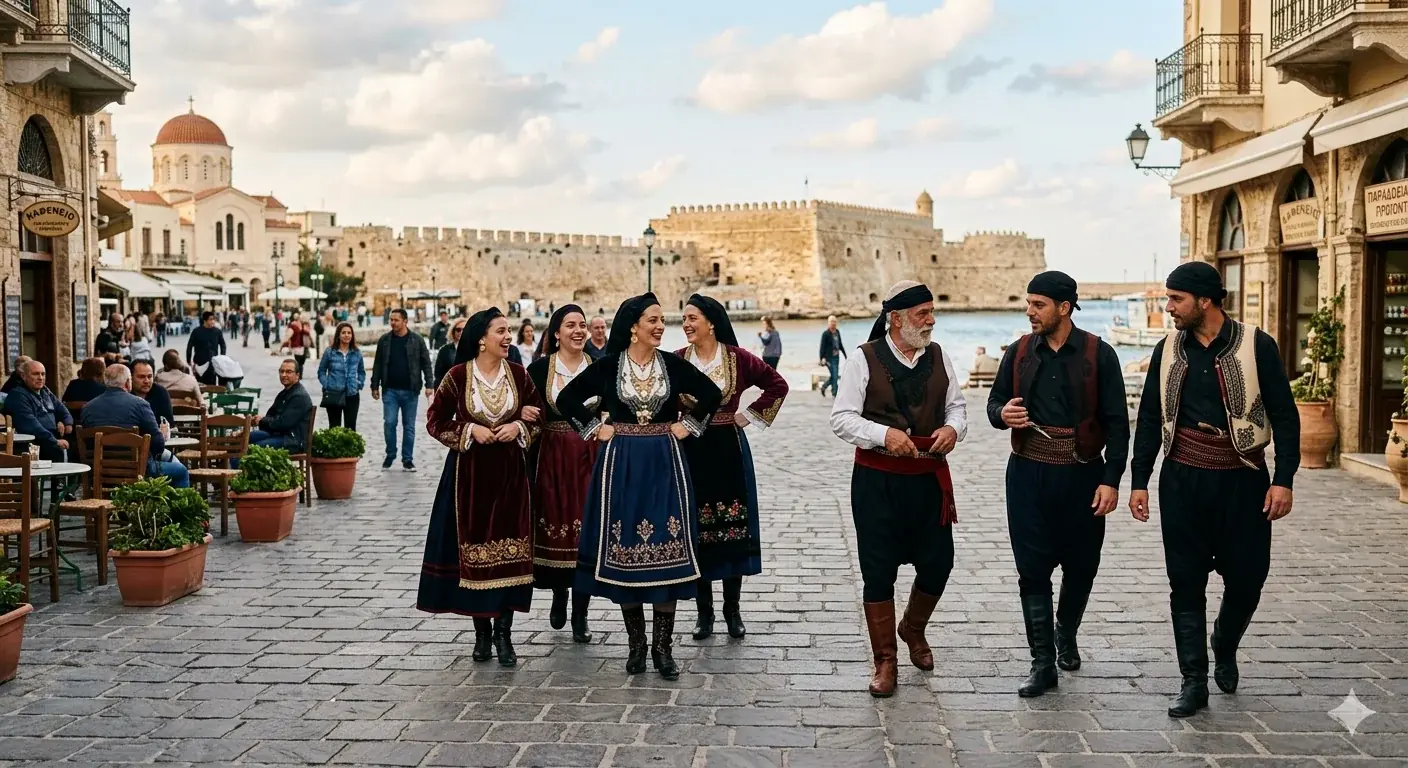
Heraklion is not the island postcard. It is the real Crete — dense, layered, occasionally chaotic, and completely alive. The largest city in Crete and one of the most important in Greece, it earns respect the way serious places do: slowly, on its own terms.
The Minoan Palace of Knossos sits 5 kilometres from the city centre — the most visited archaeological site in Greece after the Acropolis, and one of the most significant in the entire world. The Venetian walls that encircle the old city are among the finest surviving Renaissance fortifications in the Mediterranean. The Archaeological Museum holds the most important Minoan collection on earth. And all around this, there is a city that eats and drinks with genuine conviction: a morning market that runs seven days a week, a raki culture that begins at noon, fish tavernas where the sea is never more than a few steps away.
What this means for the traveller is layering of a rare kind. Knossos is not a side trip from a beach town — it is a day spent inside the oldest palace civilisation in Europe. The Archaeological Museum is genuinely world-class, holding the Phaistos Disc, the Snake Goddess figurines, the Minoan frescoes, and a collection that changes how you understand the ancient world. The Venetian walls are 4 kilometres long and up to 40 metres thick — you can walk them, and people do.
Away from all this, Heraklion eats well. The central market on 1866 Street is among the finest food markets in Greece. The Cretan diet — often described as the original Mediterranean diet — manifests on every table. Raki arrives without being asked. This is not a city of performance. It is a city of habit, depth, and genuine conviction.
Planning a wider trip around Crete? Explore our full Crete Travel Guide for regional ideas and more places to stay.
Heraklion
Why Visit Heraklion
Heraklion divides opinions, and that is one of the more honest things you can say about it. Visitors expecting the whitewashed serenity of the Cyclades will find something else entirely: a working Mediterranean port city with a soul built on thousands of years of trade, invasion, resistance, and reinvention.
**Knossos is one of the great sites of the ancient world** — a partially reconstructed palace complex that gives a genuine spatial sense of Minoan civilisation in 1700 BC. No other site in Greece gives you this.
**The Archaeological Museum is exceptional** — the finest Minoan collection in existence. The Phaistos Disc, the Snake Goddess figurines, the frescoes. Two hours here is not enough.
**The Venetian city is one of the best preserved in the Mediterranean** — Koules fortress, the walls, the Morosini Fountain, the Loggia — an entire Renaissance urban layer.
**The food is among the best in Greece** — the central market, the mezedopolia, the fish tavernas of the old harbour. Cretan cuisine at its capital.
**It is a gateway to the rest of Crete** — Rethymno, Phaistos, Lassithi Plateau, Archanes — all within day-trip range.
Heraklion
Best Time to Visit Heraklion
**Spring (April–May)** — The most rewarding months for the city and Knossos. Mild temperatures, few crowds, countryside in bloom.
**June** — Best balance of warm sea, manageable temperatures, and a city alive without being overwhelmed.
**July–August** — Peak heat and peak tourism. Knossos can feel congested; visit before 09:00 or after 16:00. The museum is air-conditioned.
**September–October** — Arguably the finest period. Warmest sea, extraordinary light, crowds thin. Grape harvest across the wine region.
💡 Secret: The Heraklion wine region — centred around Archanes — harvests in September. Several estates open for visits. Early September is one of the best times in Crete.
Heraklion
How to Get to Heraklion
**By air** — Heraklion International Airport (HER) is one of Greece's busiest. Direct flights from across Europe. Year-round domestic connections. 5 km east of the city centre.
**By ferry** — Daily overnight service from Piraeus (7–8 hours). Regular connections to Santorini, Mykonos, Rhodes. The classic Greek maritime journey.
**By car across Crete** — The E75 runs along the north coast. Heraklion is the midpoint. A car is strongly recommended for exploring beyond the city.
💡 Secret: The overnight ferry from Piraeus is an experience, not a compromise. Book a cabin and arrive at 06:00 as the city wakes up and the market opens.
Heraklion
The Old Venetian City
Koules Fortress
The Venetian fortress at the entrance to the old harbour. Built between 1523 and 1540. Three Venetian lions carved into the seaward face. The harbour view from the battlements is one of the defining images of Crete. Go at dusk — the fortress stays open into early evening in summer.
Lion Square & Morosini Fountain
The social centre of old Heraklion. The Morosini Fountain (1628) sits at the intersection of the main pedestrian streets, surrounded by kafeneions and mezedopolia. The fountain is still fed by the same 17th-century aqueduct from Mount Giouchtas.
The Venetian Loggia
The most elegant surviving Venetian civic building in Crete. Built in the early 17th century as a meeting place for Venetian nobles. Now serves as the city hall. The arcade is open during the day.
Venetian Walls
4 km long, up to 40 metres thick at the bastions, pierced by four gates. Commissioned by Venice in the 16th century. You can walk the top from Pantokratoras Gate to Martinengo Bastion — where Nikos Kazantzakis is buried — in about 45 minutes.
Heraklion
Knossos & the Archaeological Museum
Palace of Knossos
5 km south of the city centre. The ceremonial and political centre of Minoan civilisation (2700–1450 BC). The partially reconstructed complex includes the Throne Room (the oldest throne in Europe), the Grand Staircase, the Central Court, and the storage magazines. Open daily; combined ticket with the museum available. Go before 09:00 or after 16:00.
Heraklion Archaeological Museum
The finest Minoan collection in the world. The Phaistos Disc, the Snake Goddess figurines, the Bull-Leaper fresco, the Harvester Vase, the Linear A and B tablets. Allow a minimum of two hours. Buy the combined ticket with Knossos.
💡 Secret: Visit the museum before Knossos — seeing the actual artefacts before walking the site transforms the experience.
Heraklion
Heraklion Food: What to Eat
**Dakos** — The canonical Cretan dish: barley rusk with tomato, mizithra, olive oil, and oregano.
**Kalitsounia** — Small pastries filled with mizithra and honey or wild greens.
**Apaki** — Smoked pork from the Psiloritis mountains, marinated in wine vinegar and herbs.
**Snails (Chochlioi boubouristi)** — Snails cooked in olive oil with rosemary until caramelised.
**Graviera** — The great Cretan hard cheese, PDO protected from sheep's milk.
**Fresh fish** — The old harbour fish tavernas serve the day's catch with minimal preparation.
**Raki (Tsikoudia)** — Crete's spirit, distilled from grape pomace. Arrives automatically with food in traditional tavernas.
💡 Secret: The best value food is one block behind any tourist-facing street. If the menu has photos, keep walking.
Heraklion
Beaches Near Heraklion
Amoudara (3km west)
The closest organized beach. Long sandy stretch with sunbeds and services. The western end toward the salt lake is wilder and quieter.
Matala (75km southwest)
Famous south coast beach with red sandstone cliffs and cave tombs. Crystal clear water. Worth a full day trip from Heraklion.
Agia Pelagia (25km west)
A sheltered bay with calm clear water and good tavernas on the beach. Popular with Heraklion locals.
Karteros / Amnissos (8km east)
Two adjacent beaches east of the airport. Karteros is organised and calm; Amnissos has a Minoan site above the beach.
Heraklion
Day Trips from Heraklion
Archanes (15km south)
A beautifully preserved Venetian-era village in wine country. The wine cooperative produces excellent Kotsifali and Mandilari reds. The Fourni Minoan cemetery nearby is exceptional and uncrowded.
Phaistos & Agia Triada (60km SW)
The second great Minoan palace — unrestored, with a dramatic position overlooking the Messara Plain. Combined with Agia Triada, they make a full and excellent day.
Spinalonga (90km east)
The Venetian island fortress in the Gulf of Elounda. A leper colony until 1957. The boat crossing across the clear gulf is part of the experience.
Lassithi Plateau (50km east)
A high mountain plateau at 840m, ringed by the Dikti Mountains. The Psychro Cave — legendary birthplace of Zeus. The drive through mountain switchbacks is itself an event.
Heraklion
Practical Tips
**Orientation** — The old city is compact. The main pedestrian street (25 Avgoustou) runs from the ferry port to Lion Square. Knossos is 5 km south — accessible by city bus (lines 2 and 4).
**Getting around** — Walk within the old city. Bus or taxi for Knossos. Rent a car for day trips.
**When to book** — Knossos and the museum offer online tickets. In July–August, arriving without a ticket for Knossos means significant queuing.
**Language and money** — English is widely spoken. The central market operates largely in cash.
**The raki question** — Raki is offered as hospitality. It is rude to decline without a reason.
💡 Secret: The city bus to Knossos (lines 2 and 4) runs from the central bus terminal east of Lion Square, takes about 20 minutes, and costs a fraction of a taxi.
Heraklion
FAQ — Heraklion Essentials
How many days do you need in Heraklion?
Minimum two full days: one for Knossos and the Archaeological Museum, one for the Venetian old city, the market, and the harbour. Three to four days allows day trips to Phaistos, Archanes, or the south coast.
Is Heraklion worth visiting or should I go to a resort?
Heraklion is worth visiting if you are interested in history, archaeology, and food. It is not for people whose primary goal is a beach holiday.
Is Knossos worth visiting?
Yes, emphatically. One of the most significant archaeological sites in the world. Go with some preparation — read about Minoan civilisation beforehand or visit the museum first.
Do you need a car in Heraklion?
Not for the city itself. Essential for any exploration beyond the immediate city.
What is the best area to stay in Heraklion?
The old city within the Venetian walls for proximity to everything. The harbour area around the Venetian Arsenal for views and atmosphere.
Is Heraklion expensive?
Less expensive than the island resorts. The central market, traditional tavernas, and public transport are all good value.