Hydra
Attica

Hydra

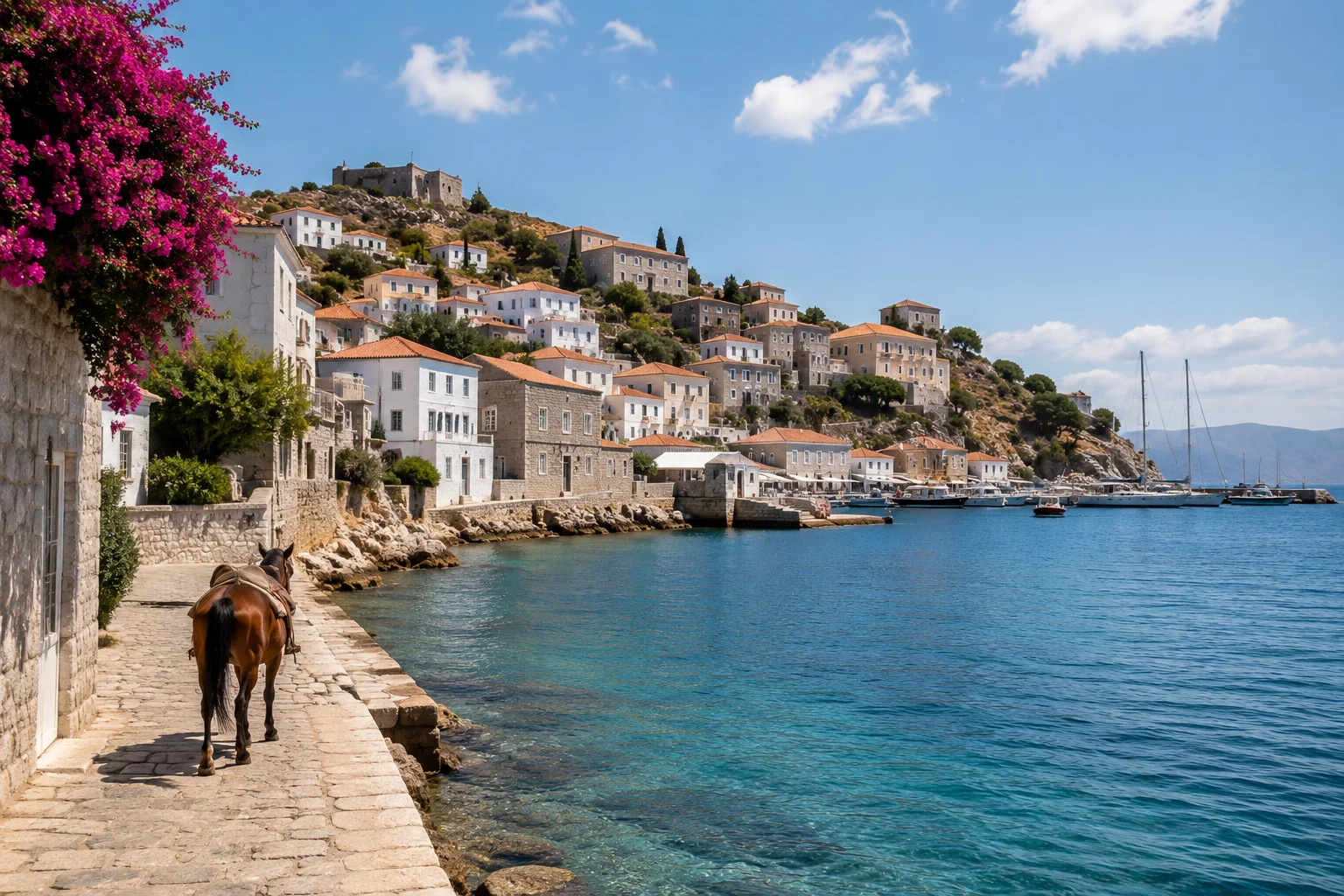
Hydra is the only place in Greece — and one of the very few places in the world — where the internal combustion engine was simply refused entry. There are no cars, no motorbikes, no scooters. Transport is by donkey, mule, water taxi, or on foot. The ban has been in place since the 1950s and has produced something remarkable: an island whose stone port looks almost exactly as it did when the ships of Hydra's merchant fleet dominated Mediterranean trade in the 18th century. Step off the Flying Dolphin from Piraeus and the harbour that opens before you — grey stone mansions ascending the hillside, donkeys picking their way along the quay, wooden caïques bobbing in the water — is architecturally preserved in a way that has nothing to do with tourism and everything to do with a community that made a deliberate choice about what kind of place it wanted to be.

Car-free since the 1950s

18th-century captain mansions

Leonard Cohen's island

Deste Foundation Slaughterhouse

Travel Guide

Where to Stay in Hydra

Beach Guide

Best Beaches in Hydra

Activities

Things to Do in Hydra

Destination Overview

Hydra

Hydra is the only place in Greece — and one of the very few places in the world — where the 20th century's defining invention, the internal combustion engine, was simply refused entry. There are no cars here, no motorbikes, no scooters. Transport is by donkey, mule, water taxi, or on foot. The ban has been in place since the 1950s and has produced something remarkable: an island whose stone port looks almost exactly as it did when the ships of Hydra's merchant fleet dominated Mediterranean trade in the 18th century. That visual continuity is Hydra's most immediate gift to the visitor. The harbour — grey stone mansions ascending the hillside, donkeys picking their way along the quay, wooden caïques bobbing in the water — is architecturally preserved in a way that has nothing to do with tourism and everything to do with a community that made a deliberate choice about what kind of place it wanted to be. The result attracted artists. The artists attracted writers. The writers attracted Leonard Cohen, who bought a house here in 1960 for $1,500, wrote some of the finest songs of the 20th century on its terrace, and returned for decades. The creative current he embodied still runs through the island today.

Hydra

Why visit Hydra

1

The only car-free island in the Aegean — and what that actually feels like

The absence of cars is not a quirky tourism gimmick. It is a physical transformation of what a place feels and sounds like. On Hydra, the ambient noise of the port is the clip of donkey hooves on stone, the slap of water against the hulls of boats, and conversation. There is no traffic light anywhere on the island, no petrol station, no car park. The effect is cumulative and takes about an hour to feel properly: a particular kind of ease that has no equivalent elsewhere in Greece. The island's silence — especially in the upper lanes after dark — is the most complete available within 90 minutes of Athens.

2

18th-century stone architecture preserved without compromise

During Hydra's maritime golden age — roughly 1750 to 1820 — the island's merchant fleet numbered over 150 ships and its captains built mansions in proportion to their wealth. The Lazaros Kountouriotis Mansion, the Tombazis Mansion, the Voulgaris Mansion — these are not restored heritage sites but lived-in, functioning buildings whose facades have changed almost nothing in 250 years. The island's entire architectural fabric is protected by law: no new buildings can be constructed, no facades altered. Walking the lanes above the port is the closest thing in Greece to a functioning time machine for the 18th century.

3

A genuine international art scene, not a curated tourist version of one

The Hydra Workshop, founded by painter Nikos Hadjikyriakos-Ghikas, established the island as an art colony in the mid-20th century. The Deste Foundation's Slaughterhouse — a converted 19th-century abattoir on the waterfront that hosts some of the finest contemporary art exhibitions in the Mediterranean — continues that tradition today. Beyond the institutions, a walk through Hydra's lanes passes a density of working artists' studios, independent galleries and private exhibition spaces that is extraordinary for an island of 2,000 permanent residents. This is not art-for-tourists. It is a functioning creative community.

4

Leonard Cohen's island — and why it still matters

In 1960, Leonard Cohen was a broke Canadian poet who bought a house on Hydra for $1,500, moved in with his Norwegian muse Marianne Ihlen, and wrote his first novel and some of his earliest songs sitting on the terrace. The island gave him the silence and the light and the community of fellow writers and painters that produced some of the most enduring creative work of the century. His house on Kountouriotou Street can be seen from the lane (it is privately owned and not open to visitors), and the island's connection to his memory remains genuine and unforced — a quality Hydra has always had, of making artists feel that the work is possible here in a way it is not elsewhere.

5

Proximity to Athens — the best same-week combination in Greece

Ninety minutes from Piraeus on the Flying Dolphin. No other island of Hydra's quality and character is this close to the Greek capital. For travelers spending time in Athens — or using Athens as a transit hub — Hydra offers a two-to-three day complete contrast: the noise and energy of the city replaced immediately by stone and silence, the urban anonymity replaced by a community where the baker knows which house you are staying in. The Athens–Hydra combination is the most rewarding short pairing in the Greek island network.

6

A landscape for walking that most visitors never discover

The interior of Hydra is a network of mule paths through wild thyme, cistus and pine that connects a series of monasteries, hilltop hermitages and abandoned settlements. The path to Profitis Ilias monastery at the island's highest point takes about two hours from the port and rewards with a panorama of the Saronic Gulf that takes in the Peloponnese coast, the outline of Spetses, and on clear days the mountains above Corinth. Most Hydra visitors spend their entire stay in the port town and never discover that the island extends for another 50 square kilometres of trail beyond it.

Hydra

Best time to visit

💡 Secret: The best time of day on Hydra is 07:00–09:00, when the light hits the stone mansions at a low angle, the port is still, and the first donkey of the morning carries supplies down to the harbour. This hour is accessible only to overnight guests.

April – June

The best balance of weather, crowds, and value. Spring wildflowers carpet the hillsides. The sea is warm enough for swimming from late May. Fewer day-trippers, easier water-taxi availability, and accommodation prices significantly below summer peak. The hiking is at its best — the slopes are green and the heat is manageable.

July – August

Peak season. The port is at its busiest, hydrofoils arrive packed, and the waterfront restaurants are full. The famous Hydra silence recedes to the early morning and late night. If you visit now, book accommodation well in advance, plan water taxis ahead, and accept that some of the island's particular quality is temporarily suspended. The compensation: perfect swimming weather, evening social energy, and the full range of restaurants and water taxis operating.

September – October

Many experienced Hydra visitors consider this the ideal window. The sea is at its warmest (warmer than June). The day-trip crowds diminish after the first week of September. The light softens, the evenings are long, and the island exhales. Accommodation prices drop. The silence returns.

November – March

Hydra in winter is an entirely different island. The permanent population of 2,000 reclaims the port. The hydrofoil runs daily but the island is genuinely quiet. Several tavernas and hotels close. The experience is raw, atmospheric, and memorable — the stone architecture in grey winter light, the wet cobblestones, the cafés where locals outnumber visitors. Not for everyone, but unforgettable for those who choose it.

Hydra

How to get there

💡 Transport tip: Hydra has no airport and no vehicle access — not even bicycle access. The only way in is by sea. The standard approach for most visitors is the Flying Dolphin hydrofoil from Piraeus, which is fast, reliable and scenic. Book tickets in advance for summer weekends; the Piraeus–Hydra route is heavily used by Athenians escaping to the island on Friday evenings and returning Sunday. The best seat on the Flying Dolphin is on the left side (port side) — the approach to Hydra harbour is one of the great arrivals in Greek island travel. **From Athens (Piraeus) by hydrofoil — the standard option** Flying Dolphins (Hellenic Seaways) depart from Gate E8 at Piraeus port. The journey takes approximately 90 minutes. Departures run year-round, with increased frequency in summer. Book tickets in advance for July–August weekends. The service calls at Poros en route on some sailings. **From the Peloponnese — for drivers** Drive to the port of Ermioni (2 hours from Athens) or Porto Heli, from which water taxis connect directly to Hydra in 15–20 minutes. This is the option for anyone who wants to combine Hydra with a Peloponnese road trip. **From Spetses and Poros — island hopping** Hydra is connected by regular hydrofoil to Spetses (20 minutes) and Poros (30 minutes), making it part of the classic Saronic Islands triangle. A multi-day loop of Hydra–Spetses–Poros is one of the best short itineraries in Greece. **Getting around Hydra** You walk. This is not a limitation — it is the point. Donkeys and mules carry luggage between the port and the hillside hotels and houses. Water taxis (small boats) connect Hydra Town with Kamini, Vlyhos, Mandraki, the remote beaches, and — for the adventurous — with restaurants on the far side of the island. Negotiate the fare before boarding.

Hydra

Top Attractions & Experiences in Hydra

1

The Port — Hydra's living room

Hydra's harbour is the most intact 18th-century maritime settlement in Greece. The mansions that line the waterfront were built between 1680 and 1820 by the merchant captains who made Hydra one of the wealthiest places in the Mediterranean. The architecture is unique in Greece: grey stone, tile roofs, symmetrical facades, and tall windows that reflect the naval hierarchy of their owners. The Tombazis, Kountouriotis, and Voulgaris families — each with their own mansion — financed the Greek War of Independence from these buildings. The harbour is not a historic district within a modern town — it is the entire town, and it is still lived in. Morning is the time to understand it: before the day-trippers arrive from Athens, the fishermen are unloading, the donkeys are beginning their rounds with supplies, and the light on the upper mansions is at its most dramatic.

2

Kountouriotis Mansion — the flagship of Hydra's museums

The Kountouriotis Mansion, built in 1810, is the finest surviving captain's mansion and has been operated as a museum since 1955. The interior is furnished as it would have been in the 1820s — Venetian furniture, family portraits, naval memorabilia, and the original kitchen. The rooftop terrace offers one of the best views of the harbour. The mansion tells the story of the Kountouriotis family, whose fleet of 50 ships made them one of the wealthiest in Greece and whose son Pavlos became Prime Minister and President of Greece.

3

Deste Foundation Slaughterhouse — art in an unlikely space

One of the most remarkable art spaces in Greece. The Deste Foundation, founded by collector Dakis Joannou, converted a 19th-century municipal slaughterhouse into a contemporary art exhibition space that mounts rotating shows of international artists. The building itself — a simple stone structure at the western edge of the harbour — is architecturally striking, and the contrast between its brutalist history and the often delicate conceptual art it houses creates an experience found nowhere else in the Cyclades or the Saronic.

4

The Four Windmills & Eastern Hydra

At the eastern edge of Hydra Town, four restored stone windmills stand on a ridge above a small pebble beach (Spilia). The windmills date from the 18th century and were used to grind grain brought by the captain's ships from across the Mediterranean. The path to the windmills is a 10-minute walk from the harbour and offers the best sunset viewpoint on the island. Beyond the windmills, the coastal path continues toward Kamini — a 20-minute walk that passes small swimming coves and the picturesque chapel of Agios Nikolaos.

5

Monastery of Profitis Ilias — the island's rooftop

Perched at 590m elevation, the Monastery of Profitis Ilias is the highest point on Hydra and the most rewarding day hike from the port. The monastery itself is modest — a small stone church and a few cells — but the setting is spectacular. The 360-degree panorama takes in the entire Saronic Gulf, from the Peloponnese mountains to Aegina, Poros, Spetses, and on clear days all the way to Cape Sounion and the Athens coast. The hike takes approximately 90 minutes from the port via a well-maintained stone path.

6

Historic Archives Museum of Hydra

Housed in a restored 19th-century mansion on the harbour front, the Historic Archives Museum contains one of the most important collections of documents and artifacts from the Greek War of Independence. The collection includes original correspondence from Theodoros Kolokotronis, the personal flag of Admiral Miaoulis, shipbuilding plans, maritime maps, and an archive of over 25,000 documents from the 18th and 19th centuries.

Hydra

Best Beaches in Hydra

Spilia — the port swim

The closest swimming to Hydra Town, located directly below the four windmills at the eastern edge of the harbour. Concrete and stone platforms set into the rocks, with ladders into deep, clear water. Excellent water quality.

Kamini — the village swim

Small fishing harbour 20 mins walk east of Hydra Town. Swimming from rocks, tiny pebbly cove, tavernas on the water. Relaxed, local atmosphere.

Vlyhos — pebble beach

Sheltered pebble beach, 15 mins by water taxi. Pine trees for shade, calm clear water, historic stone bridge overhead.

Bisti — the sandy cove

One of the few sandy beaches, 20 mins by water taxi. Small cove, rocky cliffs, seasonal taverna. Excellent swimming.

Limnioniza — remote and quiet

Remote pebble cove, 30 mins by water taxi. No facilities, crystal-clear water, excellent snorkelling. Very quiet.

Agios Nikolaos — the secret beach

Small, remote pebble beach on the southeastern coast, accessible by water taxi or steep path. No facilities, complete silence.

Hydra

What to Eat in Hydra

**Amygdalota (Hydriot Almond Sweets)** — Signature sweet of Hydra: small, chewy almond macaroons made from ground almonds, sugar, and rosewater. Best from family bakeries behind the harbour. **Fresh Fish & Grilled Octopus** — Fresh catch from local boats. Tavernas in Kamini are the most reliable. Octopus drying on lines is not just decoration — it is a local staple. **Lavender Honey** — Local honey with distinctive floral aroma from hillsides. Sold in small grocery stores behind the harbour. **Stifado (Hydriot Style)** — Slow-cooked rabbit or beef stew with pearl onions, tomato, cinnamon, and allspice. Found in traditional tavernas.

Hydra

Practical tips

**Pack light:** There are no cars/porters. You carry your own luggage over cobblestones/steps. Backpacks/soft bags are best. **Book early:** Hydra has limited hotels. July–August rooms book months ahead. **Negotiate water taxis:** Agree price for round-trip before boarding. A typical fare to Vlyhos/Bisti is €15–25/person. **Shoes:** Cobblestones are slippery when wet. Wear flat, grippy shoes. **Cash:** ATMs run low on summer weekends. Carry cash for small shops/tavernas. **Hiking:** Profitis Ilias takes ~90 mins. Wear proper shoes, carry water/flashlight.

Hydra

FAQ — Hydra Essentials

How do I get to Hydra from Athens?

Flying Dolphin from Piraeus (Gate E8). ~90 mins. Multiple daily departures. No airport.

How many days should I spend in Hydra?

Two nights minimum. The silence after the last hydrofoil leaves is Hydra's most extraordinary quality.

Are there cars on Hydra?

No. Banned since the 1950s. Transport is by donkey, mule, water taxi, or on foot.

Does Hydra have sandy beaches?

Very few. Bisti (sandy) and Vlyhos (pebble) are closest by water taxi. Spilia and Kamini offer swimming from rocks.

Is Hydra expensive?

Harbour tavernas are expensive. Kamini has better value. Book accommodation early.

Leonard Cohen's Hydra connection?

Cohen bought a house in 1960, wrote songs like 'Suzanne' there. House stands above the port.

Can you visit Hydra in winter?

Yes. Hydrofoil runs daily. Quiet, atmospheric, belongs to residents.

Hiking in Hydra?

Excellent. Stone paths connect port with Kamini (20'), Vlyhos (45'), Profitis Ilias (90').