Ios
Cyclades

Ios

Ios has a reputation that arrived decades before most visitors do, and that reputation — wild parties, sun-bleached youth, the Cyclades' most legendary nightlife — is not entirely undeserved. But it is also dramatically incomplete. The island that has been sending young travellers home with the best stories of their Aegean summers is also an island of genuine beauty, ancient significance and an interior that most of its own visitors never see. The geography of Ios is compact and dramatic: a rugged, hilly landmass of approximately 108 square kilometres, rising steeply from the sea with a spine of bare rock running north to south. The port — Ormos Iosou — sits in a deep protected bay on the west coast. Above it, connected by a road and a long flight of marble steps, the Chora perches on a rounded hilltop at 150 metres, a dense cluster of whitewashed Cycladic architecture that is genuinely one of the most beautiful village streetscapes in the archipelago. Directly south of the Chora, the long sandy arc of Mylopotas beach occupies the island's largest bay, flanked by low hills and backed by a string of beach bars, restaurants and accommodation. Beyond this trinity of port, Chora and Mylopotas — which is where most visitors spend their entire stay — Ios has considerable depth. The remote south coast culminates in Manganari, a series of broad sandy bays accessible only by boat or a long dirt track, with water of exceptional clarity and almost no development. The northern tip of the island holds what tradition identifies as the tomb of Homer — one of the most poetically resonant sites in the Greek world, reached by a winding road through empty countryside. The interior has abandoned windmills, Byzantine churches and the kind of silence that makes the Chora's midnight energy feel like a different planet. Ios is changing. The island that was synonymous with cheap package tourism in the 1980s and 1990s has been quietly repositioning for over a decade. The quality of accommodation has risen substantially; the food scene has developed genuine seriousness; the boutique hotel market has arrived; and an increasing number of visitors come not for the bars but for the beaches, the landscape and the Chora's exceptional evening atmosphere. Ios at its best — and it is frequently at its best in June, early July and September — is one of the most complete islands in the Cyclades.

The Chora (hilltop village)

Homer's Tomb (north ridge)

Mylopotas beach

Manganari (wild south coast)

Skarkos Bronze Age site

Venetian windmills at sunset

Chora nightlife

Agia Theodoti beach

Koumbara cove

Caïque to Manganari

Travel Guide

Where to Stay in Ios

Travel Guide

Tours & Experiences

Travel Guide

Local Food Ideas

Beach Guide

Best Beaches in Ios

Activities

Things to Do in Ios

Destination Overview

Ios

Ios has a reputation that arrived decades before most visitors do, and that reputation — wild parties, sun-bleached youth, the Cyclades' most legendary nightlife — is not entirely undeserved. But it is also dramatically incomplete. The island that has been sending young travellers home with the best stories of their Aegean summers is also an island of genuine beauty, ancient significance and an interior that most of its own visitors never see. The geography of Ios is compact and dramatic: a rugged, hilly landmass of approximately 108 square kilometres, rising steeply from the sea with a spine of bare rock running north to south. The port — Ormos Iosou — sits in a deep protected bay on the west coast. Above it, connected by a road and a long flight of marble steps, the Chora perches on a rounded hilltop at 150 metres, a dense cluster of whitewashed Cycladic architecture that is genuinely one of the most beautiful village streetscapes in the archipelago. Beyond this trinity of port, Chora and Mylopotas — which is where most visitors spend their entire stay — Ios has considerable depth. The remote south coast culminates in Manganari, a series of broad sandy bays accessible only by boat or a long dirt track, with water of exceptional clarity and almost no development. The northern tip of the island holds what tradition identifies as the tomb of Homer — one of the most poetically resonant sites in the Greek world, reached by a winding road through empty countryside.

Ios

Why visit Ios

1

The Chora is one of the most beautiful whitewashed villages in the entire Cyclades

The hilltop capital of Ios is a labyrinth of narrow marble-paved lanes, arched passageways, blue-domed churches and whitewashed cube houses that climb toward a windmill-crowned ridge. It is genuinely stunning — not as a tourist construction but as a living Cycladic settlement that has retained its architectural logic for centuries. In the morning, before the day visitors arrive from Mylopotas, it is one of the most atmospheric places in the islands.

2

Homer's Tomb — one of the most evocative ancient sites in the Aegean

Ancient tradition held that Homer was born on Ios and is buried on its northern tip. The site — a low stone enclosure on a bare rocky hillside with views across the sea to Sikinos and Folegandros — cannot be verified by archaeology, but the location is extraordinary regardless of its historical claims. Standing there on a clear morning, looking out over the Aegean in every direction, the myth feels entirely plausible.

3

Manganari — a series of wild south-coast bays with some of the clearest water in the Cyclades

The south coast of Ios is almost entirely undeveloped, and Manganari — its principal beach area — consists of three broad sandy bays separated by rocky headlands, with water that shades from pale turquoise at the shore to deep cobalt at the edge of the bay. There is one seasonal taverna and almost no infrastructure. It is the complete counterpoint to Mylopotas and one of the finest natural beach environments in the southern Cyclades.

4

Mylopotas is one of the finest long sandy beaches in the Cyclades — at any level of organisation you prefer

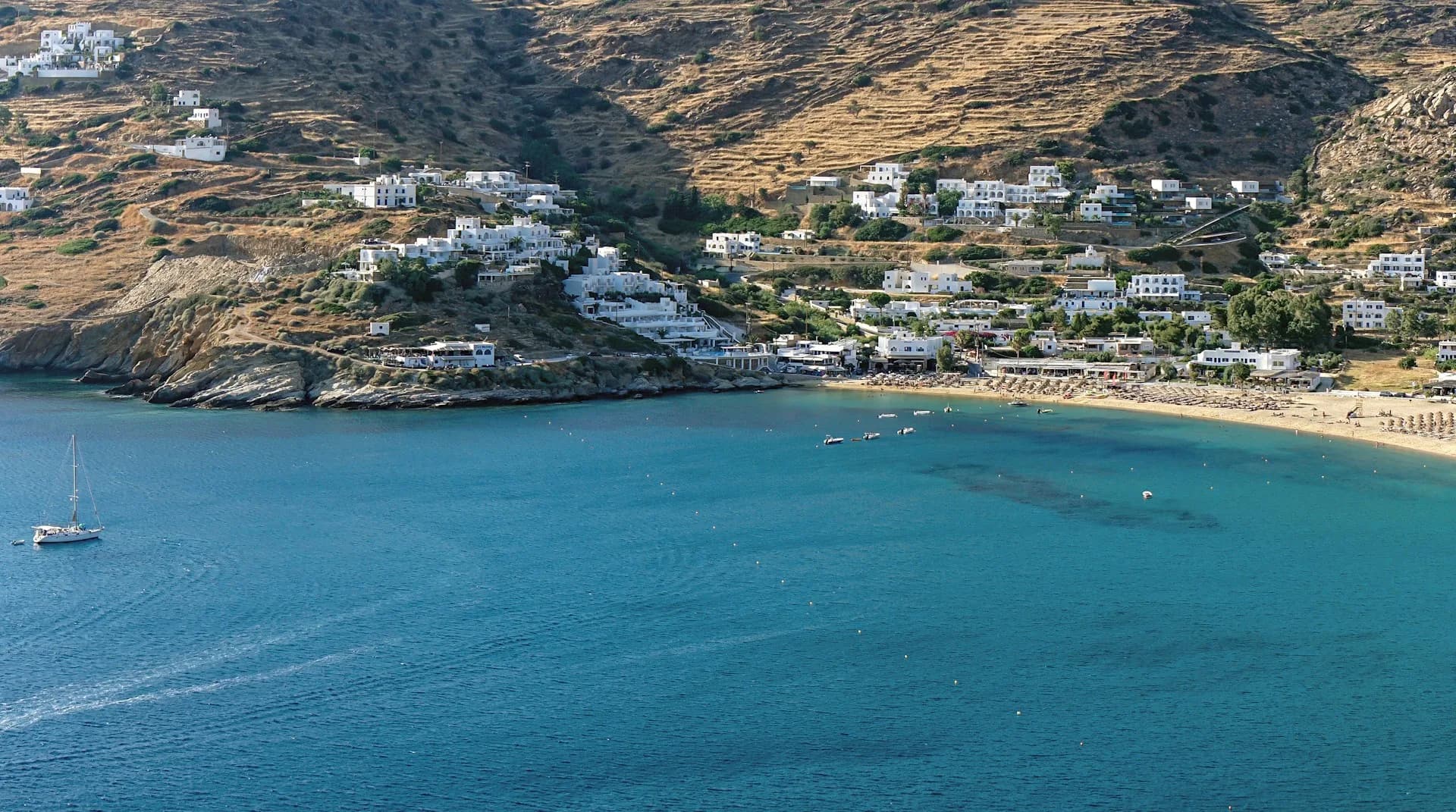
The beach at Mylopotas is two kilometres of fine pale sand curving around a protected south-facing bay. The eastern end is highly organised — sunbeds, beach bars, watersports, cocktails from noon — while the western end dissolves into a quieter stretch where the sand runs out and the rocks begin. The range of experiences available on a single beach is genuinely unusual: you can be in a full beach-club scene at one end and in near-total solitude at the other.

5

The nightlife in the Chora is unlike anything else in the Greek islands — and genuinely worth experiencing once

The concentration of bars and clubs in the narrow lanes of the upper Chora has been drawing summer visitors for forty years, and it remains one of the most vivid nocturnal experiences in the Mediterranean. The bars open at sunset and the energy builds through the evening into a density of music, movement and good-natured chaos that is uniquely Cycladic. It is not for every traveller — but dismissing it entirely without experiencing it once is to miss something real.

6

Ios is positioned perfectly for island hopping — Santorini, Folegandros, Sikinos and Naxos are all close

The island sits at the intersection of several major ferry routes in the southern Cyclades. Santorini is 45 minutes by high-speed ferry; Naxos is under an hour; Folegandros and Sikinos — two of the most unspoiled small islands in Greece — are each reachable in under two hours. For island hoppers using Ios as a base, the geographic position is ideal.

Ios

Best time to go (and when to avoid)

💡 Secret: September is the finest month on Ios — the sea is at its warmest, the crowds have thinned dramatically, and the Chora is quiet and beautiful in the evenings.

May — green, quiet, excellent value

The island is green and quiet. Accommodation is good value, the Chora is uncrowded, and the sea is reaching swimming temperature. Excellent for walkers, explorers and anyone who wants Ios without the party energy.

June — the ideal month

The ideal month for most visitors — the sea is warm, Mylopotas is lively without being overwhelming, the Chora is at its most beautiful in the evenings, and the accommodation choice and price point are both at their best.

July (early) — still excellent

Still excellent — before the mid-July peak the island is active and exciting without being saturated. Book ahead. The beach is at its best and the Chora nights are at their most energetic.

July (late) – August — peak season

Peak season and very full. The island receives its maximum number of visitors and the atmosphere at Mylopotas and in the Chora is intense. Book everything months in advance. The meltemi can make the north-facing beaches rough.

September — the finest month

The finest month on Ios for most travellers. The sea is at its warmest, the crowds have thinned dramatically after mid-month, the Chora is quiet and beautiful in the evenings, and the south coast beaches are at their most accessible and empty. Exceptional.

October – April — off-season

Ios quiets significantly outside summer. Some facilities remain open through October. The island in winter is almost entirely local — a handful of year-round residents, open kafeneions and a Chora that feels profoundly different from its summer self.

Ios

The Chora and main sights

1

The Chora (Ios Town) — the most beautiful Cycladic hilltop village in the southern islands

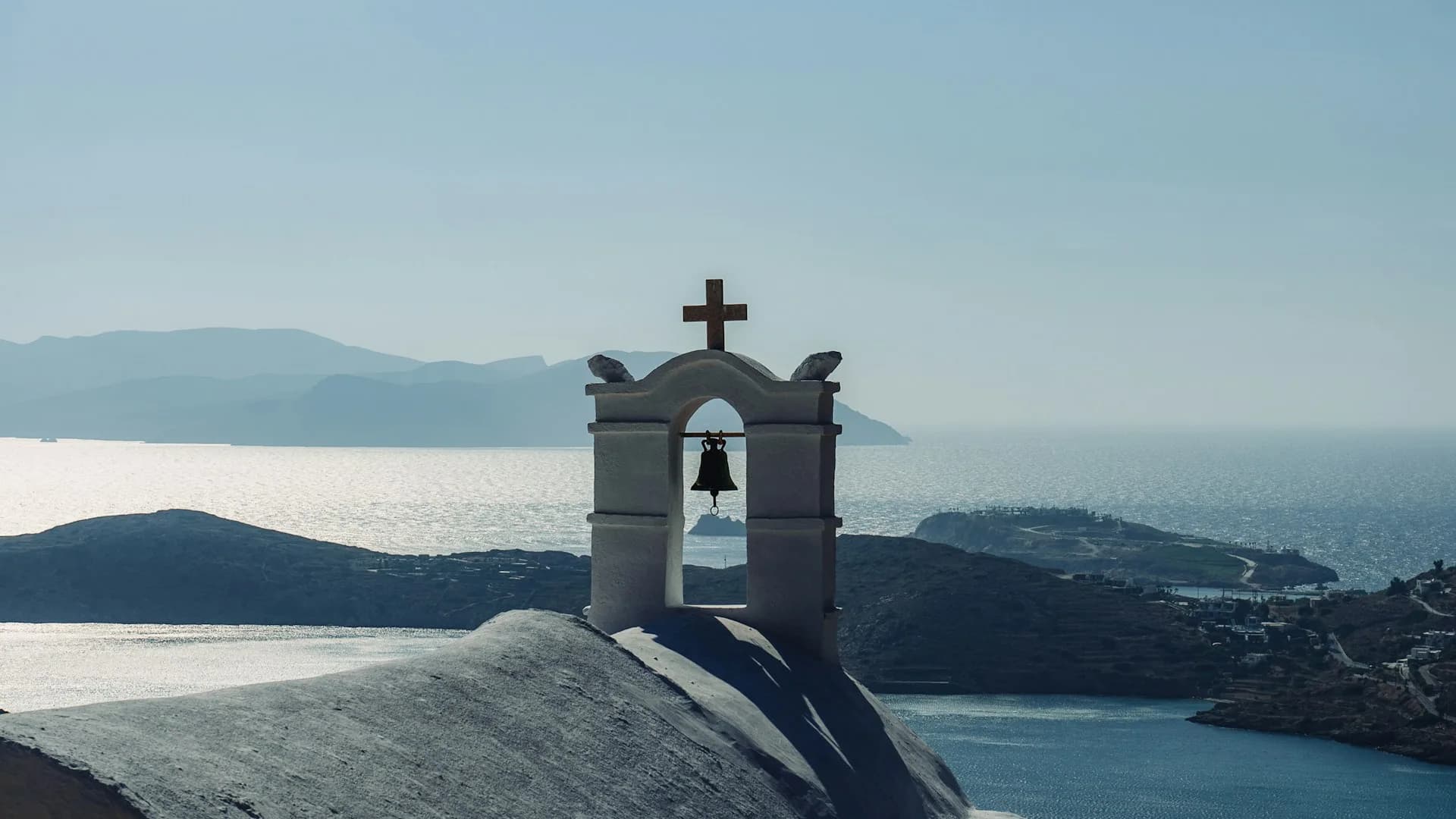
The Chora of Ios is everything a Cycladic village should be: dense, labyrinthine, blazingly white, with blue-domed churches appearing at intervals along lanes that twist and double back on themselves with no apparent logic. It sits at 150 metres above the port bay, reached by a paved road or — more correctly — by the long marble staircase that has connected the two since long before cars existed. From the ridge at the top, crowned by three windmills and the ruins of a Venetian kastro, the views extend north to Naxos and south toward Santorini on clear days. The Chora divides cleanly into two temporal personalities. By day it is a quiet, domestic place where locals shop, children play in the square, and cats sleep on sun-warmed steps. By night — from around 9pm onward — the bar-lined lanes of the upper village fill with a kind of concentrated energy that is specific to Ios and to no other place in the Cyclades. Both personalities are worth experiencing.

2

Homer's Tomb — the northern ridge and the oldest tradition on the island

Ancient sources — including Thucydides, Pliny the Elder and the Homeric tradition itself — record that Homer died on the island of Ios and was buried on its northern tip. The Archaeological Museum in the Chora holds inscriptions and fragments that reference the tradition, and the site on the northern ridge — a reconstructed enclosure of ancient stones set into a bare hillside above a deep sea view — has been known and visited since antiquity. Whether or not the tomb is genuinely Homer's is a question that archaeology cannot resolve; what is not in question is the extraordinary quality of the location and the emotional weight of standing in a place that the ancient world treated as sacred.

3

The Archaeological Museum of Ios

The Archaeological Museum in the Chora is small but intelligently curated, containing finds from the island's Mycenaean-era settlement at Skarkos — one of the most significant Early Bronze Age sites in the Cyclades, with occupation dating to approximately 2800–2300 BC. The Skarkos site itself, on a low hill north of the port, is accessible and worth a visit; the combination of site and museum gives a clear picture of Ios's very long human history that stands in sharp contrast to its modern reputation.

4

Skarkos — Early Bronze Age settlement (UNESCO Tentative List)

The hill of Skarkos, just north of the port, contains the remarkably well-preserved remains of an Early Cycladic settlement from approximately 2800 BC — one of the oldest organised urban sites in the Aegean. Multi-roomed stone houses, storage vessels, animal bones and cooking implements have all been found here, revealing a structured community that predates the classical world by over two thousand years. The site is on Greece's UNESCO Tentative List and is openly accessible with information panels.

Ios

Beaches in Ios

Mylopotas — iconic and long

The island's main beach — two kilometres of fine sand in a south-facing bay, with the full spectrum from organised beach clubs at the east end to quiet, undeveloped sand at the west. The clearest water on the main coastline. The beach bar scene here from June through August is one of the most vivid in the Cyclades.

Manganari — wild and remote

Three broad south-coast bays of exceptional natural beauty, accessible by caïque from the port or a rough dirt road. No sunbeds, minimal facilities, extraordinary clarity. The finest natural beach experience on the island and one of the best in the southern Cyclades.

Koumbara — closest to Chora

A small rocky cove ten minutes' walk west of the port — pebble and coarse sand, clear water, a seasonal beach bar and a quiet atmosphere that makes it the preferred swimming spot for the island's longer-term residents. Completely different in character from Mylopotas.

Psathi — nudist and free

A sandy cove on the east coast, reached by a short dirt track from the main road. Quieter than Mylopotas, traditionally clothing-optional, with good clear water and a low-key atmosphere that suits visitors who want to escape the main beach scene.

Agia Theodoti — sheltered and calm

A long, broad sandy beach on the northeast coast, sheltered from the meltemi and excellent on windy days when the west coast is rough. A Byzantine church and the ruins of a Venetian castle sit above the beach. Taverna open in summer.

Plakes & Kalamos — hidden gems

Two small, largely undiscovered coves on the north coast, reached by rough tracks. Rocky entries, very clear water, and almost no other visitors even in August. For those with a car and a willingness to walk the last five minutes on a stony path.

Ios

Eating and drinking in Ios

The Chora restaurant scene — better than the reputation suggests

The Chora has developed a genuine restaurant culture over the past decade, with several excellent tavernas serving modern Greek food alongside traditional dishes. The best are concentrated on and around the main square and on the quieter lanes north of the bar district. Booking is recommended in July and August.

Fresh seafood at the port

The waterfront tavernas at Ormos Iosou serve fresh fish at prices that are considerably more reasonable than in the Chora. The port is a working fishing harbour and the daily catch quality is reliable. Grilled red mullet, sea bream and octopus are staples; the smaller family-run tavernas outperform the larger ones consistently.

Loukoumades — the Chora's essential street food

Ios has its own tradition of loukoumades — honey-drenched fried dough — and the long-established stall near the Chora's main square has been serving them for decades. Eaten at midnight after a long evening, they are one of the island's most specific pleasures.

Local Ios wine and thyme honey

The island produces small quantities of wine from indigenous varieties — light, aromatic whites and robust reds — and a thyme honey that is among the finest in the Cyclades. Both are available from the food shops in the Chora and from the Saturday morning market at the port. Take them home.

Breakfast culture in the Chora

Ios has an unusually good breakfast culture — several café-bakeries in the Chora open early and serve fresh pastries, Greek yogurt with local honey, proper espresso and fruit platters. After a night out, breakfast here is a ritual. After an early morning walk to Homer's Tomb, it is a reward.

Beach tavernas at Mylopotas and Manganari

The tavernas at the east end of Mylopotas serve good food alongside beach-bar cocktails; the quality varies but the better ones take their kitchen seriously. At Manganari, the single seasonal taverna serves simple grilled fish and salads that taste considerably better for being eaten on a remote beach with no roads and nothing between you and the horizon.

Honest Advice — What to Skip in Ios

✕ **Spending your entire stay on Mylopotas without ever going to the Chora.** The beach is excellent but the Chora — particularly in the early morning and at sunset — is where the island's real character lives. Walking up the marble staircase from the port, exploring the lanes before the day warms up, and sitting at a table above the village with a coffee and a view across the Aegean costs nothing and is an entirely different experience from the beach scene below.
✕ **Dismissing Ios as 'just a party island' without looking further.** The nightlife is real and concentrated and can dominate the experience if you stay in the wrong part of the Chora and keep the wrong hours. But the same island contains Homer's Tomb, the Bronze Age settlement at Skarkos, the wild south coast at Manganari and one of the most beautiful Cycladic villages in the archipelago. Travellers who come with only one of these dimensions in mind miss the others entirely.
✕ **Visiting Manganari only by dirt road.** The road is rough, long and hard on rental vehicles — several car hire companies specifically exclude it in their terms. The daily caïque from the port is faster, more pleasant and arrives directly at the beach. Take the boat.
✕ **Staying in August without booking months in advance.** Ios in late July and August is among the busiest small islands in the Cyclades. Accommodation fills completely; prices are at their highest; the Chora becomes very crowded after midnight. If flexibility is important, June and September offer the same beaches, the same Chora and the same island with dramatically less pressure on every resource.

💡 What nobody tells you: Ios has been quietly evolving for over a decade, and the gap between its reputation and its reality is now wider than at almost any other island in Greece. The travellers who arrive expecting a rowdy package resort and find a stunning hilltop village, an ancient Bronze Age site, a wild south coast and genuinely good restaurants are consistently the ones who leave with the strongest impressions. The island's party reputation has functioned, accidentally, as a filter — keeping away a certain type of visitor and leaving the rest of Ios remarkably underpressured for an island this beautiful, this well-connected and this close to Santorini. In September, when the party season ends and the island returns to something closer to its year-round self, Ios is one of the finest places in the Cyclades.

Ios

How to visit Ios

Getting there by ferry

Ios is well-connected by ferry from Piraeus (4–5 hours conventional, 3 hours high-speed), from Rafina (3–4 hours), and from Santorini (40 minutes), Naxos (1 hour) and Paros (1.5 hours). High-speed services run frequently in summer. The port is compact and all connections are from one quay.

Getting around the island

The port, Chora and Mylopotas are connected by a regular bus service that runs until late in summer — one of the few islands where the bus is a genuinely practical option for the main triangle. For Homer's Tomb, Manganari, Agia Theodoti and the east coast beaches, a rental car or scooter is needed. ATV hire is popular but requires care on the rougher tracks.

How many days?

Three days covers the Chora, Mylopotas, Homer's Tomb and a caïque to Manganari comfortably. Four to five days allows a day trip to Folegandros or Sikinos, more beach exploration and a slower pace. Ios is an island that rewards not rushing — the best experiences here are found by wandering without a plan.

The port–Chora–Mylopotas triangle

These three points form the practical axis of daily life on Ios. The bus runs the triangle reliably until at least 1am in summer. The marble staircase between the port and the Chora takes about 15 minutes on foot uphill and is worth doing at least once — the views over the bay from halfway up are exceptional.

The Meltemi in summer

The meltemi blows from the north in July and August, affecting the north-facing coast and occasionally making the sea at Mylopotas choppy. South-facing beaches — Manganari in particular — are sheltered. On very windy days, the caïque service to Manganari may not run; check at the port the night before.

Noise and sleep

If you are staying in the Chora and want to sleep before 3am, choose accommodation in the lower Chora or on the Chora-Mylopotas road rather than the bar district. If you are staying at Mylopotas, the beach-side hotels furthest from the main cluster of bars are significantly quieter. The port is quiet at night.

Island hopping from Ios

Ios's position in the southern Cyclades makes it an excellent hopping base. Santorini (40 min), Naxos (1 hr), Folegandros (1.5 hrs), Sikinos (1 hr) and Paros (1.5 hrs) are all easily reached. High-speed ferry schedules change each season — check current timetables at the port information office or online before planning day trips.

Cash and connectivity

ATMs are available in both the port and the Chora. Mobile signal is good throughout the main settled areas and at Mylopotas. The remoter beaches — Manganari, Psathi — have limited or no signal. Most restaurants and accommodation accept cards; some smaller cafés and the loukoumades stall are cash-preferred.

Ios

Frequently asked questions about Ios

Is Ios only for young party-goers?

No — and this is perhaps the most important thing to understand about Ios. The island's nightlife is concentrated in a specific part of the upper Chora and operates between roughly 11pm and 4am. Outside that zone and those hours, Ios is a beautiful Cycladic island with excellent beaches, an extraordinary hilltop village, a wild south coast and genuine historical depth. Couples, older travellers, families and cultural visitors all spend very successful holidays here — provided they choose the right accommodation and understand that the party scene is one option among many, not the defining feature of the entire island.

How does Ios compare to Santorini?

Ios and Santorini are an hour apart by high-speed ferry and profoundly different in character. Santorini has the caldera, the iconic architecture, the international luxury hotels and the crowds that come with all of those things — particularly in July and August. Ios has better beaches, a more authentic Cycladic village character, dramatically lower prices and significantly less pressure on every resource. Many travellers who find Santorini's peak season overwhelming base themselves on Ios instead and make Santorini a day trip — arriving early, staying for the sunset, returning in the evening. This is one of the most practical combinations in the southern Cyclades.

Is Homer really buried on Ios?

The tradition is ancient — Thucydides, Pliny, Pindar and other ancient sources all record the belief that Homer died on Ios and is buried on its northern tip. Modern archaeology cannot confirm or deny this. The site on the northern ridge contains a reconstructed stone enclosure that has been venerated since antiquity and which is referenced in ancient inscriptions found on the island. Whether or not the tomb is genuinely Homer's, the site is extraordinary in its setting and its symbolic resonance — and the Archaeological Museum in the Chora provides the full context of the tradition and the evidence.

What is the best way to get to Manganari beach?

The daily caïque from the port is by far the best option. It departs in the morning and returns in the late afternoon, and the journey by sea along the west and south coast of Ios is scenic and enjoyable in its own right. The alternative — a long dirt road from the Chora — requires a robust vehicle (many hire companies exclude the Manganari track in their terms and conditions) and takes about 40 minutes each way. Several rental ATVs have been damaged on this track. Take the boat.

When is the best time to visit Ios for beaches without crowds?

June and September are the ideal months. The sea is fully swimmable (from late May at Mylopotas, which is south-facing and warms early), the beaches are active without being congested, and the island has atmosphere without the August intensity. September in particular — from the 10th onward — sees Mylopotas significantly emptier while remaining warm, and Manganari effectively deserted. The water in September is at its warmest of the year.

Can I visit Santorini as a day trip from Ios?

Yes — and many experienced Cyclades travellers recommend this as the best way to experience Santorini. The high-speed ferry takes approximately 40 minutes. Leaving Ios in the morning, spending the day in Oia and Fira, watching the sunset from the caldera edge and returning on the evening ferry gives you Santorini's most iconic experience without paying Santorini accommodation prices. It also means you avoid waking up to Santorini's August crowds and can retreat each evening to the considerably more relaxed atmosphere of Ios.

Is Ios good in September and October?

September is arguably the finest month on Ios. The sea is at its warmest, the beaches are at their quietest since May, the Chora is peaceful and beautiful in the evenings without the high-season energy, and the restaurants are operating at their best. October is quieter still — some beach facilities and bars close, but the core of the island remains open and the autumn light on the Chora's whitewashed architecture is exceptional. For travellers who want Ios's beauty without its summer intensity, September is the month.