Nafpaktos
Mainland escapes

Nafpaktos

Nafpaktos is one of the most historically freighted small towns in Greece — a place where a single afternoon of walking the harbour wall, climbing through the layers of a Venetian fortress and reading the plaques scattered through the old town delivers more concentrated history per square metre than destinations ten times its size. Known to the Western world as Lepanto, the town gave its name to the 1571 naval battle in which the Holy League fleet defeated the Ottoman navy — ending over a century of Ottoman dominance in the Mediterranean and inspiring one of the most famous passages in European literature. Miguel de Cervantes fought at Lepanto and lost the use of his left hand in the battle; he considered it, he wrote, the finest thing he ever did. The surrounding Nafpaktia region encompasses the only inhabited island in the Gulf of Corinth, the sacred wetlands of Messolonghi, a wild west coast and forested mountain villages of exceptional beauty.

Venetian harbour (Bourtzi)

Castle — five rings of walls

Trizonia island — only island in Gulf of Corinth

Messolonghi lagoon & Byron monument

Galaxidi neoclassical town

Mountain villages of Nafpaktia

Flamingos at Messolonghi

Rio-Antirrio Bridge

Travel Guide

Where to Stay in Nafpaktos

Travel Guide

Tours & Experiences

Beach Guide

Best Beaches in Nafpaktos

Activities

Things to Do in Nafpaktos

Destination Overview

Nafpaktos

Nafpaktos is one of the most historically freighted small towns in Greece — a place where a single afternoon of walking the harbour wall, climbing through the layers of a Venetian fortress and reading the plaques scattered through the old town delivers more concentrated history per square metre than destinations ten times its size. Known to the Western world as Lepanto, the town gave its name to the 1571 naval battle where the Holy League defeated the Ottoman navy — ending over a century of Ottoman dominance in the Mediterranean. Miguel de Cervantes fought at Lepanto and lost the use of his left hand; he considered it the finest thing he ever did. The surrounding Nafpaktia region encompasses the only inhabited island in the Gulf of Corinth, the sacred wetlands of Messolonghi, a wild west coast and forested mountain villages that rank among the most beautiful in mainland Greece.
Nafpaktos

Why Visit Nafpaktos & Nafpaktia

Nafpaktos is one of the most historically freighted small towns in Greece — a place where a single afternoon of walking the harbour wall, climbing through the layers of a Venetian fortress and reading the plaques scattered through the old town delivers more concentrated history per square metre than destinations ten times its size. Known to the Western world as Lepanto, the town gave its name to the 1571 naval battle in which the Holy League fleet defeated the Ottoman navy — ending over a century of Ottoman dominance in the Mediterranean and inspiring one of the most famous passages in European literature. Miguel de Cervantes fought at Lepanto and lost the use of his left hand in the battle; he considered it, he wrote, the finest thing he ever did. The town's extraordinary Venetian harbour — a perfectly circular fortified anchorage with towers and walls preserved in near-complete condition — is the finest example of Venetian military harbour architecture in Greece. The castle rising behind it in five successive rings from the harbour to the mountain summit is Byzantine, Venetian, Ottoman and Greek independence compressed into stone. Forty minutes to the east, the island of Trizonia — the only permanently inhabited island in the entire Gulf of Corinth — sits in a bay of green hills and calm water. To the west, the wetlands of Messolonghi — a UNESCO Biosphere Reserve — form one of the most ecologically and historically significant landscapes in Greece, where Lord Byron died in 1824. Above the coast, the mountain interior rises through chestnut forests to high villages at 800 metres, looking down on the Gulf as if from another world.

Harbour of Nafpaktos

Nafpaktos

Four zones, four completely different worlds

Nafpaktos Town — the Venetian harbour and the fortress

The historic core of the region — perfectly preserved Venetian military architecture on the Gulf coast, a fine sandy town beach, good restaurants and the best concentrated historical experience in Western Greece.

Trizonia & the eastern Gulf — the only island in the Gulf of Corinth

A car-free island five minutes by ferry from the coast, with a natural harbour beloved by sailing yachts, excellent tavernas and the calmest waters in the region.

Messolonghi & the western lagoon — Byron's Greece

A vast wetland system of lagoons, salt pans and bird-rich islands — UNESCO Biosphere Reserve, site of Byron's death, origin of the most moving episode of the Greek Revolution, and one of the finest wildlife habitats in the Mediterranean.

Mountain Nafpaktia — Ano Chora, Platanos and the high villages

The forested interior above the Gulf coast — stone villages at 700–1,000 metres in chestnut and fir forest, the Mornos reservoir, the Vardousia peaks, traditional festivals and a silence that makes the coast feel like a different country.

Nafpaktos

Seven reasons this region rewards serious travellers

1

The Venetian harbour is the most beautiful fortified anchorage in Greece

The circular harbour of Nafpaktos — built by the Venetians on Byzantine foundations — is one of the finest examples of military harbour architecture in the Mediterranean. Walk the full castle circuit from the harbour to the topmost walls through five successive rings of fortification. The view from the summit over the Gulf toward the Peloponnese is one of the finest in western Greece.

2

Trizonia is the only inhabited island in the Gulf of Corinth

Connected to the mainland by a five-minute ferry, the island has no cars, a natural harbour attracting yachts from across the Mediterranean, about 100 permanent residents, excellent fish tavernas and a quality of stillness unlike anywhere else in the region. Arrive by early morning ferry and walk the island perimeter path before the day visitors arrive.

3

The Battle of Lepanto and its connection to Cervantes

On 7 October 1571, the combined fleet of the Holy League met the Ottoman fleet in the waters just west of Nafpaktos. A young Spanish soldier named Miguel de Cervantes fought in the battle, was wounded three times and permanently disabled in his left hand. He called it "the most noble and memorable event that past centuries have seen." The Cervantes monument at the town entrance commemorates this connection.

4

Messolonghi — one of the most significant places in Greek history

The wetlands of Messolonghi are simultaneously a UNESCO Biosphere Reserve and a landscape saturated with the history of Greek independence. Byron came here in 1824, contracted fever and died at 36 — his death electrifying European public opinion. The Garden of Heroes, with the Byron monument, is one of the most moving spaces in Greece. Visit in late afternoon when the low light turns the lagoon to bronze; flamingos arrive from November through March.

5

The mountain villages — Ano Chora, Platanos, Elatou and the Vardousia range

The forested mountains above Nafpaktos contain a network of stone villages that have preserved their architectural character to a degree unusual even in rural Greece. Ano Chora, Platanos, Elatou, Terpsithea, Gavros and Perdikovrysi: each has its own church square, its stone fountain, its kafeneion and its festival calendar that draws the diaspora back each August. The chestnut and fir forests create a landscape entirely unlike the bare limestone of most Greek mountain ranges. The drive from Nafpaktos to Lidoriki and then to Ano Chora through the Mornos gorge is one of the finest scenic routes in western Greece.

6

Kato Vasiliki and the west coast — wild beaches without tourist development

The western coast of Nafpaktia has long, sandy beaches of striking beauty that see a fraction of the visitors of the Ionian coast. Kato Vasiliki at the mouth of the Gulf has fine sand, clear water, a small fishing harbour and the extraordinary Rio-Antirrio Bridge visible to the east.

7

Perfectly positioned for Delphi, Epirus and the Ionian coast

Nafpaktos sits at a geographic crossroads — Delphi is 70km northeast (90 minutes), Ioannina is 2.5 hours north, the Ionian islands are accessible via Astakos and Patras, Meteora is 3 hours, Athens is 2.5 hours via the Rio-Antirrio Bridge. A week based in Nafpaktos allows Delphi, the Ionian coast, Messolonghi, the mountain interior and three days for the town and Trizonia.

Nafpaktos

The Battle of Lepanto — 7 October 1571

In October 1571, in the waters just west of Nafpaktos, the combined fleet of the Holy League engaged the Ottoman fleet in the largest naval battle of the 16th century. Approximately 400 galleys and 170,000 men were involved. The Holy League victory was decisive: the Ottoman fleet lost 200 ships and over 30,000 men; the threat of Ottoman naval expansion into the western Mediterranean was ended permanently. Among the Spanish soldiers serving at Lepanto was a 24-year-old named Miguel de Cervantes Saavedra. He was wounded three times — twice in the chest and once in the left arm, which was permanently disabled. He later referred to the battle as "the most noble and memorable event that past centuries have seen or future generations may hope to see." The experience shaped his worldview, and the suffering and heroism he witnessed informed the moral imagination that would eventually produce Don Quixote. The battle is commemorated in Nafpaktos by a monument and a bust of Cervantes. Most of the Venetian fortifications visible today were built before the battle and were the operational base from which the Venetian contingent departed. Standing on the harbour wall, looking west over the bay, the historical imagination requires very little effort to engage.

Nafpaktos

Best time to visit Nafpaktos & Nafpaktia

March – April

The mountain interior at its most dramatic — chestnut and fir forests in new growth, wildflowers across the high meadows, villages quiet and authentic. Easter in the mountain villages is genuinely moving. The Gulf coast is mild and uncrowded; the Messolonghi lagoon has its finest birdlife.

May – June

The ideal months for the full region. The Gulf warm enough for swimming by late May; mountain villages green and their festivals beginning; Trizonia in full season without summer crowds; historical sites at their most accessible. Excellent food, reasonable prices, uncrowded everywhere.

July – August

The Gulf coast and Nafpaktos at their liveliest — the summer beach season, the evening volta on the harbour, festival events in the castle. The mountain villages receive their diaspora and hold their festivals. Book ahead for August. The mountains above 700 metres are comfortably cooler than the coast.

September – October

Outstanding. The Gulf sea at its warmest, summer visitors gone, the chestnut forests beginning to turn gold, mountain villages in autumn light. Messolonghi's flamingos begin arriving in October. The light over the castle and harbour in September is exceptional.

November – February

Nafpaktos functions year-round — café culture on the harbour, restaurants open, castle and harbour walls always accessible. The Messolonghi wetlands at their finest for birdwatching: flamingos, herons, cormorants and migratory species. The mountain villages in snow are extraordinary if the road is passable.

7 October — Battle of Lepanto Anniversary

The anniversary of the Battle of Lepanto is commemorated annually in Nafpaktos with events, re-enactments and cultural activities at the castle and harbour.

Nafpaktos

Nafpaktos Town — the historic town and its monuments

1

The Venetian harbour (Bourtzi)

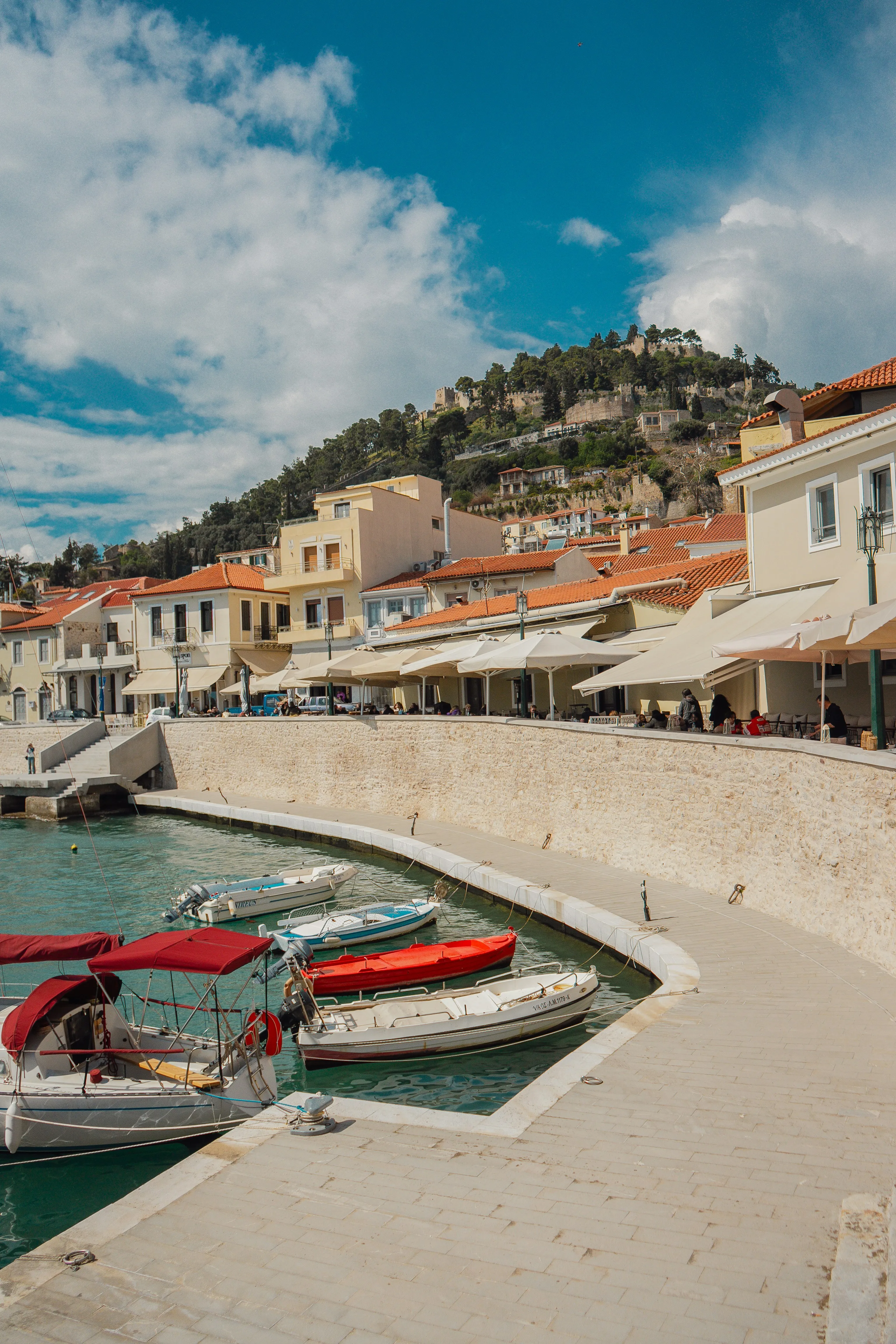
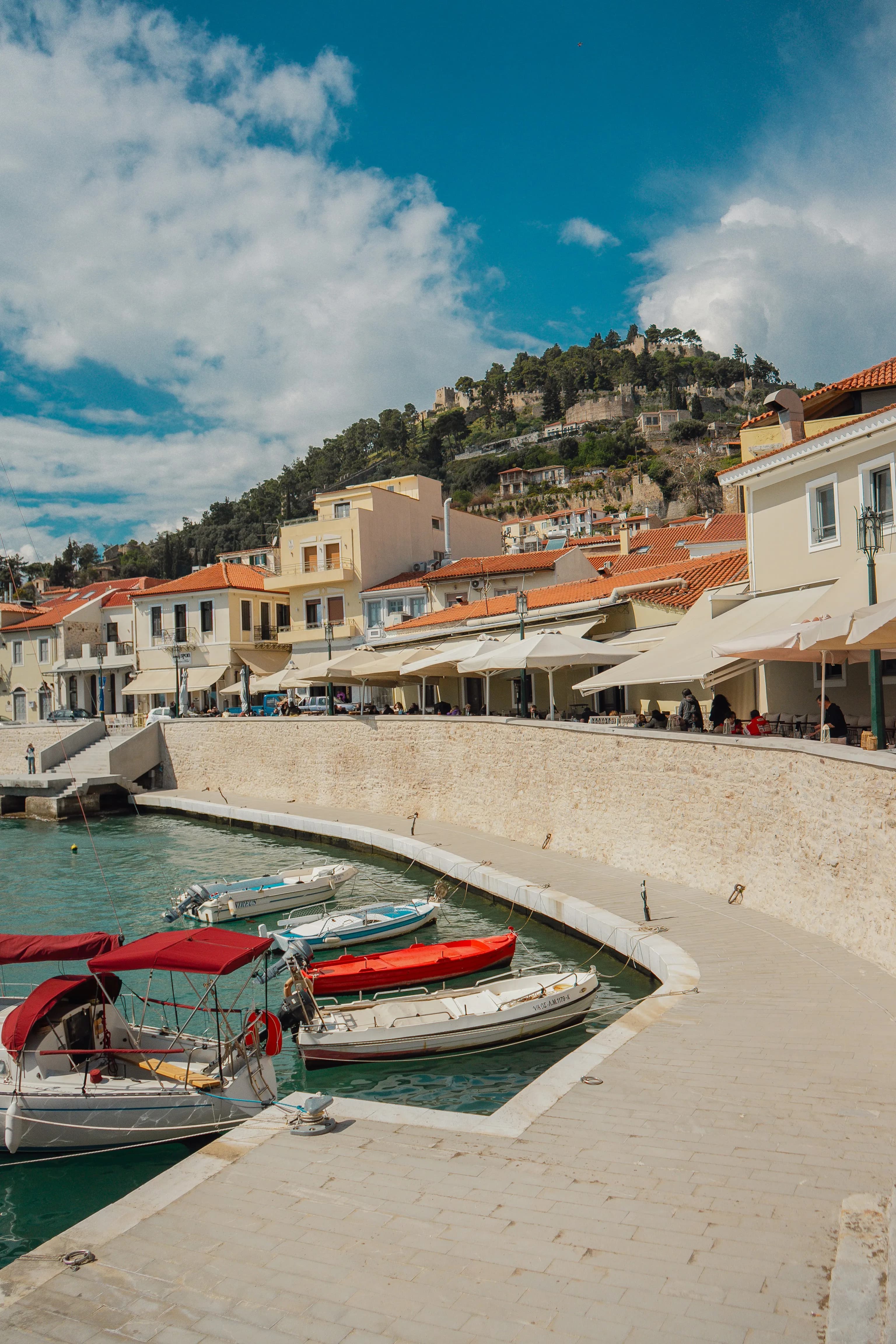
The harbour of Nafpaktos is the centrepiece of the town — a perfectly circular basin enclosed by two curved moles, each terminated by a tower. The chain that once stretched between the towers to close the harbour mouth was the mechanism by which the Venetians controlled entry. The towers, walls, gateways and interior spaces are all accessible on foot. The harbour circuit — walking both moles from their landward bases to the towers at their tips — takes about 30 minutes and is the finest single walk in the town. 💡 Sit at one of the café tables on the inner mole in the early evening, when the castle walls above catch the last light and the water goes flat and dark.

2

The Castle of Nafpaktos — five rings of walls

One of the most complete and dramatically positioned medieval fortifications in Greece. Five successive rings of walls rise from the harbour to the mountain summit, enclosing an area that once contained the entire medieval city. The castle is freely accessible and unguided — marked paths through pine and cypress forest. The entire circuit from harbour level to the summit and back takes about two hours. 💡 Go early morning in summer — the paths face south and west and become very hot by midday. The view from the summit at dawn is outstanding. Bring water.

3

Old town, Cervantes monument and the waterfront

The old town between the lower castle walls and the beach has retained its Venetian and Ottoman street pattern and several fine neoclassical buildings. The main square is a functioning Greek town space with kafeneions and good restaurants. The Cervantes monument at the town entrance commemorates the writer's participation in the Battle of Lepanto. The town beach immediately west of the harbour — long, sandy and backed by a pine promenade — is one of the finest town beaches in western Greece.

Nafpaktos

Messolonghi — Byron & the Sacred Lagoon

Messolonghi occupies a singular position in the Greek national imagination. Lord Byron arrived here in January 1824 with money, military volunteers and a determination to assist the Greek cause for independence. He died here in April of the same year, aged 36, of fever contracted in the miasmal air of the lagoon town. His death — widely reported across Europe — transformed the Greek struggle from a Balkan insurgency into a cause célèbre of Romantic civilisation, contributing directly to the intervention that led to the Battle of Navarino in 1827. The Garden of Heroes in central Messolonghi contains the cenotaph of Byron — his heart was buried here by his own request — along with the graves of Greek fighters who died in the town's famous Exodus of 1826. The garden, the cenotaph and the small museum telling this story are among the most moving cultural spaces in Greece. Beyond the history, Messolonghi is the gateway to one of the finest natural environments in the Mediterranean. The Messolonghi-Aitoliko lagoon complex — a UNESCO Biosphere Reserve — covers approximately 35,000 hectares of interconnected lagoons, salt pans and reed beds supporting flamingos, spoonbills, herons, pelicans and dozens of migratory species. The town of Aitoliko, built on an island in the inner lagoon, is connected to the mainland by two bridges — an inhabited island in a freshwater lagoon surrounded by a saltwater lagoon, surrounded by the sea. The smoked eel of Messolonghi and the local avgotaraho (bottarga) — dried mullet roe — are among the most celebrated food products in western Greece.

Nafpaktos

Beyond Nafpaktos — the wider Nafpaktia region

1

Trizonia — the only inhabited island in the Gulf of Corinth

Thirty kilometres east of Nafpaktos, connected to the mainland at Roiza by a small on-demand ferry. The island has about 100 permanent residents, no cars, a natural harbour beloved by sailing yachts and excellent fish tavernas. For day visitors: arrive on the morning ferry, swim, eat lunch and return on the afternoon crossing. 💡 The fish at the taverna on the island quayside is among the freshest in the region — caught locally and served within hours.

2

The mountain villages — Ano Chora, Platanos, Elatou and the Dorida plateau

The mountain interior of Nafpaktia rises steeply from the Gulf coast into chestnut and fir forests, high meadows and stone villages that feel profoundly remote. Ano Chora, the highest village of the region at over 800 metres, has panoramic views over the Mornos reservoir. Platanos and Elatou, slightly lower in the chestnut belt, preserve traditional architecture and a festival culture that draws the diaspora each August. Terpsithea, Gavros and Perdikovrysi are smaller but each has its own character. Lidoriki serves as the main hub for exploring the upper villages. 💡 The Mornos reservoir — the main water supply for Athens — is visible from the high road west of Lidoriki. The viewpoint above the dam is freely accessible and genuinely dramatic.

3

Kato Vasiliki and the west coast

The western coast of Nafpaktia has long, sandy and relatively undeveloped beaches with a wild quality. Kato Vasiliki at the mouth of the Gulf has a broad sandy beach, a small working harbour and the Rio-Antirrio Bridge visible to the east — the longest cable-stayed bridge in Europe when it opened in 2004.

4

Galaxidi — the maritime town east of Nafpaktos

Galaxidi is 35 kilometres east of Nafpaktos on the south shore of the Gulf — one of the finest neoclassical port towns in Greece, built on 19th-century shipping wealth. Its stone mansions, cobbled lanes, excellent restaurants and sophisticated café culture have made it a favourite weekend destination for Athenians. The combination of Nafpaktos and Galaxidi gives an extraordinary picture of Gulf of Corinth maritime identity. 💡 Galaxidi's Clean Monday carnival — flour fights in the streets — draws thousands in February or March. Book accommodation months in advance.

5

Delphi — the navel of the world, 70km from Nafpaktos

The sanctuary of Apollo at Delphi — UNESCO World Heritage Site, home of the most famous oracle of the ancient world — is 70 kilometres northeast via one of the finest scenic routes in central Greece. Delphi is entirely feasible as a full day trip from Nafpaktos. 💡 Arrive at Delphi when it opens (8am in summer) and spend the first two hours on the site before the tour buses arrive from Athens.

Nafpaktos

Beaches in Nafpaktos & Nafpaktia

Nafpaktos Town Beach (Psani)

The long sandy beach immediately west of the Venetian harbour — backed by a pine promenade, organised with sunbeds and umbrella rental, with good water quality and the castle walls visible above. The finest town beach in the region.

Trizonia island beaches

Small pebble and sand coves on the island's south and west sides, with the distinctive water of the inner Gulf — calm, warm and clear. Accessible only by ferry; no cars, no noise.

Kato Vasiliki beach

A long, broad sandy beach at the mouth of the Gulf — wilder and less organised, with stronger wind and wave action. The view of the Rio-Antirrio Bridge is one of the most striking in the region.

Gribovo & Platanos beaches

Organised sandy beaches east of the harbour — sunbeds, beach bars, shallow calm water and easy access from the town centre. The most family-friendly beach zone in the immediate Nafpaktos area.

Monastiraki & Selinitsa

Small coves west of Nafpaktos on the road toward Messolonghi — rocky entries, pine-backed and significantly quieter than the main town beach. Excellent water clarity and pine forest shade.

Kirra & Itea beaches (near Galaxidi)

Long, sandy beaches on the south Gulf shore — set against olive groves and the Parnassos mountain backdrop. Particularly beautiful in the afternoon light.

Nafpaktos

What to eat and drink in Nafpaktos & Nafpaktia

Avgotaraho — the Messolonghi bottarga

The dried and wax-sealed roe of the grey mullet from the Messolonghi lagoon — eaten in paper-thin slices with lemon and olive oil. The Messolonghi version is considered the finest in Greece. Available from specialist food shops in Messolonghi and Nafpaktos.

Smoked eel from Messolonghi

Eels raised in the lagoon's brackish waters and smoked over wood in the traditional method — eaten cold in thin slices as a meze. A speciality specific to this wetland system.

Fresh Gulf seafood

The protected waters of the Gulf produce excellent fish — sea bream, sea bass, red mullet and octopus, supplemented by locally caught shellfish. The fish at Trizonia island is the freshest in the region.

Mountain lamb and goat

From the mountain villages of Nafpaktia — raised on high pastures and prepared slow-roasted in wood-fired ovens. Available at tavernas in Ano Chora, Lidoriki and Artotina.

Nafpaktia honey and chestnuts

The chestnut forests produce a dark, strongly flavoured honey with a faint bitterness from the chestnut blossom. Fresh chestnuts are available in October and November. The honey is available at the Nafpaktos Saturday market and from village producers.

Tsipouro and local wine

The evening culture at the Nafpaktos harbour — café tables on the inner mole, the castle in the evening light, a glass of tsipouro and a plate of small fish. The regional white wines from the Gulf slopes are light, aromatic and worth asking for.

Nafpaktos

The region's distinct settlements

Nafpaktos

The Venetian harbour capital — the finest historic town in western Greece, with the circular harbour, the five-ring castle, a good town beach and evening café culture on the mole. The base for exploring the entire region.

Trizonia island

The only inhabited island in the Gulf of Corinth — car-free, calm, with a natural harbour, excellent fish tavernas and the finest simple lunch in the region. Five minutes by ferry.

Messolonghi

The lagoon town of western Aetolia — UNESCO Biosphere Reserve, Byron monument and Garden of Heroes, exceptional food products (avgotaraho, smoked eel), flamingos from October. 45 minutes west of Nafpaktos.

Aitoliko

A remarkable settlement built on an island within the inner lagoon, connected to the mainland by two bridges. Surrounded entirely by still water — a surreal, unique sight in western Greece.

Galaxidi

35km east of Nafpaktos — a perfectly preserved 19th-century maritime town with stone mansions, cobbled lanes and one of the finest restaurant scenes in the region. An essential complement to Nafpaktos.

Ano Chora

The highest mountain village of Nafpaktia at over 800 metres — set in chestnut forest with panoramic views over the Mornos reservoir. A traditional plateia, a stone fountain, a kafeneion that opens at noon, and the kind of mountain silence that makes the Gulf coast feel like another world.

Nafpaktos

Practical tips for visiting Nafpaktos & Nafpaktia

Getting to Nafpaktos

By car from Athens: 2.5 hours via the Rio-Antirrio Bridge and E65 motorway — one of the finest drives in central Greece. From Patras: 45 minutes east. From Delphi: 90 minutes via Itea. No direct train; nearest rail is Patras.

Do I need a car?

Yes, for the full region. Nafpaktos town is walkable, but Trizonia, Messolonghi, the mountain villages and Galaxidi all require independent transport. A car hired for three days covers the entire region comfortably.

How many days?

Two days covers Nafpaktos and one day trip. Four to five days covers the whole region: the town, Trizonia, Messolonghi, the mountain circuit and Galaxidi. Seven days with Delphi as a day trip gives the most complete experience.

Getting to Trizonia

Drive east from Nafpaktos approximately 60km to the small ferry landing at Roiza (near Aigion). The ferry takes 5 minutes and runs on demand — wave from the quay or phone the ferryman. No cars on the island.

Rio-Antirrio Bridge

The Charilaos Trikoupis Bridge — 2,883 metres, the longest cable-stayed bridge in Europe when built. A toll is charged. The older ferry alternative still operates for those who prefer it.

Messolonghi birdwatching

One of the finest birdwatching locations in Greece year-round, exceptional October–March. Flamingos (up to 4,000) visible from the road west of Messolonghi November–April. Boat trips and the Biodiversity Park observation platforms available.

Mountain village festivals

The villages hold their major festivals in July and August — feast days of local patron saints with music, dancing and traditional food. The festivals at Ano Chora, Platanos and Lidoriki are the most accessible.

Combining Nafpaktos with Delphi

Delphi is 70km northeast via the Gulf coast road through Itea. The drive passes through exceptional olive grove landscapes. Nafpaktos as base, Delphi as day trip, Galaxidi for dinner on return — one of the finest one-day circuits in central Greece.

Nafpaktos

FAQ about Nafpaktos & Nafpaktia

What is the connection between Nafpaktos and Cervantes?

Miguel de Cervantes, author of Don Quixote, participated in the Battle of Lepanto on 7 October 1571 as a young Spanish soldier. He was wounded three times, including a wound to his left arm that permanently disabled his hand. He considered his participation in the battle the most important event of his life and described it as "the most noble and memorable event that past centuries have seen or future generations may hope to see." A monument to Cervantes stands at the entrance to Nafpaktos town.

Why did Byron come to Messolonghi?

Lord Byron arrived in Messolonghi in January 1824 with a strong personal commitment to the Greek cause for independence. He contracted fever in the miasmal conditions of the lagoon town and died in April 1824, aged 36. His death was reported across Europe and transformed the Greek cause into a matter of European civilisation, contributing significantly to the international intervention that secured Greek independence. His heart was buried in Messolonghi by his own request; his body was returned to England.

How do I get to Trizonia island?

Drive east from Nafpaktos approximately 60km to the small ferry landing at Roiza, near Aigion. The ferry takes approximately 5 minutes and runs on demand. No cars on Trizonia; leave your vehicle at the mainland parking. The ferry is inexpensive and operates year-round.

Is Nafpaktos a good base for visiting Delphi?

Excellent — possibly the finest base for Delphi outside of the village of Delphi itself. The drive takes approximately 90 minutes via the Gulf coast road through Itea. Staying in Nafpaktos gives you both the historical interest of the town and easy access to Delphi for a full day at the site.

What is avgotaraho and where can I buy it?

Avgotaraho is Greek bottarga — the dried and wax-sealed roe sac of the grey mullet. The Messolonghi version is considered the finest in Greece. Available from specialist food shops in Messolonghi and Nafpaktos. It is expensive but among the most specific and rewarding food souvenirs from western Greece.

How does Nafpaktos compare to other historical towns in Greece?

Nafpaktos ranks among the finest historical towns in Greece. The Venetian harbour is better preserved than its equivalents in Heraklion and Chania. The castle is more extensive and accessible than most comparable fortifications. The specific historical narrative — Lepanto, Cervantes, the Venetian-Ottoman struggle — is of European rather than merely Greek significance. It is less famous than Nafplio or Rhodes because it has been less marketed, not because it is less deserving.

When is the best time to see flamingos at Messolonghi?

Greater flamingos are present from approximately October through April, with numbers peaking in winter (December–February) when up to 3,000–4,000 birds can be seen in the salt pans west of the town. Visible from the road without specialist equipment. The lagoon in winter light — flamingos pink against silver water — is one of the most beautiful natural spectacles in mainland Greece.