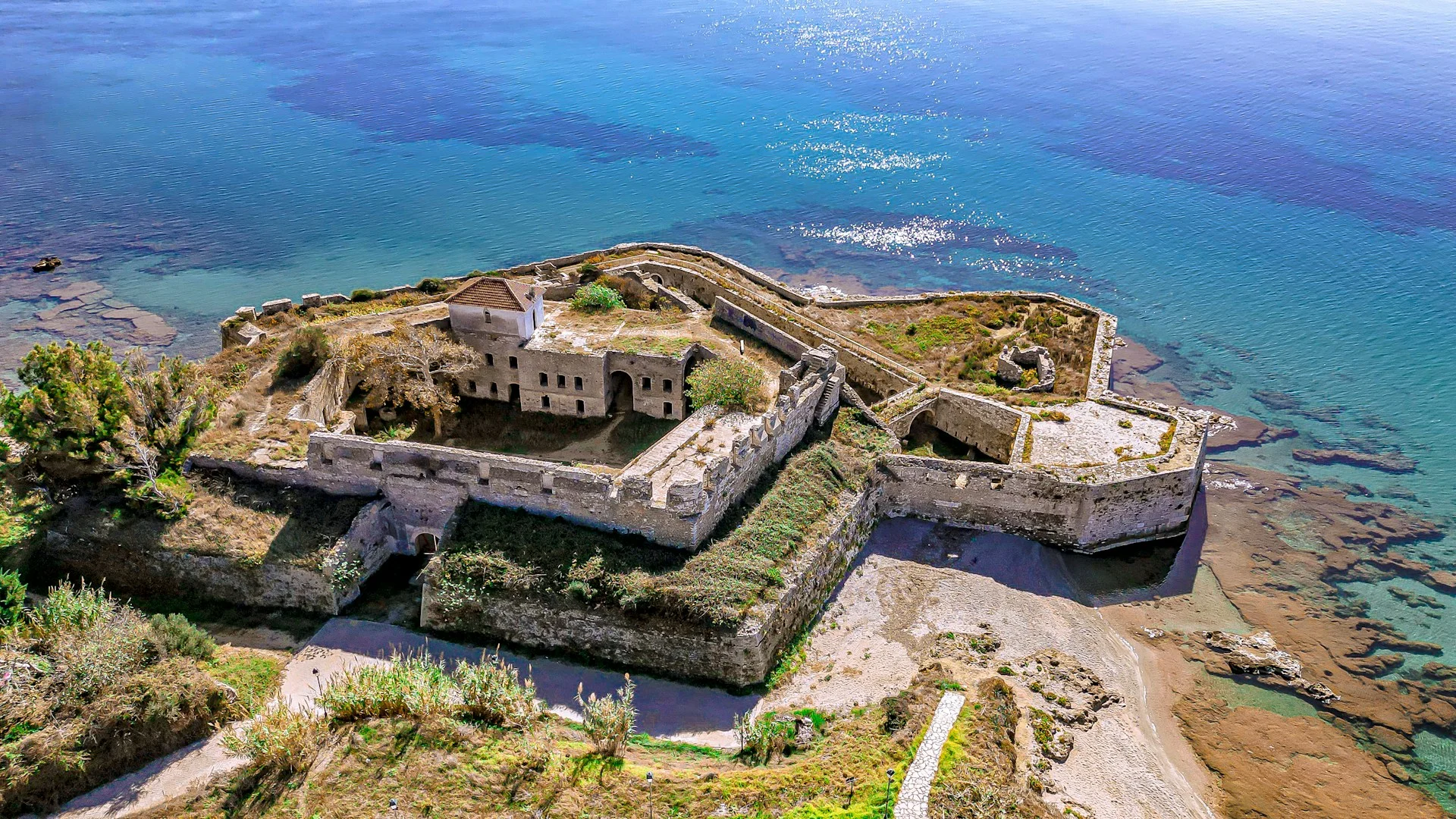
Preveza
Epirus

Preveza

On the 2nd of September, 31 BC, two fleets met in the narrow strait at the mouth of the Ambracian Gulf. Octavian's victory at the Battle of Actium ended the Roman Republic and began the Roman Empire — a single day that shaped the next two millennia of Western civilisation. He built Nikopolis (City of Victory) on the peninsula overlooking the battle site. The ruins are still there, five minutes from modern Preveza. Today Preveza is a coastal town of 20,000 people sitting at one of the great hinge points of world history. The Ambracian Gulf behind it is a vast protected wetland ecosystem with dolphins, pelicans and flamingos. Monolithi Beach stretches for 22km of uninterrupted golden sand. And the region offers ancient Kassope, the Zalongo monument, the Necromanteion of Acheron, and the finest seafood in Epirus.

Ancient Nikopolis

Monolithi Beach — 22km

Avgotaracho — Greek caviar

Ambracian Gulf dolphins

Travel Guide

Where to Stay in Preveza

Beach Guide

Best Beaches in Preveza

Activities

Things to Do in Preveza

Destination Overview

Preveza

On the 2nd of September, 31 BC, two fleets met in the narrow strait at the mouth of the Ambracian Gulf. On one side: Octavian, the adopted heir of Julius Caesar. On the other: Mark Antony and Cleopatra VII, queen of Egypt. The battle that followed — the Battle of Actium — lasted a single day and determined the shape of the next two millennia. Octavian's victory ended the Roman Republic, inaugurated the Roman Empire, and set in motion a chain of events that would directly produce the political, legal and cultural framework of the Western world. He built a city on the peninsula overlooking the battle site and named it Nikopolis: the City of Victory. The ruins are still there, five minutes from the centre of modern Preveza, and they are among the most historically significant in Greece. This is the context in which Preveza exists — a coastal town of 20,000 people, easy in its manner and genuinely uncrowded by tourist standards, sitting at one of the great hinge points of world history. The Ambracian Gulf behind it is a vast, almost landlocked inlet of the Ionian Sea, one of Europe's most important protected wetland ecosystems, home to bottlenose dolphins that can be seen on boat tours with over 80% reliability, pelicans, flamingos, and the grey mullet whose roe — avgotaracho, the Greek equivalent of beluga caviar — has been salted and dried on these shores since Byzantine times. North of town, Monolithi Beach stretches for 22 kilometres of uninterrupted golden sand and was named the safest beach in Europe by the European Commission. The wider region adds layer after layer: the dramatic hilltop ruins of Kassope, the monument at Zalongo where Souliot women chose the cliff rather than captivity, the mythological Acheron river where the ancients believed Charon ferried the dead to the underworld, and the medieval Pantocrator castle above the town whose terrace catches the Ambracian Gulf at sunset. Preveza is not a hidden gem in the sense of being small or modest. It is a genuinely large, rich destination that international tourism has simply not yet discovered at the scale it deserves.

Preveza

Why visit Preveza & the Ambracian Gulf

1

Nikopolis: the city built on the battle that shaped Western civilisation

Ancient Nikopolis is not simply another set of Greek ruins. It is the physical monument to one of the most consequential single days in world history — the site chosen by Octavian Augustus to commemorate his victory at the Battle of Actium (31 BC) that made him master of the Roman world. The ruins are extraordinary in scale: five kilometres of Byzantine city walls, a 6,000-seat theatre, an odeon, a stadium, a monumental arch, thermal baths, and early Christian basilicas with floor mosaics among the finest in Greece.

2

The Ambracian Gulf: dolphins, flamingos and one of Europe's great protected wetlands

The Ambracian Gulf is a vast, near-landlocked inlet covering 400 square kilometres, connected to the Ionian Sea only by the narrow strait at Preveza. Over 200 bird species including flamingos and Dalmatian pelicans inhabit the wetlands, while a resident bottlenose dolphin population — one of the largest in the Mediterranean — makes boat tours from Preveza port consistently remarkable, with sighting success rates exceeding 80%.

3

Monolithi Beach: 22 kilometres of golden sand

Monolithi begins a few kilometres north of Preveza and extends uninterrupted for 22 kilometres along the Nikopolis peninsula. Named the safest beach in Europe by the European Commission and Blue Flag certified, it remains largely uncrowded relative to its scale. The northern sections are effectively empty even in August. Beach bars and water sports cluster at the southern end near the Preveza access road.

4

Avgotaracho: the most prized food product of northwestern Greece

Avgotaracho is the salted and pressed roe of the grey mullet, produced in the Ambracian Gulf for over a thousand years. It is a Protected Designation of Origin product, comparable in culinary prestige to Italian bottarga. Served in thin slices with warm bread, ouzo or tsipouro, it is the defining meze of Preveza's taverna culture and available at a fraction of the price it commands in Athens.

5

Preveza's old town: a pedestrianised neoclassical centre with genuine evening life

The Saitan Pazar (Devil's Bazaar) district of narrow pedestrian lanes, neoclassical buildings, and ouzeries with tables spilling into the street is one of the most attractive small-town environments in northwestern Greece. The Venetian Clock Tower, the Ottoman courthouse, the harbour promenade and the remains of the Venetian fort all sit within easy walking distance. The evening volta — coffee, aperitivo, dinner at a harbour taverna — unfolds with relaxed civic rhythm.

6

A mainland base for Lefkada, Parga and the Acheron

Preveza's position is strategically rich. Lefkada is 20km south via causeway, Parga is 45 minutes by road, the Acheron River — the mythological entrance to the underworld — is 30km north, and the Ionian islands of Kefalonia and Ithaca are reachable from nearby ports. Preveza functions as a gateway to an extraordinary range of landscape and history within a two-hour radius.

Preveza

Best time to visit

💡 The Sardine Festival (Σαρδελοπανήγυρη) in August celebrates the papalina — the small sardine unique to the Ambracian Gulf — with music, dancing, wine and free grilled sardines distributed to everyone in the harbour. Check the local calendar for the exact date.

April – May

Ideal for Nikopolis and Kassope without summer heat. Excellent birdwatching in the Ambracian wetlands during peak migration. Acheron gorge canoeing with high water. The sea is not yet warm for sustained swimming.

June

Warm, settled and uncrowded. The sea reaches 24-25°C. Monolithi's seasonal beach infrastructure operates. The Nikopolis theatre season often starts. An excellent month with full services and none of the August density.

July – August

Peak season. The town fills with Greek families, Monolithi is animated, waterfront tavernas are at capacity and the Sardine Festival takes place. The gulf is at its warmest. Dolphin boat tours run at maximum frequency.

September

Excellent month. Sea still warm (26°C), crowds thinning after the first week, tavernas operating normally, prices dropping. Birdwatching improves with autumn migration. Nikopolis in September light is exceptional for photography.

Preveza

How to get there

💡 Preveza is connected to the mainland via Greece's first undersea road tunnel, running beneath the strait of Actium. Approximately 500 metres long, it takes about 45 seconds — a pleasing transition from mainland Epirus to the Preveza peninsula.

By air — Aktion Airport (PVK)

Aktion Airport sits on the Aktio promontory across the Gulf, connected to Preveza by the undersea tunnel. Domestic flights from Athens take approximately 50 minutes. International charter flights from the UK, Germany and Scandinavia arrive in summer. Car rental is available at the airport.

By road from Athens

Approximately 370km via the Ionian Motorway (A5) — around 4 hours. The Ionian Motorway is one of Greece's most scenic driving routes, passing through the mountains of Epirus before descending to the coast. Well-maintained and largely toll-based.

By KTEL bus

Regular services from Athens (6.5 hours), Ioannina (1.5 hours), Arta (1 hour) and Lefkada (30 minutes). Practical for those without a car, though exploring the region's archaeological sites and beaches requires either a rental car or organised tours.

The Aktio ferry & island connections

A small car ferry crosses the strait between Preveza and Aktio throughout the day (5 minutes). Serves both pedestrians and vehicles as an alternative to the tunnel. Seasonal boat connections to Lefkada, Kefalonia and Ithaca from nearby ports.

Preveza

Top attractions & experiences

1

Ancient Nikopolis & the Archaeological Museum

The ruins extend across the peninsula south of Preveza — a vast archaeological landscape of Roman and Byzantine remains. The theatre, odeon, stadium and thermal baths are enclosed by the Byzantine walls. The early Christian basilicas contain floor mosaics of extraordinary quality. Budget a half-day minimum for the combined site and museum visit.

2

Ambracian Gulf boat tours — dolphins and wetlands

Boat tours from Preveza port explore the gulf's enclosed waters where bottlenose dolphins are resident year-round — sighting success rates above 80%. The same trips pass bird-rich lagoon areas with flamingos and pelicans, anchor in hidden coves for swimming, and serve fresh local seafood.

3

Ancient Kassope — the best view in Epirus

Twenty kilometres north of Preveza, the Hellenistic city of Kassope occupies a dramatic hillside above Kamarina. Founded in the 4th century BC, it was one of the most completely planned Hellenistic cities in Greece. But it is the view that makes it unforgettable: the Ambracian Gulf, Ionian Sea, Lefkada and Epirus mountains occupy 270 degrees simultaneously.

4

The Necromanteion of Acheron

At the confluence of three rivers near Ammoudia, the ancients located the entrance to the underworld. The Oracle of the Dead was a sanctuary where petitioners underwent elaborate rituals before descending to receive messages from the deceased. The Acheron gorge upstream offers kayaking through a mythologically charged landscape.

5

Zalongo — the monument, the monastery and 412 steps

Above Kamarina, the rock of Zalongo rises dramatically. In 1803, Souliot women leapt to their deaths rather than surrender to Ottoman forces. A monumental sculpture by Georgios Zongolopoulos stands at the summit, reached by 412 steps. The 18th-century monastery of Agios Dimitrios sits in the woodland below.

6

Preveza old town & the Saitan Pazar ouzeries

The pedestrianised lanes of Preveza's historic centre contain a concentration of ouzeries and meze tavernas that constitutes one of the finest small-town eating environments in Epirus. The evening ritual — ouzeries opening at 18:00, locals appearing for tsipouro and meze, taverna tables filling from 20:00 — is the most authentic version of Greek provincial town life.

Preveza

Best beaches

💡 The Preveza peninsula's beaches face the Ionian Sea to the west — the evening light on the water is among the finest in northwestern Greece. Beach visits after 17:00 are as rewarding as midday swimming.

Monolithi

22km of uninterrupted golden sand — one of Europe's longest beaches — beginning 5km north of Preveza. Named safest beach in Europe. The northern sections are effectively empty even in August. Beach bars and water sports cluster at the southern end.

Alonaki

A compact, sheltered bay with exceptionally clear water and white-rock formations at its edges. The enclosed geology creates calm water even when the Ionian is rough. Less organised than Monolithi and more intimate.

Kastrosykia

A Blue Flag organised beach north of Preveza, near the base of the Zalongo rock and close to the ruins of Kassope — the natural rest point in a day combining archaeology with swimming.

Vrachos – Loutsa

Further north toward Parga, a long, relatively undiscovered beach. Fine sand, clear water, seasonal tavernas and a largely Greek clientele in summer. A good destination for a full day combined with a lunch stop.

Lygia & Kanali

Two beaches on the Preveza bay side, sheltered by the Gulf's enclosed waters with calmer conditions than the exposed Ionian coast. Good for families with young children who prefer still water.

Agios Sostis

A quieter sandy beach south of Monolithi with fewer facilities and a more local character. Preferred by residents who know Monolithi's peak-season dynamics and seek the same water quality with fewer visitors.

Preveza

Local food & drink

💡 The Saitan Pazar ouzeries typically do not open for dinner until 20:00 and are at their best between 21:00 and 23:00 — the rhythm of Greek provincial town life, entirely different from Cycladic tourist-resort timing.

Avgotaracho — Greek bottarga

The cured roe of the Ambracian Gulf grey mullet — PDO product produced for over a thousand years. Served in thin slices on warm bread with ouzo or tsipouro. Available in Preveza delicatessens at a fraction of its Athens price.

Ambracian gambari (gulf prawns)

The large, sweet prawns of the Ambracian Gulf are a trademark of the region. Served grilled or in tomato sauce at harbour tavernas. The gulf's nutrient-rich waters produce prawns of exceptional sweetness.

Papalina — the Ambracian sardine

A small sardine unique to the Gulf, grilled over charcoal with lemon and oregano. The August Sardine Festival celebrates it specifically — fish distributed free to everyone in the harbour.

Kefalos petali & smoked eel

Kefalos petali is butterflied grey mullet, sun-dried briefly and grilled whole. Smoked eel from the Gulf lagoons is an older Preveza speciality, still produced by a handful of traditional smokehouses.

Epirus olive oil & ouzo meze

The Saitan Pazar ouzeries serve a meze spread built around Epirus olive oil, local cheese (graviera, fresh manouri), grilled cuttlefish, zucchini fritters and bekri meze.

Tsipouro & the Saturday market

Local tsipouro distilled by family operations across Preveza. The Saturday farmers' market offers seasonal produce, local honey, herbs, and fresh fish directly from the Gulf boats.

Preveza

Day trips from Preveza

Lefkada — beaches & island atmosphere

20km · 30 min · no ferry needed. The only Ionian island connected by causeway. Porto Katsiki and Egremni beaches are among the most dramatic cliffside beaches in Greece.

Parga — the most beautiful harbour town in Epirus

45km · 50 min. Hillside harbour town with colourful waterfront houses, a Venetian castle and a festive evening atmosphere. Combine with Kassope and the Necromanteion.

Acheron Gorge — kayak the mythological underworld

35km · 40 min. Kayaking through the gorge identified in ancient texts as one of the rivers of the underworld. Green water, limestone walls, birdsong. Full-day guided trips from Glykis.

Arta — Byzantine bridges & Epirus capital

70km · 1 hr. The 13th-century stone bridge, Byzantine citadel, church of Panagia Paregoretissa, and a lively old town.

Ioannina — the Ottoman lakeside city

100km · 90 min. Walled citadel with Ottoman mosques, Byzantine churches and the tomb of Ali Pasha. The island in the lake (by boat) is where Ali Pasha was shot in 1822.

Kefalonia & Ithaca by ferry

Seasonal ferry connections from nearby ports. Myrtos Beach and Vathy harbour are reachable as ambitious day trips or overnight excursions. Check current timetables.

Preveza

Practical tips

Rent a car on arrival

The region's best experiences — Kassope, Necromanteion, Zalongo, northern beaches, Acheron gorge — are spread across a large area. Most visitors find a car essential after day one.

Visit Nikopolis early or late

The site is large and exposed. Visit at opening (08:00) or in the last two hours. Bring water and sun protection. Allow 2-3 hours including the museum.

Book the dolphin cruise in advance

Particularly for July-August. The morning departure offers better dolphin-spotting conditions and avoids the afternoon heat. Contact Amvrakikos Cruises directly or through your hotel.

Buy avgotaracho directly

Available at local delicatessens in Preveza old town at significantly lower prices than in Athens. Ask at the harbour market for that week's production.

Saitan Pazar dining hours

Ouzeries typically do not open until 20:00 and are at their best between 21:00-23:00. Arriving hungry at 19:00 will find most places still setting up.

Birdwatching timing

Most productive in spring (April-May) for peak migration and autumn (September-October) for the return. The lagoon areas around the River Louros estuary near Arta are the most accessible without a guide.

Preveza

FAQ

What is Preveza famous for?

Preveza is famous for three things: Nikopolis (the Roman city founded by Octavian after the Battle of Actium), Monolithi Beach (22km, one of Europe's longest), and avgotaracho (cured grey mullet roe, PDO product from the Ambracian Gulf).

How do you get to Preveza?

Aktion Airport (PVK) serves domestic flights from Athens (50 min) and international charters in summer. By road, 370km from Athens (4 hours) via the Ionian Motorway. KTEL buses connect Preveza with Athens, Ioannina, Arta and Lefkada.

When is the best time to visit Preveza?

May, June and September offer beach weather without peak-season crowds. July-August is busy with the Sardine Festival. Spring is excellent for birdwatching. September combines warm sea with thinning crowds.

What is the Battle of Actium?

Fought on 2 September 31 BC in the strait at the mouth of the Ambracian Gulf. Octavian's fleet defeated Mark Antony and Cleopatra, ending the Roman Republic and beginning the Roman Empire. Octavian built Nikopolis on the adjacent peninsula — the ruins remain 5km from Preveza.

How many days do I need in Preveza?

Three to five days covers the immediate area well. Preveza also works as a week-long base for a full northwestern Greece road trip combining the city with Parga, Lefkada, Ioannina and the Acheron.