
Food & Wine Guide
Greek Street Food Guide: How Locals Really Eat on the Go
📍 Place: Greece
Overview
The Experience
Greek street food is not a trend. It is a centuries-old daily ritual that runs through every city, island and village in the country. Whether you are grabbing a cheese pie from the neighbourhood bakery at 8am, eating a gyros standing up at 1am, or buying a Freddo Cappuccino from a kiosk at noon — Greek street food is woven into how people actually live.
For over a decade, Athens and Thessaloniki have ranked among Europe's best cities for street food. But the real magic is not in the rankings — it is in the simplicity of the food, the quality of the ingredients, and the instinctive hospitality that turns every purchase into a brief human exchange.
This guide takes you through the complete Greek street food experience: from the morning bakery run to the late-night souvlaki fix, from the beach canteen to the periptero coffee ritual, and from the classic pies to the lesser-known regional specialties that every visitor should know.
You can also read more about traditional Greek dishes in our blog post.
Morning: The Fournos — Greece's Neighborhood Bakery
For Greeks, the day does not begin with a home-cooked breakfast. It begins at the fournos (φούρνος) — the neighbourhood bakery. These small, family-run bakeries are everywhere, and they are the foundation of Greek street food.
What to order at the bakery:
• Tiropita — the classic cheese pie. Flaky phyllo filled with feta or a blend of cheeses. The most eaten breakfast item in Greece.
• Spanakopita — spinach and feta in phyllo. Served warm, often with a squeeze of lemon.
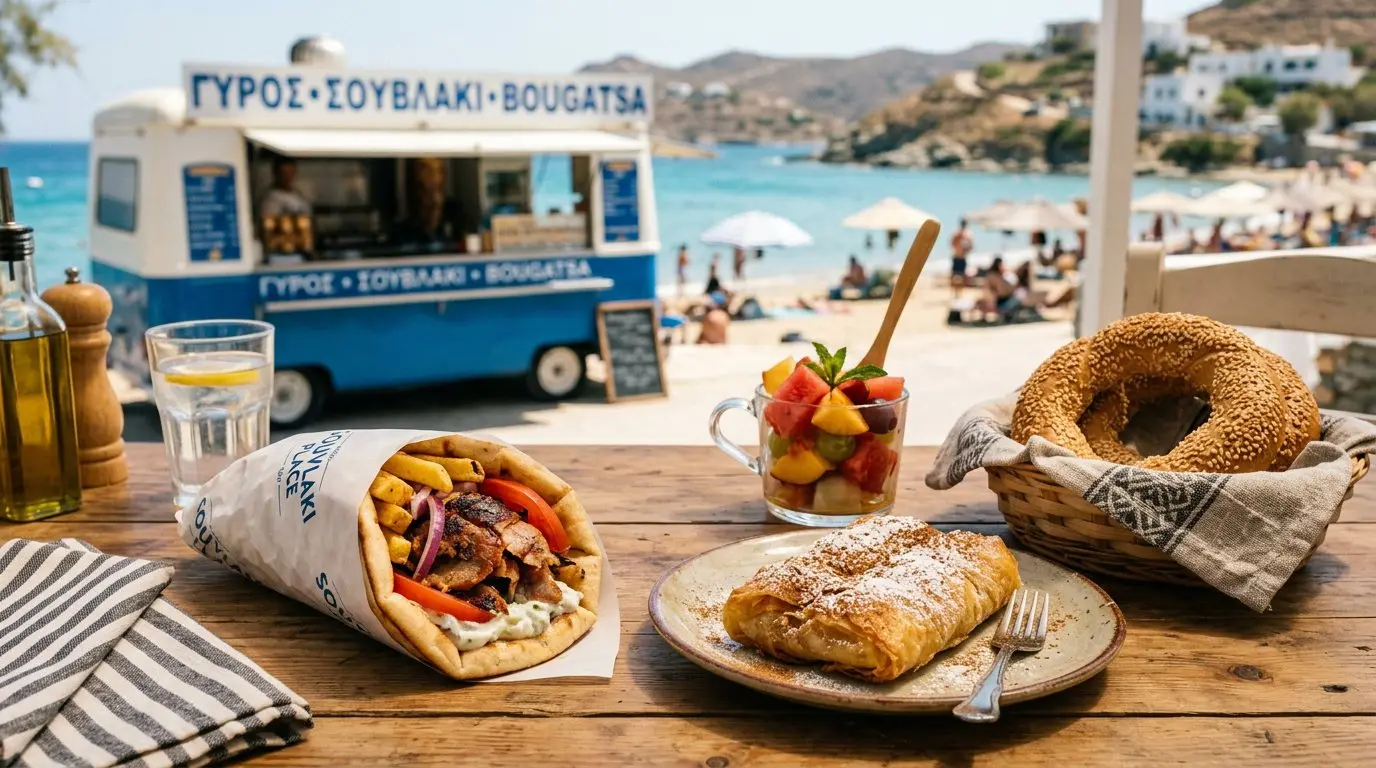
• Bougatsa — a Northern Greek specialty now found everywhere. Warm phyllo filled with semolina cream (the most common), dusted with powdered sugar and cinnamon. Also available with minced meat or cheese.
• Koulouri — a simple sesame-covered bread ring. Sold from carts and bakeries across the country. The original Greek street food.
• Kourou — a buttery shortbread cookie (also called koulourakia or kourabiedes depending on the region).
• Fresh orange juice (portokalada) — freshly squeezed, served cold. Often ordered alongside a pie.
• Greek coffee — ellinikós kafés, strong and unfiltered, ordered glykós (sweet), métrios (medium), or skétos (no sugar).
The ritual: You walk in, point at your pie in the display case, the baker heats it briefly in the oven, wraps it in paper, and hands it over. You eat it standing outside, walking to work, or sitting at a small plastic table. It takes three minutes. It costs €2–3. This is the most common breakfast in Greece — and has been for generations.
Midday & Night: The Grill House — Souvlaki, Gyros & the Art of the Pitogyro
At the centre of Greek street food stands the psitopoleio (ψητοπωλείο) or souvlatzidiko (σουβλατζίδικο) — the Greek grill house. These shops are the backbone of quick eating in Greece, serving from late morning until well past midnight.
The Main Players:
• Gyros (γύρος) — vertically stacked seasoned meat (pork or chicken), roasted on a rotating spit, shaved off in thin slices. Served in a warm pita with tomato, onion, tzatziki, and fries. The most iconic Greek street food internationally.
• Souvlaki (σουβλάκι) — cubes of meat (pork, chicken, or lamb) skewered and grilled over charcoal. Served on a plate with sides or wrapped in pita.
• Kalamaki (καλαμάκι) — what Athenians call souvlaki on a skewer. Served by the stick, often alongside other grilled meats.
• Kontosouvli (κοντοσούβλι) — large pieces of pork or lamb slow-roasted on a horizontal spit. Incredibly tender and flavourful. Less known abroad but beloved locally.
• Bifteki (μπιφτέκι) — grilled minced meat patties, spiced with herbs and onion. Served in pita or on a plate.
• Sheftalia (σεφταλιά) — Cypriot-style grilled minced meat wrapped in caul fat. Increasingly popular in Greek grill houses.
The Anatomy of a Perfect Pitogyro:
A proper gyros or souvlaki wrap (known as pitogyro — πιτόγυρο) is assembled in a specific order:
1. The pita is warmed on the grill (never microwaved)
2. Spread with tzatziki (yogurt, cucumber, garlic, dill)
3. Layered with shaved gyros meat or grilled souvlaki
4. Topped with sliced tomato, red onion, and crispy fries
5. Wrapped tightly in greaseproof paper — one end twisted closed
How to order:
• "Ένα γύρο με όλα" — one gyros with everything (all toppings)
• "Χωρίς κρεμμύδι" — without onion
• Prices: pitogyro (wrap) €4–5, souvlaki kalamaki (on a stick) €2.50–3.50
Tips: The best grill houses have queues of locals. If there is a picture menu in five languages and nobody inside, keep walking.
All Day: Canteens, Beach Eating & Sweet Street Food
Beyond bakeries and grill houses, Greek street food operates through a network of seasonal canteens, beachside vendors, and sweet shops that cover every hour of the day.
Canteens — The Greek Cantina (Καντίνα):
Kantines are mobile or semi-permanent food stalls found at beaches, squares, parks, and outside nightclubs. They are a defining feature of Greek summer life.
What canteens serve:
• Souvlaki and gyros — many canteens grill on the spot over small charcoal grills
• Bifteki and sausages — grilled, served in bread rolls
• Hot dog — ψωμί με λουκάνικο, κέτσαπ και μουστάρδα
• Sandwiches (τοστ) — toast sandwiches with cheese and ham, pressed hot
• French fries (τηγανητές πατάτες) — hand-cut, fried in olive oil or seed oil
• Soft drinks, beers, and coffee — always available
Canteens are most active from May to October. In popular beach areas, they stay open until the early morning hours.
Beach Corn & Chestnuts:
• Grilled corn on the cob (καλαμπόκι) — boiled or charcoal-grilled, brushed with salt and butter. Sold by beach vendors year-round.
• Roasted chestnuts (κάστανα) — a winter street food staple, sold in foil bags on street corners, especially in Athens and Thessaloniki.
• Roasted nuts & seeds — such as φυστίκια (peanuts) or πασατέμπος (roasted salted pumpkin seeds), sold from small carts.
Sweet Street Food:
• Loukoumades (λουκουμάδες) — deep-fried dough balls soaked in honey syrup and dusted with cinnamon and walnuts. The oldest recorded Greek dessert (mentioned by Aristotle). Found in dedicated loukoumadika year-round.
• Pasteli (παστέλι) — sesame seed and honey bars. The original Greek energy bar, sold everywhere.
• Kataifi (κανταΐφι) & Baklava (μπακλαβάς) — syrup-soaked pastries, available in most bakeries and sweet shops.
• Souvlakia glacé — chocolate-covered frozen banana on a stick, a retro Greek beach staple.
• Ice cream (παγωτό) — Greek ice cream (kaimaki) is dense, stretchy, and flavoured with mastic resin. Available everywhere in summer.
The Periptero, Kafeneio & Coffee On the Move
No guide to Greek street food is complete without covering the periptero (περίπτερο) — the small street kiosk that is one of Greece's most essential institutions. And alongside it, the kafeneio (καφενείο) and modern coffee shops that have made coffee-to-go a national habit.
The Periptero (Περίπτερο):
Periptera are small, family-run kiosks on nearly every street corner in every Greek city and town. They sell everything from newspapers and cigarettes to snacks, drinks, and packaged goods.
What to buy at the periptero:
• Bottled water, soft drinks, and beers — always cold.
• Packaged snacks — pasteli, sesame bars, chips, nuts.
• Koulouri, baked goods — some periptera stock packaged pastries.
• Chewing gum, tissues, phone chargers — the periptero covers everything.
Note: Periptera do not sell fresh coffee. For coffee on the go, visit a coffee shop or kafeneio instead.
The Kafeneio & Coffee Shops:
The traditional kafeneio (καφενείο) has served Greek coffee for centuries — slow, social, often accompanied by a small glass of water. But in modern Greece, coffee culture has evolved dramatically:
• Kafeneia now commonly serve takeaway coffee alongside their traditional sit-down service. Order a "Freddo to go" (Freddo για έξω) and they will hand it to you in a paper cup.
• Modern coffee shops (καφετέριες) across Greece primarily operate as takeaway outlets. They serve Freddo Cappuccino, Freddo Espresso, Freddoccino, and iced lattes — all year round, even in winter.
• This is the most widespread daily habit in Greece: Greeks drink more coffee per capita than almost any other country, and a very large portion of it is consumed on the move.
Coffee culture tips:
• Freddo Espresso is the most popular — two shots of espresso shaken cold with ice
• Freddo Cappuccino is Freddo Espresso with cold milk foam — equally popular
• Freddoccino is a frothy iced coffee with milk — slightly sweeter
• "Skétos" — no sugar; "Métrios" — one spoon of sugar; "Glykós" — two spoons
• A Freddo almost never costs more than €3–4
A Perfect Day of Greek Street Food (Timeline)
08:00 — The Bakery Run
Start at the local fournos. Order a tiropita and a koulouri, both warm from the oven. Add a portokalada (fresh orange juice) or a Greek coffee.
10:00 — Mid-Morning Coffee
Your first Freddo Espresso of the day — from a periptero or coffee shop. Stand at the counter or walk. This is the most Greek moment of the day.
13:00 — Quick Lunch
A gyros or souvlaki from the nearest good grill house. Eat standing. Do not sit. The paper wrapper is part of the experience.
16:00 — Afternoon Sweet Break
Loukoumades at a loukoumadiko, or ice cream (kaimaki) by the seaside. Or both. Both is better.
18:00 — Beach Canteen Stop (Summer)
Grilled corn on the cob with salt and butter. A cold beer. Maybe a cheese pie if the canteen has them.
20:00 — Evening Rooftop or Square
A Freddo Cappuccino at a cafe in a central square. Watch the volta (evening stroll) pass by.
23:00 — Late-Night Gyros
The most important meal. After a night out, before heading home — a pitogyro with everything, wrapped in paper, eaten standing on the street. This is how Greek nights end.
Regional Street Food Highlights
Greek street food changes as you move through the country. Here are the regional specialties worth seeking out:
Athens & Piraeus:
• Biftekaki — grilled minced meat patty, served on a plate with fries
• Kalamaki — skewered souvlaki, the Athenian name and style
• Tzitziki-fried mussels — a Piraeus harbour specialty
Thessaloniki & Northern Greece:
• Bougatsa — the city's signature cream-filled pastry, also available with cheese or mince
• Trigona Panoramatos — cone-shaped cream-filled pastries from the Panorama district
• Koulouri Thessalonikis — larger, softer than the southern version
• Soutzoukakia — spiced meatballs in cumin-tomato sauce (eaten as a quick meze)
Crete:
• Boureki (μπουρέκι) — zucchini and potato pie with cheese, eaten on the go
• Kalitsounia — small cheese or herb pies, sold in bakeries across the island
• Dakos — barley rusk with tomato, mizithra cheese and olive oil (street stall version)
Cyclades (especially Santorini, Naxos, Mykonos):
• Tomatokeftedes — tomato fritters from Santorini, served as a quick street snack
• Patatato keftedes — potato-based fritters from Naxos
• Loukoumades Cycladitiko — island-style honey doughnuts with local cheese
Peloponnese:
• Diples — thin fried dough sheets soaked in honey, sold at bakeries
• Karydato — walnut cake, sold by the slice
• Lalagia — fried batter pieces, often sold at festivals and markets
Ionian Islands (Corfu, Kefalonia, Zakynthos):
• Pastitsada — Corfu's slow-braised rooster with pasta in tomato-spice sauce
• Mandolato — nougat bars sold in street-side confectioneries
• Kumquat liqueur from Corfu — served in tiny plastic cups at harbour stalls
Frequently Asked Questions About Greek Street Food
What is the most popular Greek street food?
Pitogyro (gyros wrap) and souvlaki are the most popular. Tiropita is the most frequently eaten daily item.
Is Greek street food healthy?
Much of it is fresher and higher quality than typical fast food. Greek pies use real cheese and olive oil, grilled meats are cooked over charcoal, and ingredients are generally local. That said, it is still street food — balance is everything.
How much does Greek street food cost?
A tiropita costs €2–3. A gyros or souvlaki wrap costs €2.50–4.50. A Freddo coffee costs €2.50–4. Loukoumades cost about €4–7 per serving.
Where can I find the best souvlaki in Greece?
This is the most debated question in Greek food. Every city and island has its champions. General rule: look for a grill house with a charcoal fire visible from the street, a queue of locals, and no English menu.
What is the difference between gyros and souvlaki?
Gyros is stacked meat roasted on a vertical spit and shaved off. Souvlaki is cubed meat on a skewer, grilled over charcoal. Both can be served in pita or on a plate.
Is Greek street food available all year round?
Yes, most street food categories operate year-round. Canteens are seasonal (summer), but bakeries, grill houses, periptera and coffee shops are open every single day.
Can vegetarians eat Greek street food?
Easily. Tiropita, spanakopita, bougatsa, koulouri, grilled corn, loukoumades, pasteli, and Greek salads are all vegetarian. Many grill houses also serve vegetarian souvlaki options (halloumi or grilled vegetables).
What is the best street food for breakfast?
Tiropita and koulouri from a bakery, paired with Greek coffee or fresh orange juice.
What drink should I order with my street food?
With savory pies: Greek coffee or fresh orange juice. With souvlaki: a cold beer or a soft drink (try Greek lemonade or gazoza). With sweets: water or coffee. For any time of day: a Freddo Cappuccino.
💡
Greek street food is more than just souvlaki and gyros — it's a way of life built around freshly baked pies, charcoal-grilled meats, seaside canteens, sweet fried dough, and coffee on the move. This guide shows you where and what locals really eat every day.
What stands out
Highlights
- ✨ Souvlaki & Gyros
- ✨ Tiropita & Spanakopita
- ✨ Bougatsa
- ✨ Koulouri
- ✨ Loukoumades
- ✨ Grilled Corn & Chestnuts
- ✨ Freddo Cappuccino
- ✨ Periptero Coffee