
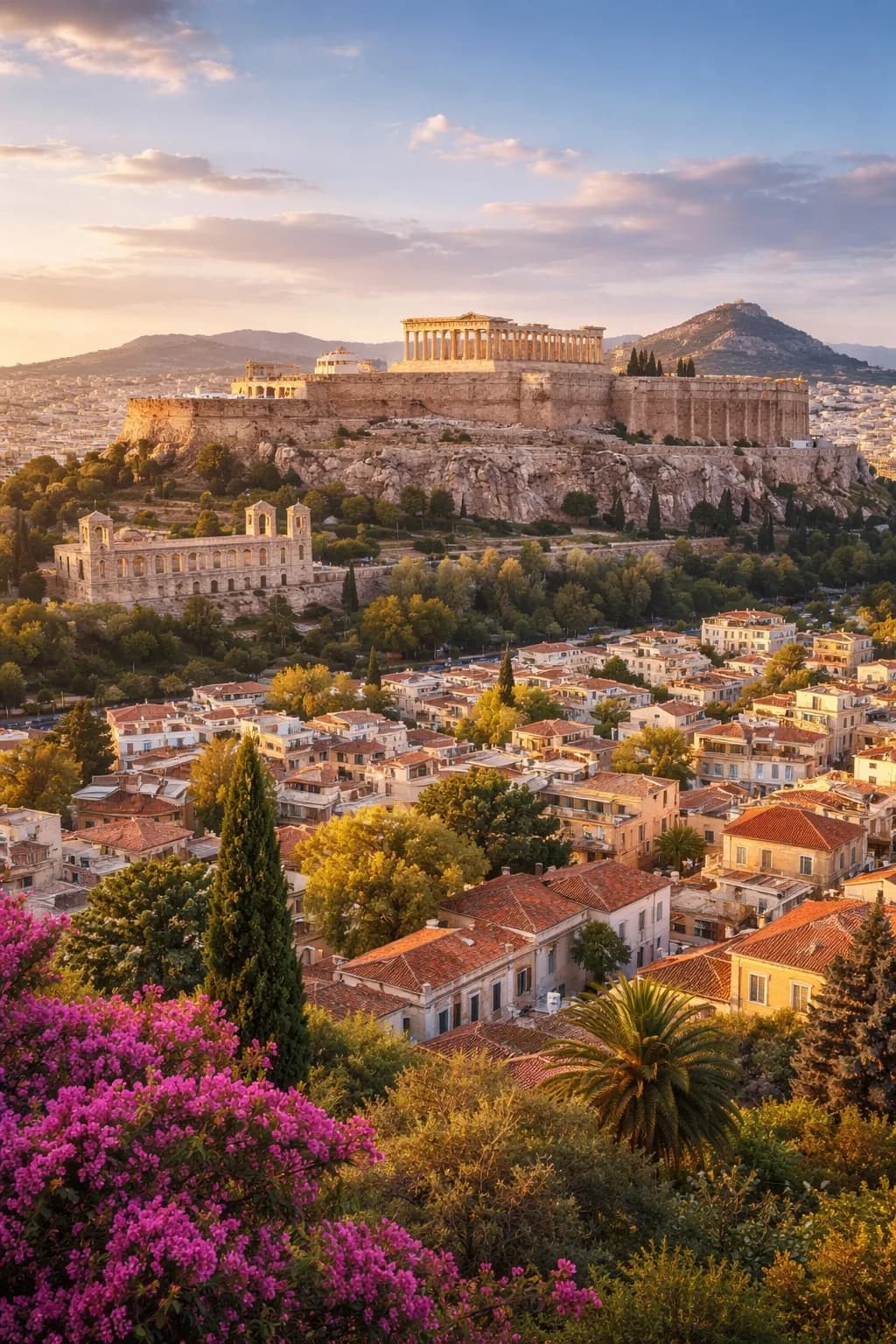
Where to Stay in Athens
Athens — Attica
Find the best neighborhoods to stay in Athens — from historic Plaka and local Koukaki to lively Monastiraki, upscale Kolonaki and the creative energy of Psyrri. A complete guide to Athens hotels and areas.
Relaxing stays, beautiful views and authentic hospitality — organized in a clear and practical way.
Description
Athens is a city that rewards those who choose their base carefully. It is compact enough to explore almost entirely on foot from the right neighborhood, yet varied enough that the wrong base can make the city feel crowded, noisy or impersonal. The good news is that the best neighborhoods for staying are clustered tightly around the Acropolis — most are within a ten to twenty minute walk of each other — so the choice is less about distance and more about atmosphere, noise levels, price and the kind of daily experience you want to wake up to. Athens also works well as an arrival or departure point before or after the Greek islands, and choosing a well-connected central base makes the logistics of ferry connections and airport transfers significantly easier.
1. Plaka: The most historic neighborhood and the classic first-visit base
Plaka is the oldest continuously inhabited neighborhood in Athens, built directly over the streets of the ancient city at the base of the Acropolis. Its cobblestone lanes, neoclassical houses, flowering courtyards and traditional tavernas create the most immediately recognizable version of Athens — the one that appears on every postcard and in every travel guide. Staying here puts you within a five-minute walk of the Acropolis entrance, the Ancient Agora and the Roman Agora, and within easy reach of Syntagma and Monastiraki. Hotels range from simple budget rooms on the quieter side streets to mid-range boutique properties with rooftop terraces and Acropolis views. The main drawback of Plaka is that it caters heavily to tourists — restaurants on the main streets are often overpriced and aimed at passing visitors rather than locals. The best approach is to use Plaka as a base for its extraordinary location and explore the surrounding neighborhoods for food and evening atmosphere. It is the right choice for first-time visitors and those who want the classic Athens experience within walking distance of everything.
2. Koukaki: The most consistently recommended neighborhood for a balanced stay
Koukaki sits immediately south of the Acropolis and is the neighborhood that experienced travelers return to most consistently. It has a residential, lived-in character — tree-lined streets, neighbourhood bakeries, family-run tavernas and a strong local café culture — while remaining within a ten-minute walk of the Acropolis Museum and fifteen minutes from the Acropolis itself. The pace here is calmer than Plaka or Monastiraki, the restaurants serve food aimed at local tastes rather than tourist budgets, and the streets are noticeably quieter at night. Boutique hotels and well-designed apartment-style accommodation are the dominant options, and prices tend to be more competitive than in the immediate tourist centre. Koukaki suits couples, independent travelers and anyone visiting Athens for the second time who wants a more authentic daily experience alongside easy access to the main sights. The pedestrian street of Dionysiou Areopagitou, which connects Koukaki to the Acropolis via a broad, tree-shaded promenade, is one of the most pleasant urban walks in the city.
3. Monastiraki and Psyrri: Energy, nightlife and the creative heart of the city
Monastiraki is the most centrally located and consistently lively neighborhood in Athens. Its famous flea market, rooftop bars with uninterrupted Acropolis views, excellent souvlaki joints and direct metro connections to Piraeus and the airport make it one of the most convenient bases in the city. The character here is loud, layered and specifically Athenian — ancient ruins sit alongside street food stalls, Byzantine churches share walls with vintage clothing shops, and the square itself hums with activity from early morning until well past midnight. Light sleepers should choose rooms away from the main square or look for soundproofed accommodation, as Monastiraki does not quiet down until the early hours in summer. Immediately adjacent, Psyrri has evolved from a working-class district into one of the city's most creative neighborhoods — street art-covered buildings, live music venues, cocktail bars and some of Athens's most interesting restaurants occupy the same industrial-era streets. Together, Monastiraki and Psyrri form the best base for travelers who want Athens at its most alive and are happy to trade quiet evenings for extraordinary atmosphere and convenience.
4. Syntagma: Maximum connectivity and the city's landmark luxury hotels
Syntagma Square is the civic and political heart of Athens — home to the Greek Parliament, the Changing of the Guard ceremony at the Tomb of the Unknown Soldier, and the city's most direct transport connections. The metro station here provides direct rail links to Athens International Airport and connects to the full metro network in every direction. Hotels around Syntagma include some of the most prestigious addresses in the city, from the historic Grande Bretagne to a cluster of well-established four and five-star properties with Acropolis views and rooftop pools. The neighborhood itself is busier and less atmospheric than Plaka or Koukaki, but its practical advantages are unmatched — particularly for short stays, business travelers and anyone who needs reliable, early-morning airport connections or same-day ferry departures from Piraeus. The National Garden is a short walk away and provides a welcome patch of green in an otherwise dense urban environment.
5. Kolonaki: Upscale, quiet and the best base for culture and refined city life
Kolonaki sits on the lower slopes of Mount Lycabettus and is Athens's most polished and residential neighborhood. Designer boutiques, high-end wine bars, the Museum of Cycladic Art, the Benaki Museum and the Byzantine and Christian Museum are all within easy walking distance. The streets are quieter than anywhere else near the centre, the accommodation tends toward elegant boutique hotels and serviced apartments, and the overall atmosphere is more European than specifically Greek in character. Kolonaki is not the closest base to the Acropolis — a twenty-minute walk — but it compensates with a genuinely comfortable, sophisticated daily environment and a restaurant and café scene aimed entirely at discerning local tastes. It is the right choice for travelers who want upscale comfort, cultural depth and a respite from the intensity of the more central neighborhoods, without sacrificing central location entirely.
6. The Athens Riviera: Beach, luxury and a different pace entirely
South of central Athens, the Athenian Riviera — stretching from Glyfada through Voula to Vouliagmeni — offers a completely different kind of stay. This is the coastal face of Athens: beach clubs, marina-front restaurants, luxury resort hotels including the Four Seasons and One&Only, and some of the clearest water accessible from a European capital. It suits travelers who want the combination of easy access to the city's ancient sites during the day and a seaside resort experience in the evenings and mornings. The tram connects the Riviera to the city centre, though journey times are long. Vouliagmeni in particular — with its famous thermal lake, pine-shaded beaches and cluster of high-end hotels — is one of the most complete luxury escapes within thirty minutes of an international airport anywhere in the Mediterranean.
Frequently Asked Questions
Which neighborhood is best for a first visit to Athens?+
Plaka and Koukaki are the two strongest options for first-time visitors. Plaka gives you the most direct access to the ancient sites and the classic Athens atmosphere. Koukaki offers a calmer, more local experience at a slightly lower price point. If convenience is your top priority, Syntagma is the most transport-connected base.
How many nights should I spend in Athens?+
Three nights is the comfortable minimum — one full day for the Acropolis, Ancient Agora and Acropolis Museum, one day for a different part of the city, and one day to slow down. Two nights is possible but leaves most visitors wanting more time.
Is Athens noisy at night?+
It depends significantly on where you stay. Monastiraki, Psyrri and streets near rooftop bars can be loud until 3–4am in summer. Koukaki, Kolonaki and the quieter side streets of Plaka are significantly calmer.
How do I get from Athens Airport to the main neighborhoods?+
The metro is the simplest option — the blue line (Line 3) runs directly from Athens International Airport to Syntagma Square in approximately 40 minutes. Trains run frequently from early morning until midnight. Taxis and pre-arranged transfers are also available.
Can I visit the Acropolis from any central neighborhood on foot?+
Yes — from Plaka, Koukaki, Monastiraki and Thiseio, the Acropolis entrance is between a 5 and 20-minute walk. From Syntagma it is around 20–25 minutes on foot.
Is Athens a good base before or after the Greek islands?+
Yes, and it is often the most logical one. Piraeus ferry port is directly connected to central Athens by metro in around 20 minutes. Staying one or two nights in Athens at the start and end of a Greece trip is a practical and genuinely rewarding way to structure an itinerary.