
Where to Stay in Chania
Chania — Western Crete
Find the best neighborhoods to stay in Chania — from the iconic Venetian harbour and the bohemian Splantzia quarter to the diplomatic Halepa, the local Nea Chora seafront and the wild Akrotiri peninsula. The most complete guide to Chania hotels, hidden beaches and areas for every type of traveler.
Relaxing stays, beautiful views and authentic hospitality — organized in a clear and practical way.
Description
Relaxing stays, beautiful views and authentic hospitality — organized in a clear and practical way.
1. The Venetian Harbour and Kastelli: The most iconic and atmospheric base in Chania
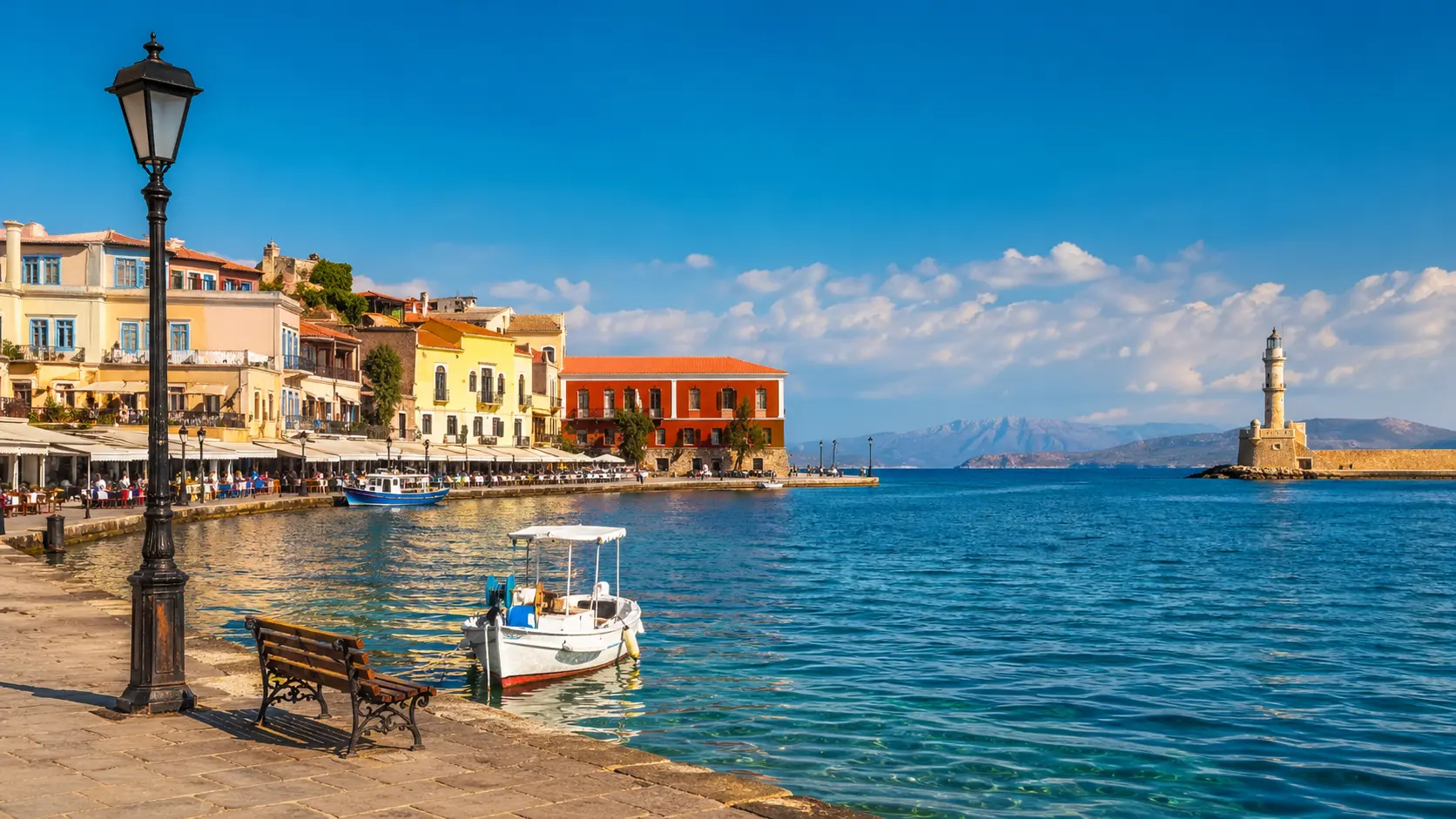
The Venetian harbour quarter — the area immediately surrounding the inner harbour, the lighthouse, the Firkas Fortress and the densely layered lanes of Kastelli above — is the first choice for almost every traveler visiting Chania for the first time. The harbour itself is one of the most beautiful in the Mediterranean: a crescent of honey-coloured stone buildings reflected in still water, with the famous Egyptian Lighthouse at the mouth and the domed silhouette of the Kiutsuk Hasan Mosque framing the view from the eastern quay. At dawn, before the tourists arrive, it is one of the finest views in all of Greece. Kastelli is the elevated neighbourhood above the harbour — the original settlement of ancient Kydonia, later the Venetian aristocratic quarter, and today a dense tangle of lanes and restored mansions with boutique hotels. Casa Delfino, a 17th-century Venetian mansion, is among the finest addresses. Porto Antico Hotel sits directly on the harbour. The main practical consideration is noise — waterfront restaurants stay lively until midnight. Choose accommodation one or two lanes back from the waterfront for peace.
2. Splantzia: The most bohemian and genuinely local quarter of the Old Town
If the harbour area is the face that Chania shows to the world, Splantzia is its soul. This neighbourhood, built around the leafy square of Plateia 1821, was the heart of the Ottoman city and retains a layered, multi-faith character. Its centrepiece is the Church of Agios Nikolaos — originally a Dominican monastery church built by the Venetians in the 14th century, converted to a mosque in 1645, and finally returned to the Orthodox church after 1918. The result carries both a minaret and a bell tower — a feat shared by almost no other building in the world. Beyond the church, the Street of Knives — Skridlof Street — has operated in largely the same form since the Ottoman period. The old Jewish Quarter around the Etz Hayyim Synagogue — one of the very few surviving Romaniote synagogues in Greece — lies at the western boundary. Hotels here are smaller and more personal than in the harbour area. Splantzia is the consistent recommendation for repeat visitors who want to go deeper than the harbour promenade allows.
3. Koum Kapi: The quietest and most local corner of the Old Town
Koum Kapi occupies the southeastern edge of the Old Town, between the old Venetian sea walls and the open sea, and is the most genuinely residential part of the historic centre. Its name — from the Turkish kumkapi, meaning sand gate — refers to the remains of the Sabbionara Rampart, a Venetian-era sea gate that still stands. The neighbourhood has a café-lined seafront path along the base of the old walls — one of the most pleasant morning walks in Chania. Koum Kapi Beach is a small, informal stretch of golden sand used almost entirely by locals. The streets are quieter and more residential than Splantzia or the harbour area — better taverna value, fewer souvenir shops. For travelers who want Old Town character without the noise, Koum Kapi is the most underrated base in the city.
4. Halepa: Chania's most elegant neighborhood and the cradle of modern Greek history
Halepa lies about fifteen minutes on foot east of the Old Town, and its character is entirely distinct from anything inside the Venetian walls. This was the diplomatic quarter during the 19th and early 20th centuries, when the European powers maintained consulates here. The result is a neighbourhood of neoclassical mansions, tree-lined streets and unhurried bourgeois calm. Eleftherios Venizelos — the most important Greek statesman of the 20th century — was born in Halepa. The Venizelos Graves at the top of the hill offer what many consider the finest panoramic view in all of Chania: the Old Town, the harbour, the Akrotiri peninsula and the White Mountains. Hotels here are typically larger boutique properties in converted neoclassical buildings — quieter and more spacious than Old Town options. Halepa suits travelers who want elegance without the harbour noise.
5. Nea Chora: The most family-friendly seafront neighborhood
Nea Chora sits immediately west of the Old Town and has the atmosphere of a proper Greek seaside neighbourhood. It has its own small marina, a good stretch of sandy beach with calm water — the closest organized beach to the Old Town, ten minutes' walk — and a beachfront promenade lined with seafood tavernas. Parking is much easier here, the streets are wide and flat — ideal for families with pushchairs. The Sunday morning fish market at the harbour is one of the most authentically Cretan experiences in the city. Hotels range from family studios to mid-range hotels. Prices are generally lower than in the Old Town.
6. The Akrotiri Peninsula: The hidden world across the bay
The Akrotiri peninsula curves around the northeastern side of Chania Bay. Most visitors look at it without ever crossing to it — a significant mistake. Gouverneto Monastery (1537) guards the entrance to the Avlaki Gorge and the path to the Cave of Arkoudospilia and the ruined Katholiko Monastery — the oldest monastery on Crete, built into a cliff face in the 11th century. The walk through the gorge is one of the most remarkable short hikes in Crete. Agia Triada Monastery (1612) has a Venetian-style facade and produces award-winning olive oil. Stavros Beach — the lagoon where Anthony Quinn danced the Sirtaki in Zorba the Greek — is a perfectly sheltered bay. Seitan Limania — also known as Stefanou Beach — is the most dramatic and photographed beach in the Chania region: three narrow coves with sheer white marble cliffs and turquoise water. Arrive before 9am in summer. Staying on the peninsula suits travelers who want quiet, nature and the monastery circuit.
7. Day Trips from Chania: The Best of Western Crete
Chania is the finest base for exploring western Crete. Balos Lagoon (55 km, 1h15min) — a sweeping double lagoon of white sand and turquoise shallows, one of the finest beaches in Europe. Elafonisi (75 km, 1h30min) — the pink-sand lagoon, beloved for its Caribbean quality. Falasarna (59 km, 1h) — golden sand on the exposed west coast with the ruins of ancient Phalassarna, one of the finest sunset beaches in Greece. Samaria Gorge (45 km to Omalos) — Europe's longest walkable gorge, 16 km from Xyloskalo to Agia Roumeli, one of the most rewarding day hikes in Greece. Aptera Ancient City (15 km, 20min) — the most undervisited archaeological site in western Crete, with a Roman theatre and sweeping views over Souda Bay. Therisso Gorge (15 km, 25min) — a short accessible walking route and traditional tavernas in the mountain village.
Frequently Asked Questions
Which neighborhood is best for a first visit to Chania?+
The Venetian harbour area and Kastelli give you the most extraordinary experience — the harbour at sunrise, the medieval lanes, the historic density. Splantzia is the best alternative for a more local daily rhythm. For families who want a beach on their doorstep, Nea Chora solves the logistics most effectively.
Do I need a car in Chania?+
For the Old Town and immediate city, no — everything is walkable. For day trips to Balos, Elafonisi, Samaria, Falasarna, the Akrotiri beaches and Aptera, a car is strongly recommended. Renting for two or three days is the most efficient approach.
How many days do I need in Chania?+
A minimum of three nights allows one day in the Old Town, one day for the Akrotiri peninsula, and one day trip to Balos or Elafonisi. Four nights is more comfortable and allows the Samaria Gorge. Five nights transforms Chania into a proper base for western Crete.
Is the Venetian harbour area noisy at night?+
Yes, particularly on the inner harbour waterfront. Rooms directly facing the promenade can be noisy until late. Choose accommodation one or two lanes back from the waterfront for peace.
When is the best time to visit Chania?+
May through June and September through October are optimal. The sea is warm from mid-May, the city is lively without peak intensity. July and August bring full capacity — book months in advance. Winter is also rewarding with lower prices and the harbour without crowds.
What are the most undervisited things to do near Chania?+
The Gouverneto Monastery and Katholiko gorge walk on the Akrotiri; the ancient ruins of Aptera above Souda Bay; the Venetian quarry marks at Stavros beach; the Etz Hayyim Synagogue in Splantzia; the Sunday fish market at Nea Chora harbour; and the path along the outer base of the Venetian sea walls at Koum Kapi at sunrise.