
Where to Stay in Delphi & Central Greece
Delphi — Phocis, Central Greece
Find the best places to stay near Delphi — from the village itself with its UNESCO ruins and Gulf of Corinth views to chic mountain Arachova, the neoclassical harbour of Galaxidi, the Venetian gem of Nafpaktos, the mountain wilderness of Orini Nafpaktia and the Rio-Antirrion Bridge gateway to Patras. The most complete guide to staying in Delphi and central Greece.
Relaxing stays, beautiful views and authentic hospitality — organized in a clear and practical way.
Description
Relaxing stays, beautiful views and authentic hospitality — organized in a clear and practical way.
1. Delphi Village: The most atmospheric base — and the key to seeing the site at its best
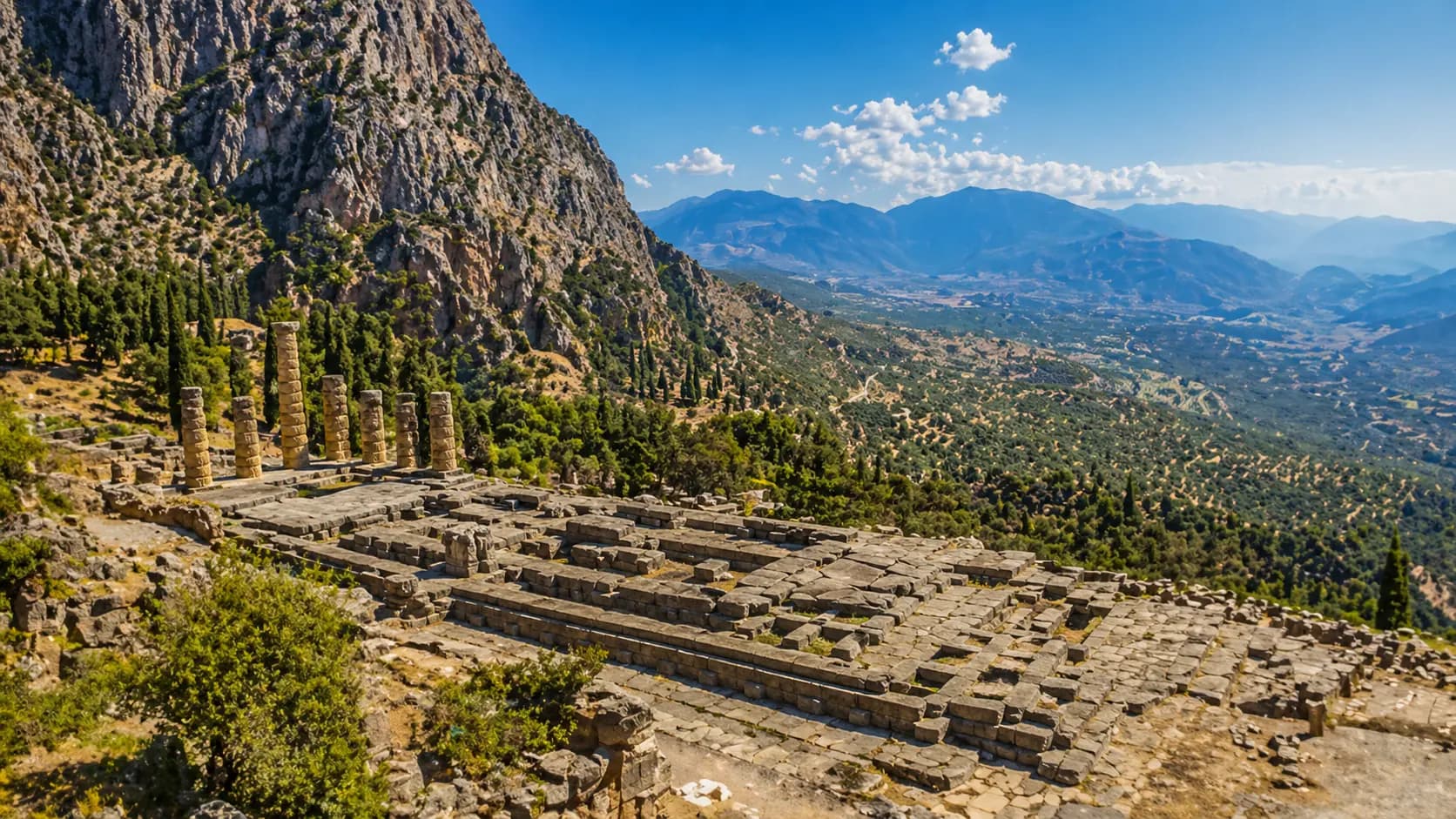
Modern Delphi village is a small settlement built immediately adjacent to the archaeological zone on the same mountainside. Its single main street is lined with hotels, restaurants and souvenir shops, but its advantage is unique: it is within ten minutes' walk of the site entrance and the museum, and it looks directly south over the Gulf of Corinth. The view from south-facing hotel balconies — the entire valley of Phocis filled with olive trees stretching to the sea — is one of the finest in Greece. The crucial advantage of staying overnight is early morning access: day-trip buses from Athens arrive from 10am, and the Sacred Way becomes crowded by midday. Visitors staying in the village can walk to the site from 8am and have the ruins almost entirely to themselves for two hours. Kastalia Boutique Hotel is the most consistently praised boutique property. Amalia Hotel Delphi is the largest with panoramic Gulf views. Hidden gem: the Museum of Angelos and Eva Sikelianos at the western end of the main street, telling the story of the revival of the Delphic Games.
2. The Archaeological Site: What to see and how to experience it
The UNESCO-listed site requires at minimum three hours — four including the museum. The Sacred Way winds upward between foundations of votive offerings. The Athenian Treasury is the best-preserved building. The Temple of Apollo is the spiritual heart, where the Pythia gave her prophecies. The Theatre seats 5,000 with a view over the valley. The Stadium at the top is one of the best-preserved ancient stadia in Greece. The Tholos at the Sanctuary of Athena Pronaia — below the main site — is the most reproduced image of Delphi. The Castalian Spring still flows from the cliff face. The Archaeological Museum is outstanding — its masterpiece is the Bronze Charioteer.
3. Arachova: The most cosmopolitan mountain village in Greece
Ten minutes east of Delphi at 970 metres on Parnassus, Arachova is the ski resort capital of Greece in winter and a cooler, quieter mountain retreat in summer. Its main street is lined with shops selling local products — Arachova wine, formaella cheese, honey, trahanas. The clock tower of Agios Georgios is the landmark. The village has a lively evening scene with excellent tavernas and cocktail bars. Anemolia Mountain Resort is the most complete luxury hotel. Mons Arachova Hotel is the most central mid-range option. The Parnassus Ski Centre above Arachova (25 km) has 24 pistes. Arachova suits travelers who want atmosphere and a lively evening scene alongside the archaeological experience.
4. The Corycian Cave: The first oracle — and one of Greece's most extraordinary hikes
High on Parnassus at 1,370 metres, the Corycian Cave is one of the most remarkable and least-visited significant sites in Greece. A vast limestone cavern over 100 metres long, sacred to Pan and the Nymphs from prehistoric times, it is considered the earliest oracle site in the Parnassus region. The cave is reached by car via the ski centre road, or by a magnificent 3.5-hour hiking trail from the Delphi archaeological site through the fir forest. Thousands of votive objects spanning three thousand years were found here, displayed in the Delphi museum. Standing inside the cave connects you to a spiritual tradition that predates the sanctuary of Apollo below.
5. Hosios Loukas Monastery: The most important Byzantine building in central Greece
Forty-five kilometres from Delphi, the Monastery of Hosios Loukas is one of only three Byzantine monuments in Greece on the UNESCO World Heritage List. Its Katholikon preserves original golden mosaics of the Pantokrator, the Resurrection and individual saints — among the finest surviving examples of middle Byzantine religious art. The crypt preserves frescoes of extraordinary delicacy. The Church of the Theotokos adjacent is slightly earlier. Most commonly visited as a stop between Athens and Delphi, it deserves more time than most visitors give it.
6. Galaxidi: The most beautiful harbour town in central Greece
Galaxidi, 40 km west of Delphi on the Gulf of Corinth, was one of the great maritime cities of 19th-century Greece. Its neoclassical mansions and sea captains' houses are among the finest in Greece. The Maritime Museum documents the town's remarkable shipping history. The harbour, divided between the old inner port and the new marina, is lined with tavernas and cafés. Ganimede Hotel in a restored 19th-century captain's house is the most consistently recommended accommodation. Galaxidi is also famous for the Flour War Carnival on Clean Monday.
7. Itea: The most convenient coastal base below Delphi
Itea is the port town at the foot of the olive-grove valley below Delphi — ten kilometres downhill, fifteen minutes by car. It is a working port town with a long waterfront promenade, fish tavernas, a beach and unpretentious daily Greek life. The sunset from Itea's waterfront is one of those understated pleasures that rewards travelers without expectations. Hotels are modest and affordable — the most economical base with reasonable access to the site.
8. Nafpaktos: The most extraordinary Venetian town in western Greece
Nafpaktos lies 60 km west of Delphi — one hour through the olive grove valley. Its perfectly circular Venetian harbour ringed by massive sea walls is one of the most photographed harbour scenes in Greece. The statue of Miguel de Cervantes commemorates the 1571 Battle of Lepanto, fought just offshore. The Castle of Nafpaktos is one of the best-preserved medieval fortifications in Greece, entirely walkable from harbour to summit. Hotels include waterfront properties and rooms in the old town. Nafpaktos is one of the most overlooked significant destinations in mainland Greece.
9. Orini Nafpaktia: The wild mountain world above the Gulf
Rising behind Nafpaktos into the southern Pindus, Orini Nafpaktia is one of the most extraordinary and least-known mountain landscapes in Greece — dense fir and beech forests, deep gorges, stone-built villages and a network of old stone-arched bridges built by 18th and 19th-century masons. The Evinos River flows through the heart of the region. The villages — Ano Chora, Kato Chora, Ampelakiotissa, Platanos — maintain traditional hospitality. The Grammeni Oxia area at 1,300 metres has the southernmost beech forest in Europe. The drive from Nafpaktos into these mountains is one of the finest short mountain drives in central Greece.
10. The Rio-Antirrion Bridge and Patras: The gateway to the western Peloponnese
Twelve kilometres east of Nafpaktos, the Rio-Antirrion Bridge crosses the narrowest point of the Gulf of Corinth. At 2,880 metres, it is one of the longest cable-stayed bridges in the world, opening in 2004 for the Athens Olympics. Driving across at dusk is a genuinely dramatic experience. Patras on the Peloponnese side is Greece's third-largest city and main western port — ferries to Italy, Corfu and Kefalonia. Its neoclassical upper town, Roman Odeon, Castle and the Patras Carnival (the largest in Greece) give it genuine cultural depth. The combination of Delphi and the western Peloponnese via the bridge is one of the great classical itineraries of mainland Greece.
Frequently Asked Questions
Should I stay in Delphi village or in Arachova?+
Delphi village is the right choice if the archaeological site is your primary purpose — early morning access before the day-trip buses is transformative. Arachova is better for atmosphere, evening scene and restaurant choice. They are ten minutes apart by car. If staying two nights, one in each is the most complete approach.
How long should I plan for Delphi?+
A minimum of one overnight stay, arriving the evening before and visiting the site first thing. Two nights allows the addition of Arachova, Galaxidi or Hosios Loukas. Three nights opens up Nafpaktos and the Corycian Cave. The day-trip version gives a fraction of what the place offers.
Is Delphi worth visiting in winter?+
Exceptionally so. The site has a quietness and atmospheric intensity that summer crowds eliminate. The light on the Phaidriades with snow on Parnassus is extraordinary. The site is open year-round. Arachova is at its most lively in ski season. Winter in Delphi is one of the best-kept secrets in Greek travel.
Can I visit Delphi from Athens as a day trip?+
Yes — the drive takes about 2h15min via the E65 highway. But arriving as a day-tripper means arriving with every other day-tripper. If a day trip is the only option, depart by 7am to arrive at opening time. An overnight stay transforms the trip entirely.
What is the best route from Delphi to the Peloponnese?+
West via Nafpaktos to the Rio-Antirrion Bridge — about 1h45min to the bridge crossing. This route passes Galaxidi and Nafpaktos and is one of the most scenically varied drives in central Greece.
Is the Parnassus Ski Centre worth visiting in summer?+
Yes, for the access it provides to the high mountain landscape and the Corycian Cave. The road from Arachova through the fir forest is remarkable, and the mountain plateau at the top is open, wild and full of wildflowers. The trail to the cave from the ski centre is significantly easier than the full ascent from Delphi.