
Where to Stay in Halkidiki
Halkidiki — Central Macedonia
Find the best places to stay in Halkidiki — from the cosmopolitan resorts of Sani and the lively beach atmosphere of Pefkochori on Kassandra, to the wild hidden beaches of Sithonia, the luxury retreats around Neos Marmaras and the mystical gateway of Ouranoupoli towards Mount Athos. A complete guide to Halkidiki hotels and areas.
Relaxing stays, beautiful views and authentic hospitality — organized in a clear and practical way.
Description
Relaxing stays, stunning beaches and authentic hospitality — organized in a clear and practical way.
1. Kassandra: The most organized peninsula — and much more
Kassandra is the first 'finger' of Halkidiki — the closest to Thessaloniki and the ancient land of Potidaea, the most touristically developed, and yet the easiest choice for a first visit. The road connection to Thessaloniki is direct — about an hour and a half — and the network of beaches, hotels and services covers the entire peninsula in depth developed over decades. On the northwestern side, Potidaea serves as the natural entry point: the archaeological site of the ancient city, founded by Corinthian colonists in the 7th century BC and extensively referenced by Thucydides, sits right next to the modern village. A few kilometres south, Pefkochori is one of the liveliest seaside towns in Halkidiki — the main beach bar runs from early morning, while clubs stay open until dawn. The main beach is sandy and wide, but the hidden gem here is the Glarokavos lagoon — a shallow cove with flat water, ideal for children and stand-up paddleboarding, just a few kilometres south. In the same area, Paliouri offers wide sandy beaches with minimal development — ideal for those who want peace within an organized peninsula. On the eastern side of Kassandra, Hanioti is perhaps the calmest and most family-friendly choice — three kilometres of Blue Flag beach with shallow waters that resemble a Caribbean lagoon. Just south, Kallithea offers a quieter character, while at the tip of the peninsula at Paliouri and Kavo Posidi lies one of the finest wild coasts in all of Halkidiki — still little-known, with white pebbles and pines touching the water. Kassandra suits families, young travelers who want activity and affordable hospitality, and anyone visiting Halkidiki for the first time.
2. Sithonia: The wilder peninsula — for those seeking the true gem
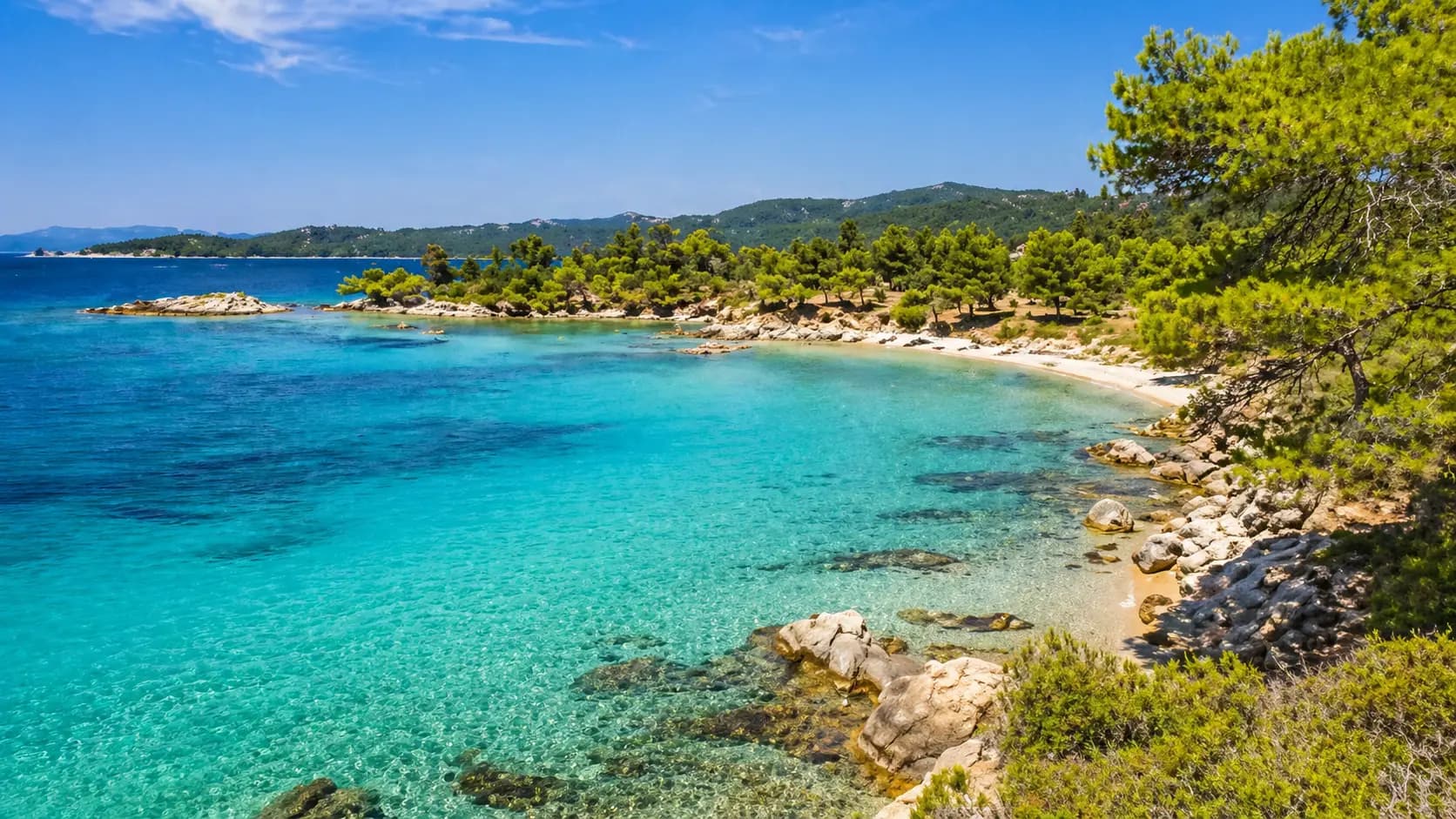
If Kassandra is the Halkidiki everyone knows, Sithonia is the one that travelers return to again and again once they discover it. The second 'finger' is more remote, more mountainous, greener — and the waters surrounding it have a deep, almost turquoise quality rarely found in mainland Greece. On the western side of Sithonia, Nikiti is a village of character that has preserved some of its old soul among the hotels. Nearby lie some of the top luxury resorts in Halkidiki, including the Danai Beach Resort & Villas — a member of The Leading Hotels of the World — with a private beach, pool villas and hospitality rivalling the great resorts of the islands. Further north at Vourvourou, a bay with multiple small islets — dormant volcanic remnants — creates a series of semi-secluded beaches with incredible blue waters. This is also home to the Ekies All Senses Resort, a member of Relais & Châteaux, with sustainability philosophy that has made it a reference for all of Europe. The hidden gem of western Sithonia is not at any resort, however — it is Armenistis Beach: a long wild coast with golden sand, shallow water and almost no human presence even in August. On the eastern side of Sithonia, Sarti is the largest seaside town — three kilometres of Blue Flag beach with shallow water and an easy daily life. From Sarti, within 8 to 15 kilometres through narrow forest roads, lie the true wonders: Kavourotrypes — a series of rocky caves opening into the sea with turquoise water that literally glows — Kriaritsi with its crystalline waters, Kalamitsi that resembles a small Fiskardo without the tourists. At the southern tip of the peninsula, Toroni offers one of the longest sandy beaches in Halkidiki — quiet, with wooden huts for shade instead of umbrellas, and the islet of Toroni with ancient acropolis ruins accessible by kayak. Sithonia suits couples, travelers seeking nature and authenticity, those who want luxury without mass tourism.
3. Sani: The most luxurious resort in Halkidiki — a world of its own
Sani is not just a location — it is a self-contained world on the northwestern tip of Kassandra. The Sani Resort is a complex of five different hotels (Sani Asterias, Sani Beach, Sani Club, Porto Sani, Sani Dunes) spread over hundreds of acres of pine forest and sandy beach, with a marina that welcomes private yachts, dozens of restaurants and bars, first-class wellness facilities, and the famous Sani Festival — an annual international music festival of classical, jazz and world music that transforms Sani every summer into one of the most refined cultural events in southeastern Europe. The Boúsoulas beach at Sani — a thin tongue of white sand between pine forest and sea — is one of the finest resort beaches in the entire Mediterranean. For those who want quiet outside the resort boundaries, Stavronikita beach a few kilometres north is undeveloped, sandy and almost always calm. Sani suits couples seeking exclusivity, families who want everything at their doorstep, and travelers for whom the hotel is not just the base — it is the destination itself.
4. Neos Marmaras & Porto Carras: The most romantic corner of Sithonia
Neos Marmaras is one of the finest villages in Sithonia — a fishing village that became a popular summer destination without losing its authentic character. The old harbour with fishing boats, the tavernas serving fresh fish by the water, and the strolls through the village with views over the bay make Neos Marmaras one of the most romantic destinations in Halkidiki. Adjacent to it lies Porto Carras — one of the largest and most complete resort complexes in the Mediterranean, with its own vineyard and winery producing the award-winning Domaine Porto Carras wine, an 80-boat marina, three enormous lagoon-style pools, the impressive Myrthia Thermal Spa spanning 3,000 sqm with an ancient thermal spring (Nero Kanistrou), and amphitheatrical architecture ensuring sea views from every point. It is one of the few resorts in Greece combining gastronomy, wine tourism, thalasso therapy and water sports in a single cohesive environment. From the port of Neos Marmaras, boats also depart for the circumnavigation of Mount Athos — an unmissable experience. Hidden gem: a few kilometres south lies Ormos Panagias — a small, quiet bay with pine forest reaching the shore, minimal hotels and waters that rival the Cyclades.
5. Ouranoupoli & The Road to Mount Athos: The gateway to another world
Ouranoupoli sits at the northwestern tip of the Mount Athos peninsula — the last town before the borders of the Holy Mountain, and one of the most atmospheric seaside towns in northern Greece. The Byzantine tower of Prosforion dominating the beach is one of the few intact medieval towers in Macedonia, built in the 14th century by Serbian monks. The beach of Ouranoupoli is sandy and very clean, with direct views across the bay to the mountains of Mount Athos rising on the horizon — a sight unchanged since the Middle Ages. Ouranoupoli is the only departure point for Mount Athos — the secret republic of 20 Byzantine monasteries living by the old calendar, which forbids entry to women but allows male pilgrims and travelers with a special passport (diamonitirion). Even for those without access to the interior, the boat tours circumnavigating Mount Athos by sea — passing close to monasteries clinging to rocky coasts — are among the most impressive experiences of the peninsula. Around Ouranoupoli, the beaches are far from tourist maps. Tripiti Beach — with a natural rock arch over the sea, a unique geological formation in the region — lies just a few kilometres south and is perhaps the greatest hidden gem in all of Halkidiki. Very few know of its existence. Ouranoupoli suits travelers who want to combine the sea with spiritual or cultural experiences.
6. Polygyros & Inland Halkidiki: The place the tourist offices forget
Few travelers know that Halkidiki also has a mountainous, completely unspoiled inland side. Polygyros, the capital of the region, is a lively Greek town with a good market, excellent cafes, a noteworthy archaeological collection at the local museum, and some of the finest local produce — honey, olive oil, dairy products. From here the best hiking trails into the Holomonda forest begin — the largest forest in Halkidiki, with oaks and chestnuts that change colour spectacularly in autumn. For travelers interested in archaeology, Olynthia — a few kilometres south of Polygyros — hosts the archaeological site of ancient Olynthos, one of the most important ancient cities of Halkidiki founded in the 5th century BC. The mosaic floors uncovered here are among the earliest known examples of pebble mosaic in the Mediterranean. Inland Halkidiki suits travelers who want to understand the place in depth.
Frequently Asked Questions
Kassandra or Sithonia? Which is the better choice?+
It depends entirely on what you are looking for. Kassandra is more organized, closer, more affordable and more suitable for families and first-time visits. Sithonia is wilder, with waters that rival the best Greek islands — but requires a car and more independence. Experienced Halkidiki visitors almost always return to Sithonia.
Do I need a car in Halkidiki?+
Yes, absolutely. Even if you are staying at an organized resort, the only way to explore the hidden beaches — Kavourotrypes, Armenistis, Tripiti, Kriaritsi — is by car. For Sithonia, an SUV or at least a high-clearance car is recommended, as some beaches have dirt road access.
When is the best time to visit Halkidiki?+
June and September are the ideal months. The sea is warm, the crowds are fewer, hotels are more affordable and the weather is excellent. August is the peak month for crowds and prices — Halkidiki receives millions of visitors every summer, mainly from Thessaloniki, the Balkans and Eastern Europe.
Can I visit Mount Athos?+
Male travelers can visit Mount Athos with a special permit (diamonitirion) issued by the Ministry of Foreign Affairs or from offices in Ouranoupoli. Advance booking is required. Women are not permitted to enter the territory of Mount Athos, but can take the boat tour around it from Ouranoupoli and Neos Marmaras.
What are the most beautiful hidden beaches in Halkidiki?+
Beyond the well-known ones, seek out: Kavourotrypes (Sithonia) — sea caves with turquoise light, Armenistis (north Sithonia) — unspoiled wild coast, Tripiti (near Ouranoupoli) — natural rock arch over the sea, Kavo Posidi (south Kassandra) — white pebbles and pines, and Ormos Panagias (south Sithonia) — a quiet bay with natural shade from pine forest.
Is Halkidiki suitable for a day trip from Thessaloniki?+
Yes for an introduction, no for a full experience. From Thessaloniki to Kassandra the distance is about 70 kilometres and the drive 1 to 1.5 hours. For Sithonia and Ouranoupoli you need at least two nights. Halkidiki rewards patience — its most beautiful moments are after 5 pm, when the day visitors have left.