
Where to Stay in Karpathos
Karpathos — Dodecanese
Find the best places to stay in Karpathos — from the convenience of the capital Pigadia and the family-friendly beaches of Amoopi to the western sunset villages of Arkasa and Finiki, the quiet seclusion of Lefkos and the living traditional culture of Olympos. A complete guide to Karpathos hotels and areas.
Relaxing stays, beautiful views and authentic hospitality — organized in a clear and practical way.
Description
Karpathos is a long island — nearly 50 kilometres from its southernmost point to the northern tip at Saria — and it behaves like several different islands compressed into one. The south is relatively developed, with Pigadia functioning as a proper small town with a working port, good restaurants, car rentals and two full-service 5-star resorts. The west coast villages of Amoopi, Arkasa and Lefkos each have distinct characters that suit different types of traveler. The north is accessible but genuinely remote: Olympos village, clinging to a ridge above the sea, has maintained a traditional Karpathian way of life — including a local dialect, traditional costume worn daily by older women, and customs that survived the 20th century intact — that has largely disappeared from the rest of the Greek islands.
The accommodation choice in Karpathos is more consequential than on smaller islands, because the areas are genuinely far apart and the road between them — particularly the drive north from Pigadia — requires time and a vehicle. Staying in Pigadia gives you the whole island as a day-trip possibility. Staying in Lefkos means two hours by road to reach Pigadia and its ferry connections. Staying in Olympos means living, briefly, inside a cultural document. The island rewards the traveler who chooses consciously rather than booking the nearest available hotel to the airport.
Karpathos is a genuinely wild island — the third largest in the Dodecanese, with a spine of mountains reaching over 1,200 metres that makes the interior road network demanding and the landscape dramatic. Its accommodation stock reflects this: small family guesthouses and boutique hotels rather than resort chains, with two exceptions at the luxury end that are large enough to offer resort-style facilities without requiring the visitor to compromise on the island's essential character.
1. Pigadia (Karpathos Town): The Practical Choice — and More Atmospheric Than Its Reputation Suggests
Pigadia is the island's capital and only real town, sitting in a natural bay on the southeastern coast with a working harbour, a sand-and-shingle beach stretching westward from the port, and a waterfront promenade lined with cafés, tavernas and the boat-trip operators who service the island's more remote beaches. The town is small by any measure — walkable in 20 minutes — but it functions: there is a post office, banks, ATMs that actually work, a small archaeological museum, car rental agencies at the port, and a range of restaurants from basic to genuinely accomplished that serve the local fishing catch and Karpathian specialities.
Staying in Pigadia is the practical foundation for seeing the whole island. The road north toward Apella, Kyra Panagia and eventually Olympos starts here. The boat trips to beaches inaccessible by road — Apella by sea, Agios Nikolaos, the day trip to Diafani — depart from the harbour. The airport is 7 kilometres south, a 10-minute taxi ride. Everything logistical about a Karpathos trip is easiest from Pigadia, which is the reason most first-time visitors, families with complex luggage, and anyone on a shorter stay bases themselves here without regret.
The beach directly at Pigadia stretches for nearly 2 kilometres west of the port and is an underrated asset — wide, sandy at its western end, clean, and backed by tavernas within easy walking distance. It lacks the dramatic setting of Apella or the protected calm of Amoopi, but for an evening swim after arriving off a late ferry, it is exactly what it needs to be. The town's evening atmosphere along the waterfront promenade — tables filling with both locals and visitors, the fishing boats lit up in the harbour, the sound of a proper town going about its business — is more authentic than the 'main town of a Greek island' often delivers.
⚠ Watch out: Several accommodation listings in Pigadia describe rooms as 'sea view' when the actual view is of the town rooftops or a partial water horizon from a side balcony. On a bay this size, a genuine sea-facing balcony with water visibility is worth specifying in your booking request — or reading at least 20 recent reviews for confirmation.
2. Amoopi (Ammopi): The Family Beach Base — Calm Water, Short Drive to Everything
Amoopi sits about 7 kilometres south of Pigadia — close enough to reach the capital by car in 10 minutes, far enough that the village has its own coherent character and feels like a deliberate destination rather than a suburb. The settlement consists of three small connected bays, each with a sandy beach of different character: the first and most developed bay has organised sunbeds and a beach bar; the second is quieter with crystal-clear water; the third, locally called Lakki, is the most private and least organised. The water throughout Amoopi is notably calm — the bays are sheltered and shallow, with a gentle entry that makes them consistently recommended for families with young children.
Amoopi is a genuine beach resort in the most literal sense: accommodation is clustered around and above the beaches, restaurants and cafés are a short walk from the water, and the majority of the daytime activity involves the sea. This suits a specific travel style very well — those who want their base to be the beach, with everything else organised as day trips from it. The Pigadia boat trips, the drive to Apella and Kyra Panagia, and the road north toward Olympos are all accessible from Amoopi without a particularly early start.
A car is effectively essential for a stay based in Amoopi beyond what the village itself offers. The beaches within the village are sufficient for a holiday oriented entirely around them; for the exploration that most Karpathos visitors want — Apella, Olympos, the western coast — a rental vehicle is the practical requirement. The airport is only 8 kilometres away, making arrivals and departures straightforward.
3. Arkasa & Finiki: Western Sunsets, a Fishing Harbour, and the Most Beautiful Beach on the West Coast
The western coast of Karpathos is a different country from the eastern shore. Where Pigadia and Amoopi face the rising sun and the ferry routes to Rhodes and Crete, the western villages of Arkasa and Finiki face the direction where the Aegean drops away toward the open sea and the sunsets are genuinely remarkable — the kind that stain the water orange from the horizon to the beach. Arkasa is the larger of the two, a proper village with a central plateia, a handful of tavernas and cafés, a small archaeological site on the headland (ruins of an Early Christian basilica overlooking the sea), and its signature beach: Agios Nikolaos, a wide sandy bay with golden sand and crystal-clear water.
Finiki, 3 kilometres north of Arkasa, is smaller and quieter — essentially a fishing harbour with a curved quay, a small fleet of boats, two or three excellent fish tavernas, and a handful of accommodation options above and around the port. It is the kind of place that rewards those who specifically seek it: the boat excursions to otherwise-inaccessible beaches on the western coast depart from Finiki's quay, the fish tavernas serve what arrived that morning with no menu beyond what the boats brought, and the evening atmosphere — fishing nets being repaired, boats returning at dusk, taverna tables filling with a mix of locals and knowing visitors — has the texture of a Greek fishing village that tourism has found but has not yet reorganised.
4. Lefkos: The Island's Most Beautiful Village Beach — and the Quietest Night Sky in the Dodecanese
Lefkos is a small coastal village on Karpathos's western coast, approximately 30 kilometres from Pigadia by the main road — a 45-minute drive through mountain scenery that is, depending on your perspective, either an adventure or an inconvenience. The village itself is modest: a handful of tavernas, a small market, and a beach that is, by virtually every account, one of the finest on the island — a protected natural harbour with white sand, turquoise water of unusual clarity, and a pine-shaded promontory that gives the bay both shelter and visual drama.
What Lefkos offers that no other part of Karpathos can replicate is a specific quality of quiet. The village has no nightlife, no organised entertainment, no beach clubs, and no significant traffic. The sound at night — once the tavernas close around 22:00 — is wind in the pines and water on the sand. The night sky above the bay, with no light pollution from Pigadia and the orientation away from the ferry routes, is exceptional.
The practical reality of staying in Lefkos is straightforward: you will need a car for anything beyond the village and its immediate beach. Pigadia is 45 minutes away; the boat trips to the island's finest eastern beaches depart from there. Olympos is another 30 minutes north. The accommodation options are limited to studios and small guesthouses — there is no hotel of significant scale in Lefkos — and they book early because the people who discover Lefkos tend to return to it. This is the most important practical note for this area: plan your accommodation booking before you plan anything else about the trip.
5. Olympos & Diafani: The Living Museum — Staying Inside One of Greece's Last Preserved Traditional Villages
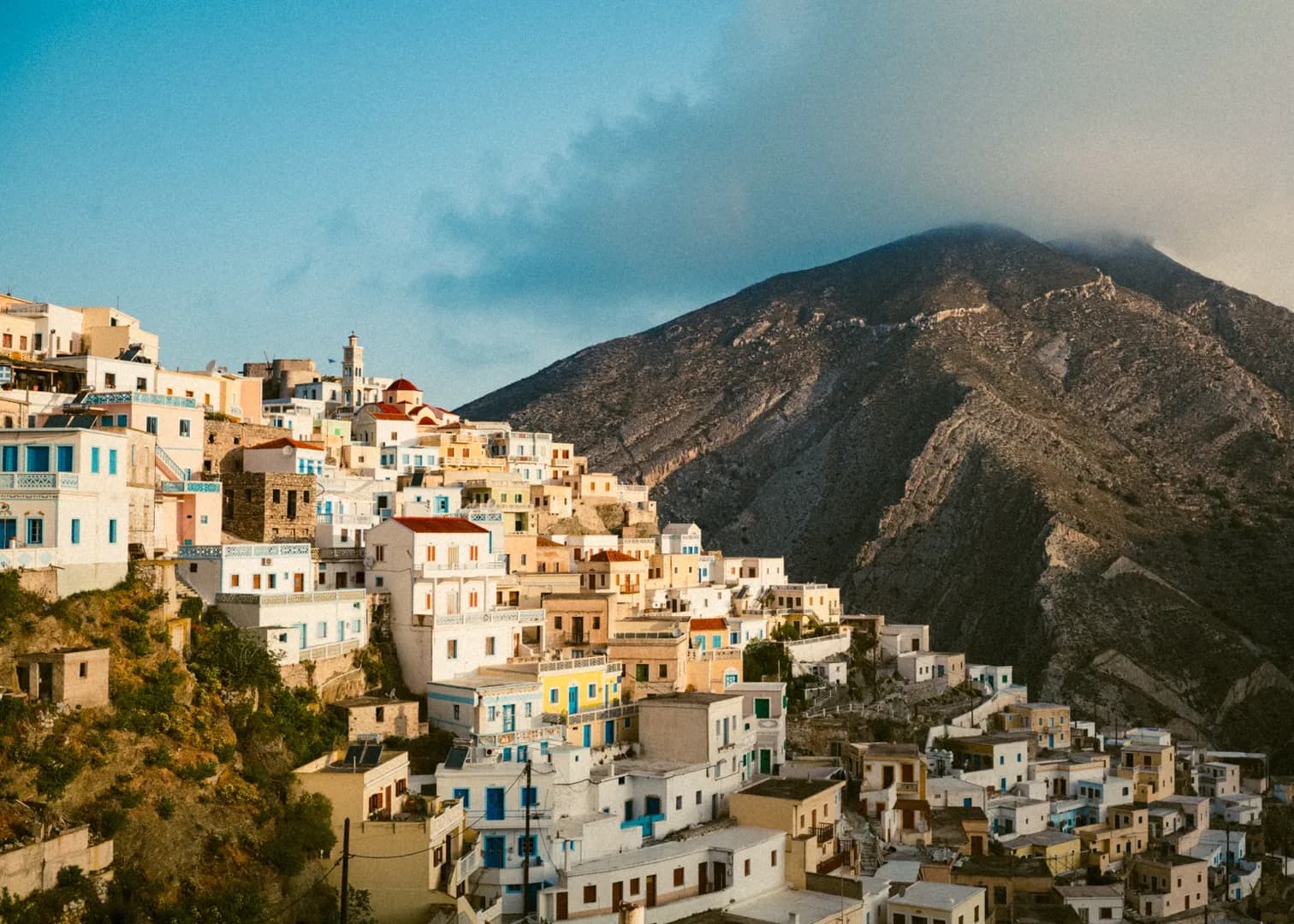
Olympos is one of the most remarkable places to stay on any Greek island — not because of its beaches or its restaurants or its sea views, though all of these exist, but because it is a functioning traditional village that has maintained aspects of its pre-modern culture more completely than almost anywhere else in the Greek islands. Women in Olympos still wear their traditional dress daily — not for tourism, but because that is what they wear. The local dialect contains elements of ancient Greek that disappeared from mainland speech centuries ago. The village's windmills still grind grain (some of them). The social structure, the festivals, the baking of traditional bread in communal ovens — these are continuations, not recreations.
Olympos sits on a dramatic ridge at approximately 500 metres altitude in the island's northern mountains, with the Aegean visible on both sides of the ridge in clear conditions. The village is accessible by road from Pigadia — a spectacular but demanding 1.5 to 2-hour drive on a mountain road that requires a confident driver and is not recommended in the dark — or by boat to Diafani on the northern coast followed by a bus or taxi up to the village. Diafani itself, Olympos's port, is a small, genuine harbour village with a handful of tavernas and a beach that is among the island's least visited.
Accommodation in and around Olympos is limited to a small number of traditional guesthouses and rooms-to-let in village houses. The rooms are simple; the experience is the point. Waking up in Olympos before the day-tripper buses arrive from Pigadia — which begin around 10:00 in peak season — and having the village's lanes and views and the bakery's morning bread to yourself for two hours is one of the genuinely special experiences available in the Greek islands today. Most visitors see Olympos as a day trip; staying overnight transforms it.
⚠ Important reality check: Olympos is not for every traveler. The village has no beach access without a bus or taxi to Diafani. The road from Pigadia is genuinely demanding — spectacular but narrow, unpaved in sections, and not suitable for anyone uncomfortable with mountain driving. The accommodation is simple by definition. If your primary travel needs include a pool, a spa, reliable Wi-Fi, and easy restaurant access at 22:00, Olympos will frustrate you. If your primary need is to experience a corner of Greece that has resisted the homogenisation of the last 50 years, it will be the best decision of the trip.
Booking Advice — What Most Travelers Miss About Karpathos Accommodation
Karpathos has been steadily increasing in international recognition without a corresponding increase in its accommodation stock. The island that was a quiet insiders' destination for Athenians and travel specialists five years ago is now appearing in mainstream European travel features — but the hotels have not multiplied at the same rate. This creates a tighter market than the island's reputation for quietness might suggest, particularly at the quality end and in the limited-inventory areas (Lefkos, Olympos, Finiki).
A car is not optional for any area outside Pigadia town itself, and needs to be booked alongside accommodation rather than assumed to be available on arrival. The major car rental agencies at Pigadia port can exhaust their smaller-car inventory in July–August by 10:00 on arrival days. Book your vehicle from the same date as your flights; the island's terrain (mountain roads to the north, dirt tracks to remote beaches) makes a 4WD or high-clearance vehicle worth the extra daily cost for those planning to explore beyond the main road.
⚠ Cash on Karpathos: ATMs exist in Pigadia and work reliably, but the villages — Lefkos, Olympos, Diafani, Finiki — have no ATMs and limited card infrastructure. Carry enough cash from Pigadia for any night spent in the northern or western parts of the island. The taverna in Diafani will not be able to run your card, and the guesthouse in Olympos does not have a card machine. This is not a complaint; it is information.
Frequently Asked Questions
What is the best area to stay in Karpathos?+
Pigadia is the right choice for most first-time visitors — the widest range of accommodation, all restaurants within walking distance, ferry connections, and the practical infrastructure to explore the whole island by day. Amoopi suits families who want beach proximity and calm water within 10 minutes of the capital. Arkasa and Finiki are ideal for couples seeking western sunsets and a genuinely local fishing-village atmosphere. Lefkos is for those who specifically want Karpathos's most beautiful beach combined with total quiet. Olympos is for the traveler whose primary interest is cultural immersion in a living traditional Greek village.
Do I need a car in Karpathos?+
Yes — practically essential for any area outside Pigadia itself. The island's bus service covers the southern corridor (Pigadia–Amoopi–Arkasa) with reasonable frequency, but Lefkos, the northern coast, the boat-trip departure point at Pigadia for the finest eastern beaches, and the road to Olympos all require a vehicle. Book your rental car from Pigadia at the same time as your accommodation — July–August inventory at the port agencies can be exhausted before noon on peak arrival days.
Which is the best hotel in Karpathos?+
For full-service luxury, Alimounda Mare Hotel (5-star, beachfront, northeast of Pigadia) is consistently rated the finest property on the island — excellent pool, spa, two restaurants, direct beach access, and family facilities. Konstantinos Palace is the credible alternative at the same tier. For adults-only boutique wellness, SOPHID Wellness Suites in Amoopi. For historic character, the Arhontiko in Finiki and the Olympos Archipelagos guesthouse come close in their respective categories.
Is Karpathos good for families with children?+
Excellent. Amoopi's three connected bays have calm, shallow, safe water and are specifically recommended for young children. The two 5-star hotels at Pigadia (Alimounda Mare and Konstantinos Palace) both have children's pools and supervised activities. The island has no aggressive nightlife scene, limited traffic in the village areas, and local residents who are notably welcoming of families.
How far in advance should I book?+
For July and August: three to four months ahead for the luxury tier and Lefkos; two to three months for mid-range Pigadia and Amoopi. For June and September: one to two months is usually sufficient for most properties. For Olympos and Diafani (very limited inventory): book as early as possible, any season. Karpathos has been rising rapidly in travel publications and booking pressure has increased significantly from 2024 onward — treat it as you would book a popular Cycladic island rather than an 'unknown' Dodecanese destination.
What is the difference between Pigadia and Amoopi?+
Pigadia is the capital town — restaurants, nightlife (moderate by Greek island standards), port, ATMs, boat trips, car rentals, and a working waterfront. Amoopi is a dedicated beach village 7 kilometres south — three calm sandy bays, family atmosphere, limited evening options, and a 10-minute drive to Pigadia for anything beyond the beach and the immediate tavernas. Most first-time visitors to Karpathos choose Pigadia for the convenience; families with young children often choose Amoopi for the water quality and calm.