
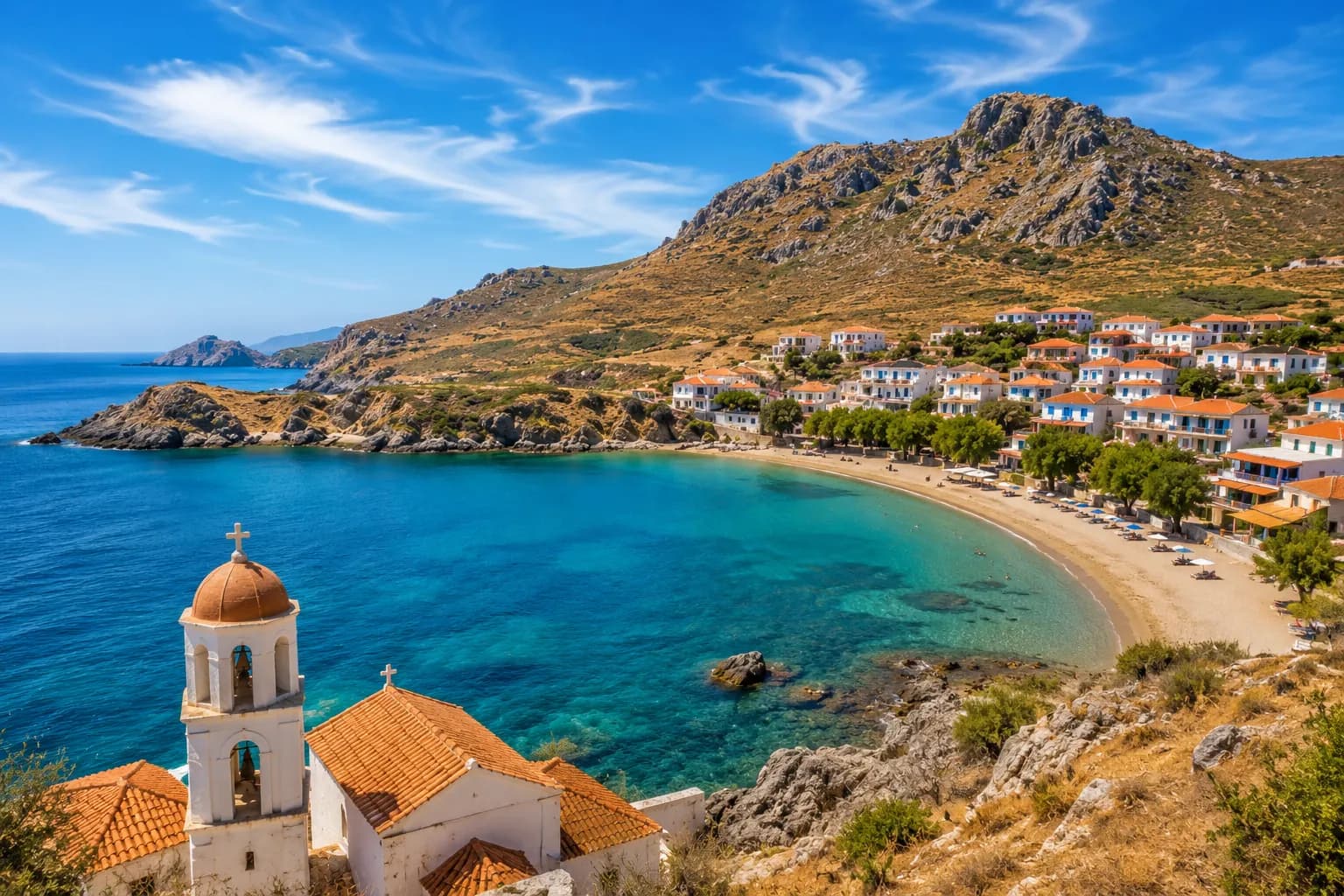
Where to Stay in Lemnos
Lemnos — North Aegean
Choosing where to stay in Lemnos shapes the entire experience on this island — and the choice is less obvious than it first appears. The island is large, varied, and largely undiscovered.
Relaxing stays, beautiful views and authentic hospitality — organized in a clear and practical way.
Description
Lemnos is one of the most genuinely surprising islands in Greece. It sits in the northeastern Aegean, roughly equidistant from Thessaloniki, Lesvos and the Turkish coast, and it has a profile that does not match expectations: volcanic geology, wide open farmland, a capital town of real character, beaches that deserve far more attention than they receive, and an almost total absence of the mass tourism that has overtaken much of the Aegean.
The island is roughly oval in shape with two large bays cutting deep into the coastline — Moudros Bay in the south, one of the largest natural harbours in the Mediterranean, and Pournia Bay in the north. The road network covers the island adequately, though some of the best landscapes and beaches require unpaved tracks. A car is essential for doing Lemnos properly.
Myrina — The Capital, the Castle and the Harbour Life
Myrina is the capital, main port and commercial centre of Lemnos, and it is also its most interesting base. The town spreads around a long sandy beach on the west coast, divided into two bays by a headland topped by a Byzantine and Genoese castle. The castle is one of the most dramatic in the Aegean.
Hotels here range from small guesthouses in the old town quarter (Apothiki district) to more modern seafront properties on Romeïkos Gialos. The airport is 20 minutes from the capital.
Stay in Myrina if... you want the most complete base on the island — harbour, restaurants, archaeology, evening atmosphere. You are arriving by ferry or flying in and want a base with minimal transfer effort. You value having good restaurants and cafés within walking distance.
Platy and the South Coast — The Island's Best Beaches, Close to the Capital
The beaches immediately south of Myrina — Platy, Thanos, Evgatis and Nevgatis — form the most visited and most organized stretch of coastline on Lemnos. The sand is fine and golden, the water is clear and calm. Platy, just five kilometres from the capital, is the most developed — sunbeds, tavernas and accommodation in the form of studios, apartments and small hotels.
Thanos beach, a few minutes further south, is longer, quieter and backed by low dunes. This is the easiest choice for visitors who want a proper beach holiday without sacrificing access to the capital.
Stay here if... you want a beach-first holiday with the best sand and water quality on the island. You want easy access to Myrina alongside a quieter overnight base. You are travelling as a couple or family looking for beach amenities without resort-scale infrastructure.
Moudros and the Bay — WWI History, Working Harbour and Complete Calm
Moudros is the island's second town and the centre of its largest natural bay — a vast, almost enclosed inlet used as the principal Allied naval base during the Gallipoli campaign of 1915. The Commonwealth War Cemetery above the town is one of the largest in Greece.
The town is small, unhurried and almost entirely without tourist performance. Waterfront, plateia, tavernas and a genuine sense of everyday Greek island life. Accommodation is limited — mostly rooms and small guesthouses.
Stay in Moudros if... you want complete calm and a base that no other tourist is likely to share. You have an interest in WWI history. You want a working-harbour atmosphere without any resort infrastructure.
Katalakko and the East — Volcanic Landscape and the Ruins of Hephaestia
The eastern part of Lemnos is the least visited and the most geologically dramatic — black basalt coastlines, collapsed sea caves, and the ruins of ancient Hephaestia, the island's most important ancient city, named for Hephaestus, the god of fire. The site is partially unexcavated, wild, and extraordinary.
Accommodation here is minimal — a handful of rooms in Repanidi and around Katalakko. This is genuinely remote territory. The reward is landscapes that feel nothing like anywhere else in the Aegean.
Stay in the east if... you are a repeat visitor or experienced independent traveler. You have a strong interest in ancient Greek history. You want dramatic, volcanic coastline and complete solitude.
Gomati and the North — A Dune Landscape Unlike Anything Else in the Aegean
The northern coast of Lemnos contains one of the most unexpected landscapes in all of Greece: a dune field — genuine Mediterranean dunes — extending along a long, exposed beach backed by cedar trees. Gomati beach is wild, windy, shallow-watered and entirely without infrastructure.
The north coast is exposed to the prevailing summer winds — excellent for windsurfing and kitesurfing. Accommodation is very limited.
Stay in the north if... you want wild, windswept coastline. You practise windsurfing or kitesurfing. You want the most remote and unpolished part of Lemnos.
Frequently Asked Questions
Do I need a car to explore Lemnos?+
Yes — without question. The island is large, public transport is minimal, and its most rewarding sites require a vehicle. Rent a car from day one.
How many days do I need in Lemnos?+
A minimum of four days, ideally six or seven. The island divides naturally into west coast, south, east and north — each area deserves at least a full day.
Which area of Lemnos is best for a first visit?+
Myrina — widest accommodation choice, best restaurants, easiest connections, and within reach of the south coast beaches in under ten minutes.
Is Lemnos suitable for families with children?+
Yes, particularly the south coast beaches at Platy and Thanos — shallow, calm, well-sheltered water and enough nearby infrastructure.
When is the best time to visit Lemnos?+
Late May, June and September offer the best conditions. July and August are popular with Greek domestic tourists.
What makes Lemnos different from other North Aegean islands?+
Its scale, variety, and almost total absence of mass tourism. Volcanic origins, Bronze Age settlements older than Mycenae, and WWI Allied history.