
Where to Stay in Parga & Epirus
Parga — Epirus, Northwestern Greece
Find the best places to stay in Parga — from the harbour Old Town and Valtos to Lichnos, Sarakiniko and Anthousa — plus the complete guide to Epirus: Sivota, Preveza, Ioannina, the Zagori villages, the Acheron River, Arta, the Tzoumerka mountains and the Paxos islands. The most complete guide to Parga and northwestern Greece.
Relaxing stays, beautiful views and authentic hospitality — organized in a clear and practical way.
Description
Relaxing stays, beautiful views and authentic hospitality — organized in a clear and practical way.
1. Parga Old Town and Harbour: The most romantic base in northwestern Greece
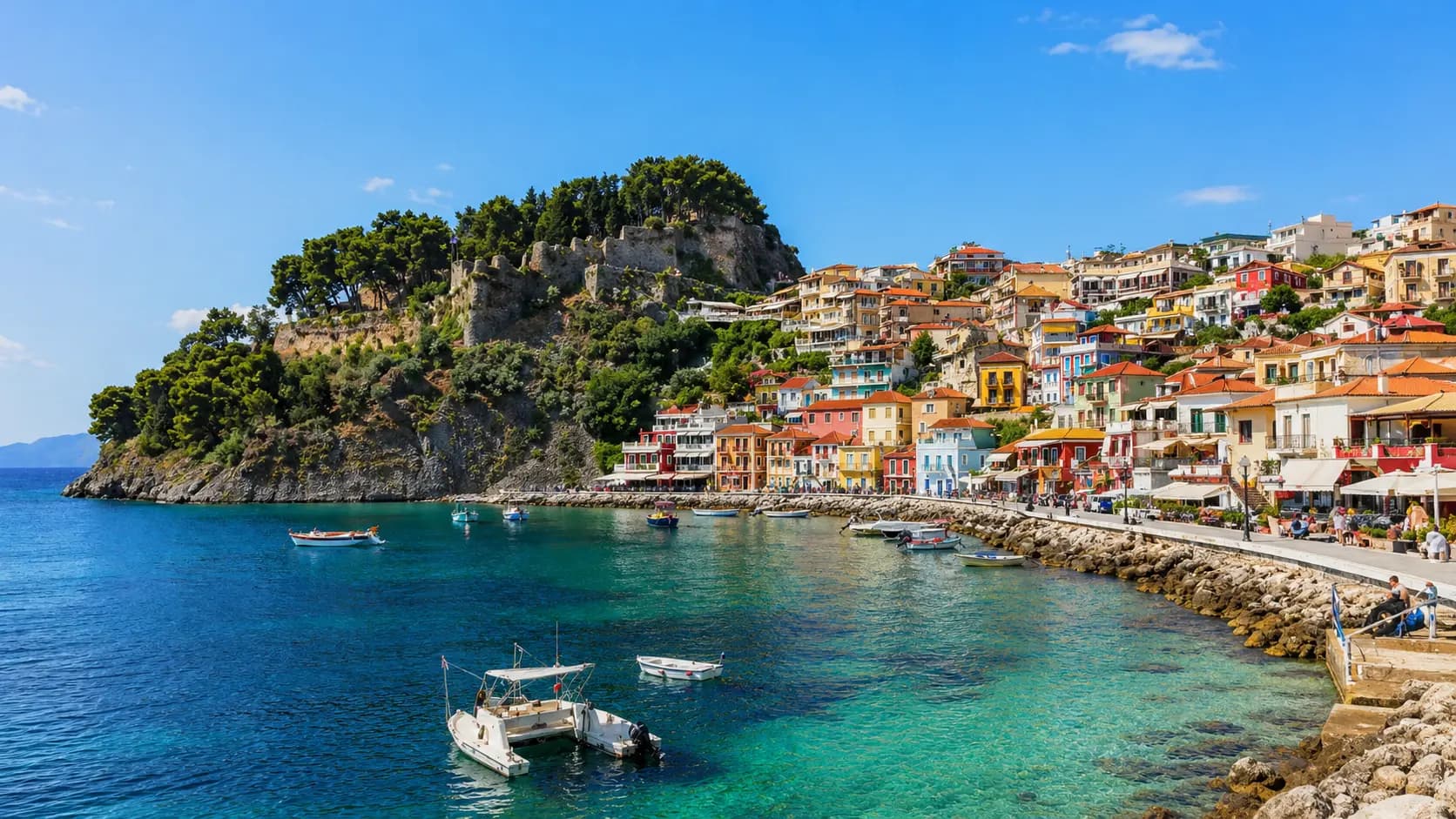
Parga is amphitheatrically built on a rocky promontory above a bay of exceptional beauty, its pastel-painted houses climbing the hillside from the waterfront to the Venetian castle at the summit. The effect — particularly at dusk when the castle walls catch the last light and the harbour fills with the smell of grilling fish — is unlike any other town on the mainland coast. The Old Town's cobblestone alleys and flower-hung archways are best explored in the morning or after sunset. The Venetian Castle at the summit is one of the defining views of northwestern Greece. The island of Panagia in the harbour is reached by a short rowing boat and contains a small Byzantine chapel. Krioneri Beach occupies the sheltered cove below the Old Town. Hotels range from boutique rooms with harbour-view terraces to mid-range hillside properties. Parga Inn Suites and Racconto Boutique Design Hotel are among the most praised. Car access in the Old Town is very limited — park outside the centre.
2. Valtos: The great beach below the castle
Valtos is the largest and most accessible beach in the Parga area — a long arc of fine golden sand stretching for nearly three kilometres directly below the Venetian castle. The combination of that view with the quality of the water makes Valtos one of the most photographed beach scenes in Greece. The beach is organised with sunbeds, beach bars and watersports. The water is calm and the depth increases gradually — good for families. Reach it by water taxi from the harbour (€2, 4-5 minutes) or by walking 15-20 minutes around the headland. Several hotels sit on the hillside above Valtos with terraces looking directly over the bay.
3. Lichnos: The finest beach in the Parga area
Three kilometres south of Parga, Lichnos is widely considered the most beautiful beach in the immediate Parga area. A deep, sheltered bay of sand and fine pebble surrounded on three sides by pine-forested hillsides, with water that moves from turquoise at the shoreline through multiple shades of blue. The sea caves at the left end of Lichnos are explorable by pedalo, kayak or swimming. Enjoy Lichnos Bay Village is the most complete resort property on the bay. Hidden gem: the path beyond the sea caves leads to a series of small, unnamed coves accessible only on foot or by kayak.
4. Sarakiniko: The wild and dramatic beach south of Parga
Sarakiniko lies five kilometres south of Lichnos, at the end of a winding road through an ancient olive grove. The beach is wider and more exposed, with a backdrop of olive trees that come almost to the shoreline. The Paragaea Olive Oil Museum nearby documents the history of Epiriot olive oil production. Sarakiniko attracts a more local, relaxed crowd. The coastline south toward Ammoudia passes a succession of unnamed beaches that are among the most beautiful and least visited in northwestern Greece.
5. Anthousa: The most atmospheric village base near Parga
Four kilometres inland from Parga, Anthousa is a remarkably beautiful and overlooked alternative base with stone houses, narrow lanes and the dramatic hilltop Ali Pasha Castle — a well-preserved Ottoman fortification with extraordinary views over the entire bay. The village has several tavernas serving proper Epiriot food. Anthousa Waterfall is a short walk through the olive grove. My Suite Boutique Hotel is one of the most consistently praised accommodation options in the wider area.
6. Sivota: The most beautiful hidden coastline of northwestern Greece
Twenty-seven kilometres north of Parga, Sivota sits in a natural harbour surrounded by uninhabited islets and a coastline of small bays and hidden coves. The Blue Lagoon — a narrow channel between the coast and a wooded islet with luminous turquoise water — is the most photographed spot in the area. Bella Vraka Beach is accessible by wading through a shallow channel. Karavostasi Beach is the largest organised beach. Hidden gem: the abandoned hilltop village of Vrachona above Sivota — fifty ruined stone houses on a hidden plateau, linked to the mythological landscape of the Acheron.
7. The Acheron River & the Necromanteion: Greece's most mythological landscape
The Acheron River flows from springs in the mountains through the Straits of Acheron to the sea at Ammoudia. In ancient Greek mythology it was one of the five rivers of the Underworld — the River of Woe. Trekking the Acheron Gorge is the finest half-day nature experience from Parga — a walk through the gorge partly along the banks and partly wading through cold, crystal-clear water. The Necromanteion of Acheron — the Oracle of the Dead — stands on a hill above the ancient Acherousian lake. The subterranean sanctuary where the living consulted the dead is still largely intact. Standing inside the underground chamber has an effect that purely historical sites rarely achieve.
8. Preveza and Ancient Nikopolis: The forgotten Roman city
Preveza sits at the mouth of the Ambracian Gulf, 65 kilometres south of Parga. The town has a pedestrianised old town of neoclassical buildings and a harbour promenade. Ancient Nikopolis — one of the largest Roman archaeological sites in Greece — was founded by Octavian in 29 BC to commemorate his victory over Mark Antony at Actium. Its extensive remains include a theatre, stadium, nymphaeum and early Christian basilicas with extraordinary mosaic floors. The Monument of Zaloggo on a clifftop above Kassopi commemorates the 63 women of Souli who threw themselves from the cliff rather than submit to Ali Pasha.
9. Arta and the Byzantine City: The most overlooked cultural destination in Epirus
Arta, 80 kilometres southeast of Parga, is one of the most significantly undervisited historical cities in Greece. Built on the site of ancient Ambracia — capital of Pyrrhus — Arta served as the capital of the Despotate of Epirus from 1204 to 1337. The Church of Panagia Parigoritissa (1295) is the masterpiece of late Byzantine architecture in Epirus. The Bridge of Arta over the Arachthos River is one of the most famous bridges in Greece, subject of the folk song the Ballad of the Bridge of Arta.
10. Ioannina: The city on the lake — the capital of Epirus
Ioannina is the capital of Epirus, 100 kilometres north of Parga — approximately 90 minutes by car. The city was the capital of Ali Pasha in the late 18th century. The Ioannina Castle at the lakeside preserves his treasury and the site of his assassination. The island of Ioannina in Lake Pamvotis — reached by a five-minute boat — has no cars, a few hundred residents, fish tavernas, and the monastery where Ali Pasha was killed. The Perama Cave on the lake's northern shore is one of the largest cave systems in Greece. Ioannina's food scene is the best in Epirus — its baklava is nationally famous. The tsipouro bars near the lake are a unique local tradition.
11. The Zagori Villages and Vikos Gorge: The most spectacular mountain landscape in Greece
The Zagori — 46 traditional stone villages in the Pindus mountain range, two hours from Parga — is one of the most extraordinary landscapes in Greece. Vikos Gorge holds the Guinness World Record for the deepest canyon relative to its width: 900 metres deep. The Voidomatis River, claimed to be the coldest in Europe, has water of impossible transparency. The Papingo rock pools are among the most beautiful natural swimming spots in Greece. Monodendri has the finest traditional architecture in central Zagori. Papingo — the twin villages — are the most photographed. Dilofo is considered the most perfectly preserved of the 46 villages. The Kipoi stone bridges are among the finest examples of vernacular stone engineering in the Balkans.
12. The Tzoumerka: The wild mountain heart of Epirus
The Tzoumerka mountain range rises to over 2,400 metres between Ioannina and Arta. For hikers and anyone drawn to wild, unspoiled mountain landscapes, the Tzoumerka is one of the last corners of Greece where you can walk for hours without meeting another person. Syrrako and Kalarites are the two most celebrated mountain villages — both at 1,000 metres altitude, both built in classic Epiriot stone style. The Tzoumerka-Peristeri-Arachtos Gorge National Park is a Natura 2000 site for exceptional biodiversity.
13. Paxos and Antipaxos: The island day trips from Parga
The island of Paxos lies 15 nautical miles from Parga — a 40-minute boat crossing. Covered almost entirely in ancient olive trees, with three harbour villages — Gaios, Loggos and Lakka — completely different in character. The Blue Caves on the western coast are among the most beautiful sea cave formations in Greece. Antipaxos, a 15-minute boat ride south, has two beaches — Vrika and Voutoumi — that are among the finest in the Ionian Sea. Voutoumi with its white pebbles and turquoise water consistently appears in lists of the best beaches in Greece.
Frequently Asked Questions
Is Parga better as a beach destination or as a base for exploring Epirus?+
It is genuinely both. Two to three days in Parga for beaches and the Old Town covers the coastal experience. An additional two days with a car for the Acheron, Ioannina and the Zagori villages transforms the trip into one of the most varied holidays in Greece.
Do I need a car in Parga?+
For the town itself, no. For Lichnos, Sivota, the Acheron, Ioannina, the Zagori and Arta — absolutely essential. Arrange a car rental for the exploration days.
When is the best time to visit Parga?+
May, June and September are ideal. The sea is warm, the beaches are active without peak crowds. July and August bring full capacity. The Zagori is most beautiful in late spring and October.
How do I get to Parga?+
Preveza/Aktion Airport (PVK) is 65 km away (55 min). Ioannina Airport (IOA) is 103 km (1h20min). From Athens by car via the E65 through Arta takes about 4h30min. By ferry: Corfu to Igoumenitsa (1.5h fast ferry), then 45 minutes south by car.
Is Parga suitable for families?+
Exceptionally so. The calm water at Krioneri, organised beaches at Valtos and Lichnos, boat trips to Paxos and the Acheron river walk are all well-suited to families. The main caution is peak-season parking and traffic.
Which is better as a base — Parga or Sivota?+
Both have strong cases. Parga has more choice, better infrastructure and the historic Old Town. Sivota is quieter and has the most beautiful immediately local coastline. Experienced travelers increasingly recommend Sivota as a primary base with Parga as a day trip.