
Where to Stay in Samos
Samos — North Aegean
Samos is a large island with five genuinely distinct zones — from the elegant neoclassical capital of Vathi and the beautiful fishing village of Kokkari to the ancient south coast around Pythagoreion, the vine-covered mountain villages and the wild remote west. A complete guide to Samos hotels and areas.
Relaxing stays, beautiful views and authentic hospitality — organized in a clear and practical way.
Description
Samos is a large island — approximately 43 kilometres from east to west — and the choice of where to stay is more consequential here than on a smaller destination. The island has five genuinely distinct zones, each with a different character, a different relationship to the coast and the interior, and a different type of traveller it suits.
The north coast, between Vathi in the east and Karlovassi in the west, is where most package and resort accommodation is concentrated — a scenic coastal road passing through Kokkari and a series of beach settlements that together form the island's primary tourist corridor. The south coast — anchored by Pythagoreion and flanked by the Heraion plain to the west — is quieter, more historically charged, and considerably closer to the ancient sites. The mountain interior, accessible from either coast, is a world of forested villages, vine terraces and silence that most coastal visitors never reach. The remote west, under the mass of Mount Kerkis, is the island's least visited and most dramatically scenic zone.
Samos has no international hotel chains and no all-inclusive resorts in the conventional sense. What it has is a well-developed stock of family-run hotels, studios, boutique guesthouses and apartment complexes — a range that runs from very simple and very affordable to genuinely design-conscious boutique properties in Kokkari and Vathi. Prices are substantially lower than Cycladic equivalents at every level. A rental car is essential for any base outside the immediate port areas.
1. Vathi (Samos Town) — the Elegant Capital and the Most Complete Base
Vathi — formally Samos Town — is the island's capital and main eastern port, and it is one of the most handsome Greek island capitals in the Aegean. Unlike most island ports, which are functional rather than beautiful, Vathi was largely built in the late 18th and 19th centuries in a neoclassical style that reflects the prosperity of the island's Ottoman-period merchant class: wide waterfront promenades, colonnaded buildings, ochre and terracotta facades and a scale that feels genuinely urban without being overwhelming. The old quarter of Ano Vathi, climbing the hill above the neoclassical waterfront, preserves an older layer of Ottoman-era and Byzantine architecture — cobbled lanes, stone houses with wooden balconies, tiny churches with carved marble doorways.
For visitors, Vathi is the most complete base on the island. The Archaeological Museum — containing the extraordinary archaic kouros from the Heraion and one of the finest collections of ancient sculpture in any Greek island museum — is a ten-minute walk from the main waterfront. The Saturday morning market, the best food shops, the ferry port, the main taxi rank, the hospital and the practical infrastructure of island life are all within walking distance. Several excellent waterfront fish tavernas serve fresh daily catches at prices that reflect the island's distance from premium tourist markets.
Accommodation in Vathi ranges from simple guesthouses above the port — practical, affordable, perfectly positioned — to a growing number of boutique hotels in the neoclassical buildings near the waterfront, with high ceilings, marble floors and period details restored to a standard that makes them genuinely characterful stays. The best properties are in the streets immediately behind the waterfront and on the lanes climbing toward Ano Vathi.
2. Kokkari — the Most Beautiful Village and the Finest All-Round Base
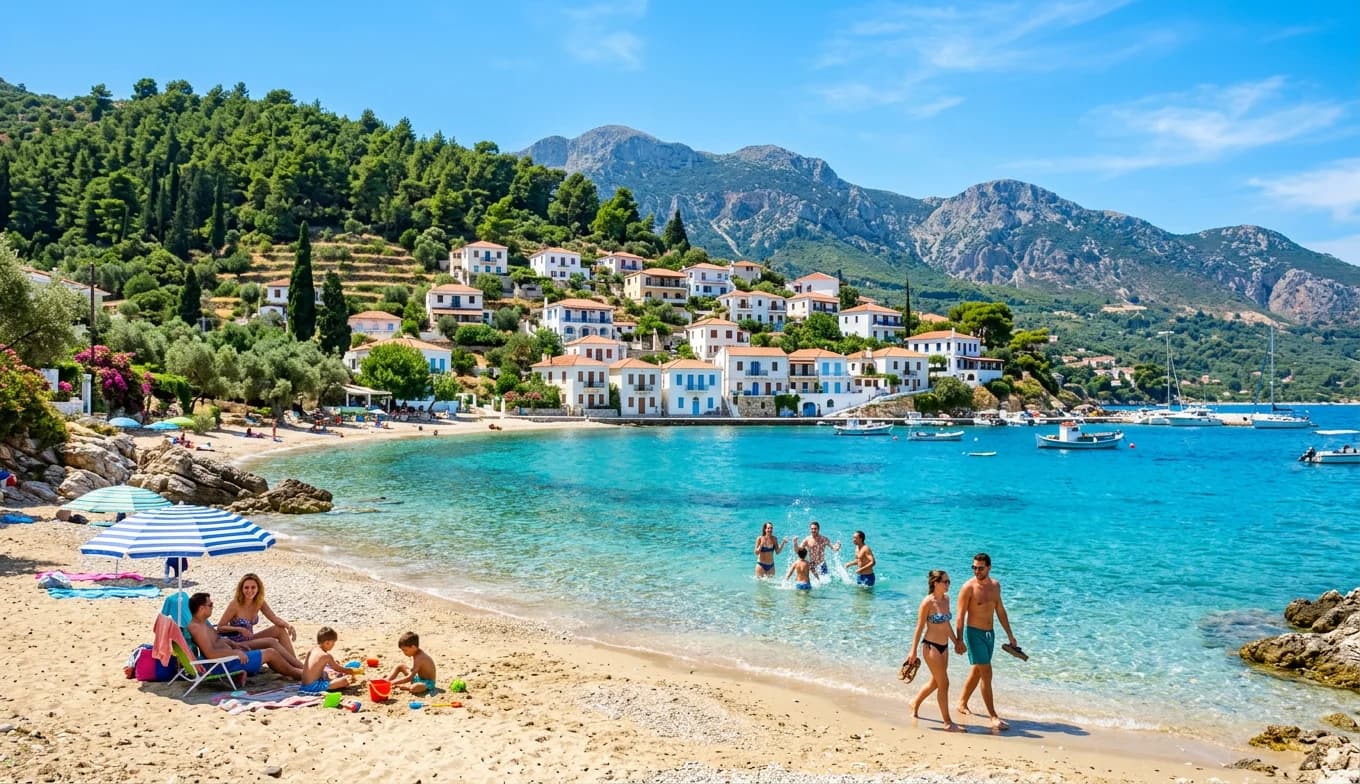
Kokkari is, for most experienced travellers, the finest place to stay on Samos — and it competes seriously for the title of most beautiful fishing village in the eastern Aegean. Built on a rocky double headland 10 kilometres west of Vathi, with whitewashed houses climbing the hillside above two curving bays, flower-draped balconies, a working harbour of painted fishing boats and a waterfront taverna scene that operates from morning coffee to late-night grilled fish, Kokkari has exactly the combination of authenticity and quality that the best Greek island villages possess.
Accommodation in and around Kokkari is the most varied and consistently well-reviewed on the island. The village itself contains small hotels in restored traditional buildings, studios with sea views and a handful of boutique properties that have understood the village's character and matched it in their design. The hillside above the eastern bay has several larger hotel complexes with pool terraces and sea views — more conventional in format but with genuine quality and good value by any standard. Within walking distance of the village, a series of small coves and pebble beaches provide excellent swimming; the afternoon wind that makes Kokkari one of the best windsurfing spots in Greece also makes the evenings cool and pleasant even in August.
The mountain villages of Manolates and Vourliotis are a fifteen-minute drive above Kokkari, connected by a marked walking trail through pine forest that is one of the finest walks on the island. Vathi is 20 minutes east by car; Karlovassi and the Seïtani beaches are 30 minutes west. Kokkari is genuinely the best-positioned single base on the island for visitors who want village atmosphere, beach access, proximity to the mountain interior and reasonable distance from the main cultural sites.
3. North Coast — Agios Konstantinos, Avlakia & the Resort Corridor
The coastal road between Kokkari and Karlovassi passes through a series of small beach settlements — Avlakia, Tsamadou, Agios Konstantinos, Platanakia — that together form the island's primary resort corridor. This is where the majority of Samos's organised tourist accommodation is found: a mix of apartment complexes, medium-sized hotels, studios and self-catering units set into the pine-covered hillside above a succession of pebble and sand coves.
The beaches along this stretch are consistently good — pebble and coarse sand, with clear water and the afternoon wind that characterises the north coast. Tsamadou is one of the most scenic, with a pine forest background and traditionally clothing-optional atmosphere. The beach at Avlakia is smaller and calmer. None of the north coast resort beaches match the drama of Seïtani or the natural beauty of the south coast, but for a family holiday with reliable swimming, organised facilities and easy access to both Kokkari and Vathi, this corridor works very well.
The village of Agios Konstantinos has a small working harbour and a more local character than the pure resort settlements further east. A handful of good tavernas here serve the local fishing community alongside tourists, and the prices reflect this mixed clientele. The mountain road south from Agios Konstantinos leads to the villages of Manolates and Vourliotis — the finest village walk on the island begins above this area.
4. Pythagoreion & the South Coast — Ancient Character and the Finest Cultural Base
Pythagoreion on the south coast is the second town of Samos and the island's most historically atmospheric base. The modern town sits directly on the ruins of the ancient Samian capital — the ancient harbour mole is still in daily use, sections of the 6th-century BC city walls are visible behind the waterfront hotels, and the Efpalinos Tunnel begins just above the town. The Heraion UNESCO sanctuary is 8 kilometres west along the flat south coast road — close enough for a morning visit before the heat builds. The airport is 4 kilometres west, making Pythagoreion the most convenient arrival base for fly-in visitors.
The town itself is genuinely pleasant: a working harbour with fishing boats and pleasure craft, a pedestrianised waterfront promenade lined with cafés and restaurants, a small archaeological museum and a quieter, more local atmosphere than the north coast resort strip. The evening here — a walk along the ancient harbour mole at sunset, dinner at a waterfront taverna with local wine — is one of the most civilised experiences on the island.
The south coast beaches — Psili Ammos east of the town and the calmer coves toward the Heraion — are among the finest on the island for families and swimmers who prefer shallow, warm water. The south coast is sheltered from the north wind that makes the north coast beaches choppy in summer, which means swimming conditions here are reliable and calm even on windy days.
5. Mountain Villages — Manolates, Vourliotis & the Forest Interior
The mountain villages above the north coast — principally Manolates and Vourliotis, at 300–400 metres elevation in the pine and chestnut forests of the central range — offer the most distinctive and least conventional accommodation experience on Samos. Staying here means waking up in a stone village above the tree line, walking forest paths between stone-walled vineyards before breakfast, eating at a kafeneion where the menu is whatever is growing in the vegetable garden behind the kitchen, and watching the sun set over the Aegean from a height that makes the curvature of the earth feel almost perceptible.
Accommodation in the mountain villages is limited and entirely self-catering or guesthouse in format — renovated stone village houses with original features, small family-run rooms with mountain views, and the occasional private villa rental. There are no hotels in the conventional sense, and facilities are minimal. This is part of the appeal: staying in Manolates or Vourliotis means committing to the village's own pace and logic.
The marked forest trail between Manolates and Vourliotis — approximately two hours through chestnut and pine — is one of the finest village walks in the eastern Aegean. The wine cooperative's vineyards cover the slopes below both villages, and small producers sell wine, honey and olive oil directly from their properties.
6. Karlovassi & the West Coast — Unspoiled, Local and Under the Shadow of Kerkis
Karlovassi is the island's second port — a sizeable town on the northwest coast with a different character from Vathi: less elegant, more working-class, with a harbour that receives the same ferry routes as Vathi and a town centre of neoclassical buildings that have seen better days but retain a certain faded grandeur. It is not a tourist destination in any meaningful sense, and this is both its limitation and its appeal.
The primary reason to base yourself in the west is access to the Seïtani beaches — two remote northwest coast coves (Mikro and Megalo Seïtani) accessible only on foot from the beach at Potami or by sea taxi. Megalo Seïtani, the further of the two, is one of the finest natural beaches in the Aegean: a broad crescent of white pebble and sand in a bay of extraordinary water clarity, backed by pine forest and entirely without roads or facilities. The 90-minute walk from Potami to reach it passes through a gorge of pine, rock and stream that is beautiful in its own right.
The foothills of Mount Kerkis — the island's highest peak at 1,437 metres — are accessible from the villages south of Karlovassi. The full ascent of Kerkis is a serious day hike (6–7 hours return) and one of the finest mountain walks in the Greek islands, with views that extend to Ikaria, Fourni, Patmos and the Turkish coast on clear days. Accommodation around Karlovassi is simple and affordable — family-run rooms, small hotels in the town itself and a handful of studios near the beach at Potami.
Frequently Asked Questions
Where should first-time visitors to Samos stay?+
Kokkari is the strongest single base for most first-time visitors — it combines the island's most beautiful village architecture with direct beach access, good restaurant choice, reasonable proximity to Vathi and the mountain villages, and an atmosphere that captures the authentic character of Samos without sacrificing quality or comfort. Vathi is the better choice for visitors who specifically want the cultural experience — the Archaeological Museum, the old quarter, the ferry connections — without needing a car. For those arriving by plane and prioritising the ancient sites, Pythagoreion is the most convenient first-night base before exploring further.
Do I need a rental car in Samos?+
For any base outside Vathi, yes — and even from Vathi a car dramatically expands what is accessible. Samos is a large island with a bus service that connects the main towns but does not reach the mountain villages, the Seïtani beaches, the Heraion or the remote west. A car is available at the port in Vathi, at the airport near Pythagoreion and in Karlovassi. Book in advance for July and August.
How does Samos accommodation compare to the Cyclades in price?+
Significantly more affordable — typically 30–50% less than comparable quality on Mykonos, Santorini or even Paros. A well-positioned boutique room in Kokkari with a sea view costs what a functional room in the Cyclades back streets would. The quality-to-price ratio on Samos is one of the best in the Aegean.
Is Samos good for families with young children?+
Yes — particularly the south coast around Pythagoreion and the calmer coves of the north coast corridor. Psili Ammos south of Pythagoreion is the finest family beach on the island: long, sandy, shallow, sheltered from the north wind and with good facilities. The beach at Porto (east of Pythagoreion) and the calmer north coast coves around Avlakia are also well-suited to younger children.
What is the best area for a romantic or boutique stay in Samos?+
Kokkari without question — the combination of village architecture, sea views, excellent evening dining and the intimate scale of the best properties makes it the most romantic base on the island. For an even more unusual experience, the restored stone houses in Manolates or Vourliotis — with views across the forested valleys and the sea beyond — offer the kind of complete immersion in the island's character that boutique hotels in the conventional sense cannot replicate.
Which area is closest to the Heraion and Efpalinos Tunnel?+
Pythagoreion is by far the closest base for both. The Efpalinos Tunnel entrance is a five-minute walk from the town centre; the Heraion is 8 kilometres west along the flat coastal road, about 15 minutes by car. From Kokkari or the north coast, both sites require a 40–50 minute drive.
Is Samos a good destination outside the summer season?+
Better than most Greek islands in shoulder and off-season. Vathi and Pythagoreion function year-round as working towns with active restaurants, cafés and cultural life. The mountain villages are at their most atmospheric in spring and autumn, when the forests are green or golden and the vineyards are either in blossom or harvest. April, May, September and October are all excellent months.