
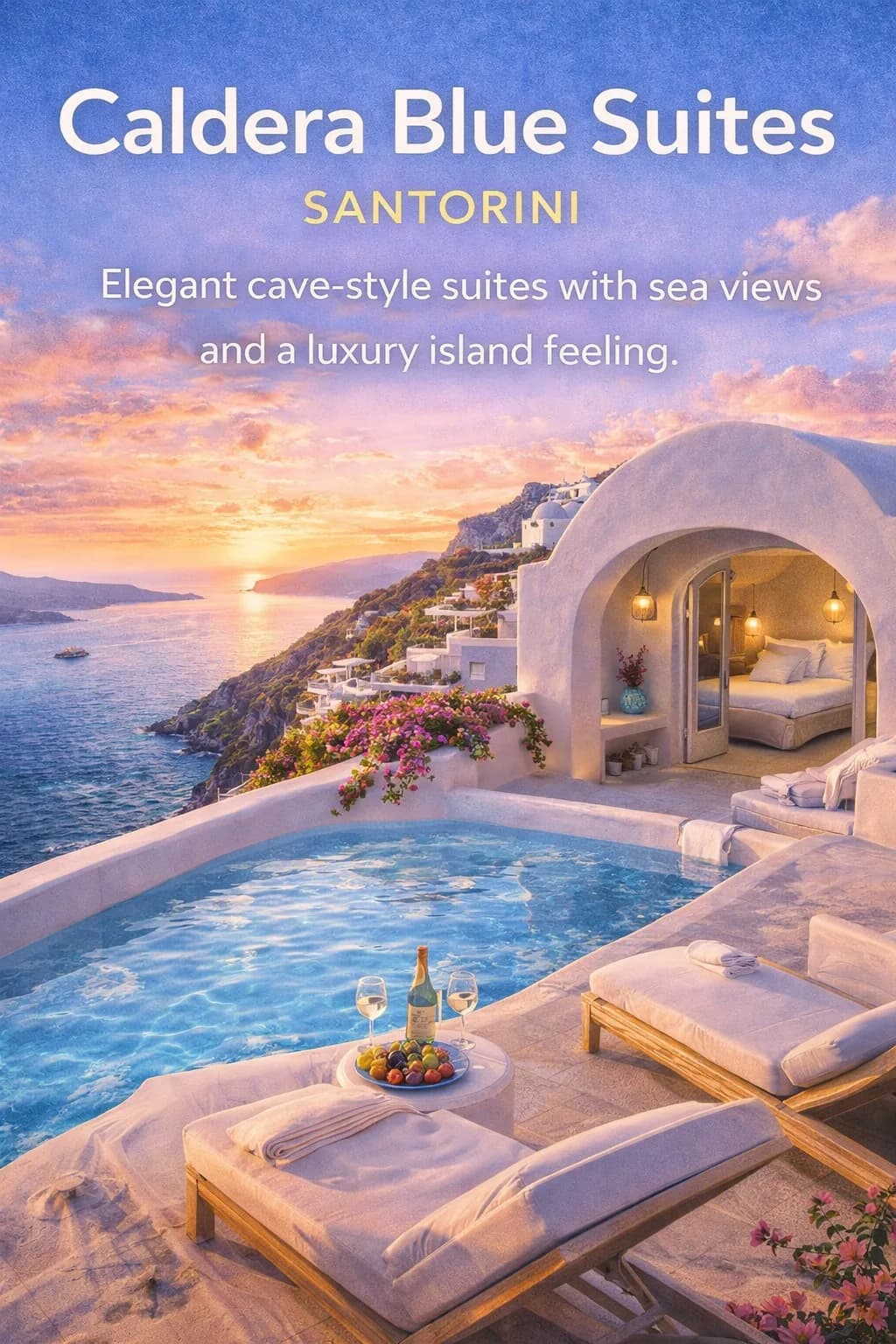
Where to Stay in Santorini
Santorini (Thira) — Cyclades
Santorini's caldera cliff towns offer extraordinary views but demand a premium, while the east coast beach villages provide ease and affordability. Choose between Oia, Fira, Imerovigli for caldera drama or Kamari, Perissa, Perivolos for beach access.
Relaxing stays, beautiful views and authentic hospitality — organized in a clear and practical way.
Description
Santorini is one of the most famous islands in the world — and one of the most misunderstood. The photographs that define it globally — white cubic houses with blue domes balanced on the rim of a vast volcanic caldera, infinity pools suspended above a sea-filled crater, sunset light turning the entire western cliff face from white to gold to deep rose — are entirely real, but they represent only one part of an island that has a great deal more to offer than its own mythology. The caldera itself — a flooded volcanic crater twelve kilometres across, formed by one of the most cataclysmic eruptions in human history, circa 1600 BC — is not just a scenic backdrop: it is the geological event that ended the Minoan civilisation at Akrotiri, possibly generated the legend of Atlantis, and left an island whose volcanic soil produces wines unlike anything grown anywhere else on earth.
The fundamental choice in Santorini is this: caldera views or beach access. The west-facing cliff villages — Oia, Imerovigli, Firostefani, Fira and southern Akrotiri — look down into the caldera, which is the reason most people travel here. The east-side beach villages — Kamari, Perissa, Perivolos — have the island's swimming beaches, flat ground and more affordable accommodation. You cannot fully have both from the same hotel. Understanding this trade-off is the first step in planning a Santorini trip that matches expectations.
The second essential thing to understand is crowds. Santorini receives over two million visitors per year concentrated into roughly five months, and the cruise ship industry delivers up to 8,000 additional day-visitors simultaneously during peak season — most of them concentrated in Fira and Oia between 10am and 5pm. The experience of these two villages before 9am and after 7pm is categorically different from the midday experience. Staying overnight — particularly in Oia or Imerovigli — and having access to the village in the early morning and late evening, is what converts a crowded Instagram location into one of the most genuinely beautiful places in Europe.
1. Oia: The Most Iconic Village in Greece — and How to Experience It Properly
Oia occupies the northernmost tip of Santorini's caldera rim, a narrow peninsula of white and ochre buildings that tumbles down the cliff face toward Ammoudi Bay below. It is the most photographed village in Greece, possibly the most photographed in all of Europe, and the images — the blue-domed churches of the Three Bells of Fira, the windmills above the castle ruins, the cave hotels with infinity pools suspended over the caldera, the sunset crowds gathered at the castle point — are among the most recognisable visual icons of international travel. None of the photographs lie. Oia is genuinely, extraordinarily beautiful. But experiencing it properly requires understanding what the photographs do not show.
The village is most beautiful at four specific times: dawn, before 9am, after 7pm, and on overcast mornings in shoulder season when the soft light eliminates the harsh midday shadows on the white walls. Between approximately 11am and 5pm in July and August, when the day-trip buses and cruise passengers concentrate in the narrow main street, Oia becomes one of the most crowded small spaces in Europe — a shoulder-to-shoulder procession along a lane barely three metres wide, with tour groups, photographer gridlock at every corner and the kind of tourist density that actively diminishes the experience it is producing. Staying overnight in Oia gives you access to the village at the times when it is genuinely magical. Visiting as a day trip from Fira, arriving at midday, does not.
The sunset from Oia is world-famous, but requires an important clarification that most guides omit: not all Oia hotels have a direct sunset view, and the sunset from the famous castle ruins is a specific experience that requires arriving at least one hour before dusk to secure a position in peak season. The castle viewpoint offers a view west toward the open sea — the sun dropping directly into the water — that is the defining Oia image. However, many of the hotels on the main south-facing caldera cliff look toward the volcano and Fira rather than toward the sunset, and while these views are magnificent, the sun sets to their right over land rather than over water. Before booking, verify the specific orientation of the hotel you are considering.
Ammoudi Bay, directly below Oia at the bottom of a 214-step descent (or a short drive around the road), is one of the finest settings for a seafood dinner in the Cyclades — a handful of tavernas built right at the water's edge, with boats moored between the tables and the cliff face of Oia rising dramatically behind. The octopus drying on lines strung between the rocks is the food image of Santorini. Swimming from the flat rocks at Ammoudi — with the cliff and village above you — is one of the more unusual and beautiful swimming experiences the island offers.
Hotels in Oia are among the most premium-priced in the Cyclades. The finest — Canaves Oia Suites, Katikies, Perivolas, Charisma Suites, Esperas Traditional Houses — offer cave-carved interiors, private plunge pools, butler service and the kind of complete privacy that justifies their rates for the right traveler. A crucial practical note: rooms in Oia access involves steps — often many of them, sometimes precipitous, always uneven. There is no flat ground in this village. Ask your hotel specifically how many steps are involved between the road and your room before booking, and be honest about your mobility. For anyone with joint problems, difficulty with stairs or traveling with a pushchair, Oia is genuinely not the right choice regardless of its beauty.
Hidden gem of Oia: The northern harbour of Armeni — smaller and less visited than Ammoudi — sits at the base of the cliff on the opposite side of the Oia peninsula and is where the fishing boats are actually moored. A simple taverna here serves grilled fish at local prices to an almost entirely Greek clientele. Getting there requires the same cliff descent as Ammoudi but in the opposite direction, on steps that fewer visitors know to follow.
2. Imerovigli: The Best Caldera Views on the Island — and What Most Guides Get Wrong About It
Imerovigli sits at the highest point of Santorini's caldera rim — 300 metres above the sea — between Fira and Oia, and holds what is widely considered by experienced visitors to be the finest overall caldera view on the island. The name means "day watchman" in Greek — a reference to its historical role as the island's sentinel position — and from this height the entire caldera panorama is visible simultaneously: the submerged volcanic islands of Nea and Palea Kameni in the centre, the arc of Thirassia across the water, Oia visible to the north and Fira to the south, and the open Aegean beyond all of them. On clear days in spring and autumn, Crete is visible on the southern horizon.
Most first-time visitors to Santorini expect Oia to have the best views, and are surprised to discover that Imerovigli's elevated position consistently delivers a more panoramic and less obstructed perspective. The village is smaller, quieter and significantly less crowded than either Oia or Fira — the main lane through Imerovigli is narrow and still lined with luxury hotels, cocktail bars and restaurants, but without the cruise passenger density of the more famous towns. It has no bus stop within the village itself, which naturally limits the day-visit crowd. Most people who stay in Imerovigli cite the quiet — the ability to have coffee on a caldera terrace with the view entirely to themselves at 7am — as the element they remember longest.
Skaros Rock is the defining physical feature of Imerovigli and one of the most remarkable natural and historical formations on the island. This massive lava-rock promontory juts dramatically into the caldera from the southern edge of the village, rising 65 metres above the water, and was once the medieval capital of Santorini — the site of the island's largest Venetian kastelli, home to over 1,000 inhabitants at its peak and serving as the island's administrative centre until the 18th century when a series of earthquakes finally forced its abandonment. The ruins are barely recognisable today — a few wall foundations, a small chapel of the Panagia Theoskepasti accessible from the north face — but the Rock itself, jutting into the caldera with the open sea on three sides, is one of the most dramatic natural viewpoints on the island. The path from the village to the tip of Skaros Rock takes approximately fifteen to twenty minutes and involves a steep descent on a well-marked path. The view from the end of Skaros — the entire caldera from this angle, the Kameni islands directly below, Oia visible to the north — is one that fewer visitors see and that rewards the modest physical effort entirely.
The Fira to Oia hike begins (or ends) at Imerovigli, and the section from Fira to Imerovigli is the most dramatic and most visually varied part of the trail. Starting this hike from Imerovigli northward toward Oia — beginning at dawn, reaching Oia for breakfast as the village wakes up before the crowds — is one of the finest experiences available on the island.
Hotels in Imerovigli include some of the most celebrated in Greece. Grace Santorini — perched directly above Skaros Rock, with an infinity pool that seems to float in mid-air above the caldera — is consistently ranked among the finest hotels in Europe and the most dramatic hotel position on the island. Astra Suites and Tholos Resort are adjacent properties with the same extraordinary caldera vista. Cavo Tagoo Santorini, Andronis Concept Wellness Resort and Absolute Bliss round out the premium tier. At the more affordable end, West East Suites and Rocabella Santorini offer genuine caldera views at prices measurably below the Oia premium. Even the most affordable rooms in Imerovigli with caldera views deliver the core Santorini experience — the view is the same whether you are paying €150 per night or €1,500. The hotel adds comfort, service and the pool; the caldera adds the memory.
3. Firostefani: The Most Underrated Village on the Caldera — and the Smartest Choice for Many Travelers
Firostefani lies between Fira and Imerovigli — a one-kilometre walk from either — and is the village that almost everyone who stays there recommends to everyone else. It has the same caldera views as the more famous villages on both sides of it. It sits on the same clifftop path. Its hotels offer the same white architecture, infinity pools and cave-carved interiors. It has good restaurants and bars on the caldera edge. And it costs consistently and measurably less than Oia while delivering essentially the same visual experience.
What Firostefani does not have is the prestige of the Oia address, the cruise passenger foot traffic of Fira, or the specific sense of occasion that staying in the most famous village creates. For travelers for whom the view is the priority rather than the social cachet of the location, this is not a compromise — it is an upgrade. For first-time visitors who are focused on the experience rather than the postcard, Firostefani consistently delivers more satisfaction per euro than any other caldera village on the island.
The caldera clifftop path connecting Fira, Firostefani and Imerovigli is one of the finest short walks in the Cyclades — a continuous pedestrian route along the rim of the caldera that passes through all three villages, with the view of the volcano and the caldera constant throughout. Walking the full section from Fira to Imerovigli and back — approximately four kilometres, with stops for coffee in each village — is one of the most consistently recommended activities on Santorini and requires no special fitness or preparation. The path is best in the morning hours, when the light is optimal and the other walkers are few.
Among the most praised hotels in Firostefani: Homeric Poems is a small, intimate property with outstanding caldera views and a level of personal service that larger hotels cannot match — one of the best-value caldera view hotels on the island. Belvedere Suites and Dana Villas offer excellent views at competitive rates. The Tsitouras Collection is the most design-forward property in Firostefani — five individually decorated suites in a restored neoclassical building, with art and antiques throughout, that feels entirely unlike any other hotel on the island.
The Catholic Quarter between Fira and Firostefani is one of the most architecturally distinctive areas of Santorini and one of the least visited by the average tourist. The Catholic community, established in Santorini during the centuries of Venetian and later Frankish rule, built a district of churches and convents whose architecture is notably different from the typical Cycladic vernacular — including the Cathedral of Saint John the Baptist and the Monastery of the Dominican Sisters, whose bell tower and neoclassical facade stand in striking contrast to the whitewashed surroundings. This neighbourhood, between the two villages, is worth a deliberate exploration on foot.
4. Fira: The Vibrant Capital — Convenience, Energy and the Best Urban Santorini Experience
Fira is the capital of Santorini and the island's principal urban centre — a bustling, genuinely cosmopolitan town of shops, bars, restaurants, museums and the island's main transport infrastructure, all arranged along the caldera rim with the same extraordinary view as the villages on either side of it. It is the most convenient base on the island by a considerable margin: the central bus station — from which all routes on the island depart, including services to the airport, both ferry ports, Kamari, Perissa, Oia and Akrotiri — is in Fira, all taxis gather here, and the widest range of accommodation at every price point is available within a fifteen-minute walk of the centre.
Fira's caldera views are genuine and impressive — the town faces west and southwest toward the volcanic islands, and the sunset light on the caldera cliffs from Fira is spectacular, particularly from the promenade that runs along the rim and from the terrace bars above it. The view is not as elevated as Imerovigli or as framed as Oia, but it is entirely real and available at every price point from budget studios to five-star suites. Athina Luxury Suites and Cosmopolitan Suites are the premium caldera-view options in Fira. Porto Fira Suites and Keti Hotel offer the most dramatically positioned rooms at mid-range prices. For budget accommodation with genuine caldera views, Fira is the best — and often only — option on the island.
The Museum of Prehistoric Thera in Fira is the finest museum on the island and one that is significantly undervisited relative to its quality. It houses the extraordinary frescoes excavated from the Akrotiri prehistoric site — including the famous Spring Fresco with its swallows and red lilies, the Fisherman Fresco, the Monkeys Fresco and the Naval Festival Fresco — which represent the most complete surviving examples of Cycladic Bronze Age art in existence. These frescoes were produced by people living on Santorini approximately 3,600 years ago, within a generation of the catastrophic volcanic eruption that buried their city. Their quality — the colour, the movement, the evident joy — is startling in a way that photographs do not prepare you for. The museum is air-conditioned, unhurried and open when the main site is at its hottest and most crowded.
Fira's nightlife is the finest on the island — a fact worth stating directly for travelers who want it. The caldera-view cocktail bars at the edge of the cliff, open until the early hours, serve what are among the most expensive drinks in Greece in settings of extraordinary beauty. The clubs and bars in the lanes behind the caldera are more affordable and more genuinely social. Fira is the right choice for groups, solo travelers, anyone who wants the option of a late evening without planning transport home, and anyone whose priority is mobility and convenience over the romantic quietness of the caldera village experience.
The cable car connecting Fira town to the old port (Fira Skala) below descends 220 metres in three minutes and offers one of the more vertigo-inducing cable car rides in Europe, with the caldera cliff face visible immediately through the glass. The old port itself — used for small tenders from cruise ships and water taxis to the volcanic islands — is an atmospheric stopping point that most visitors see only from above. A note on the donkeys that traditionally carried passengers up the 588 steps from the port: their welfare has become a significant concern, and the cable car is the strongly recommended alternative.
5. Pyrgos: The Most Authentic Village on the Island — and One of the Best Sunset Viewpoints
Pyrgos Kallistis rises from the interior of Santorini on a cone-shaped volcanic hill, its concentric rings of whitewashed houses and churches spiralling upward to a Venetian kastelli at the summit — the highest inhabited point on the island at approximately 350 metres. It is the most perfectly preserved traditional village on Santorini, built concentrically to allow the entire population to retreat within successive defensive walls in case of pirate attack, and it retains an authenticity and quietness that the caldera villages, with their tourist infrastructure, have largely lost.
Walking through Pyrgos is a genuinely different experience from any other part of Santorini. The lanes are as narrow as in Oia but without the crowds — an ordinary Wednesday morning in Pyrgos in July involves coffee at a local kafeneion, the smell of a bakery through an open window, and cats sleeping in doorways, with none of the shoulder-to-shoulder tourist density of the famous villages. The village has over thirty churches and chapels of various periods, many of them built directly into the volcanic rock, and the walk through the successive defensive rings to the castle summit takes less than twenty minutes and rewards with a 360-degree panoramic view of the entire island — caldera to the west, Aegean to the east, the airport runway and Kamari beach below, the silhouettes of other Cycladic islands on the horizon — that is arguably the finest island overview available from any single point on Santorini.
The sunset from Pyrgos is one of the best-kept secrets on the island. The view from the castle summit encompasses the entire western caldera and the open sea beyond it — a panorama that allows you to watch the sun sink into the water and the light change simultaneously over the entire island, without the crowds that make the Oia castle viewpoint so difficult to enjoy in high season. Franco's Café on the western edge of Pyrgos, a legendary sunset bar operating since 1980, serves cocktails on a terrace with unobstructed caldera and sunset views in an atmosphere of complete relaxed sophistication — one of those places that Santorini regulars treat as their private discovery.
Pyrgos is also the starting point for the hike to the Profitis Ilias Monastery at the island's highest peak — a moderately demanding walk of approximately one hour each way through terraced vineyards and scrubland, with expanding views in every direction as you climb. The monastery at the summit, founded in 1711 and still active, contains a small but excellent museum of ecclesiastical art and Byzantine manuscripts. The view from the summit — the complete island laid out below in both directions — is the most comprehensive available anywhere on Santorini.
Hotels near Pyrgos include some of the most peaceful and best-value options on the island. Santorini Sky — a boutique property of villas with private pools on the hillside just outside the village — offers caldera and sea views, complete privacy and rates well below equivalent properties in Oia or Imerovigli. Vedema Resort in nearby Megalochori is a five-star property built into a restored 400-year-old winery, with vineyards, private villas and a spa — one of the most architecturally distinctive luxury addresses in the Cyclades. Carpe Diem near Pyrgos is a smaller, intimate property with exceptional views and a following of repeat visitors who specifically avoid the more famous villages.
6. Megalochori and Emporio: The Wine Country Villages and the Medieval Heart of the Island
The inland villages of Megalochori and Emporio represent a Santorini...
7. Akrotiri and the Lighthouse: The Southern Caldera Alternative
Akrotiri is the southernmost caldera-view village on Santorini and the base for the island's most important archaeological site. Its character is entirely different from the northern caldera villages — quieter, more isolated, requiring a car for almost everything, and offering caldera views looking northward toward Oia rather than southward toward the open sea.
The Akrotiri Prehistoric Site — often called the Pompeii of the Aegean — is one of the most significant Bronze Age archaeological sites in the world. A prosperous Minoan city buried under volcanic ash in the catastrophic eruption of circa 1600 BC, preserved in extraordinary detail under a modern protective shelter, it reveals multi-storey buildings with sophisticated drainage systems, painted frescoes, storage vessels and everyday objects that speak to a level of urban civilisation that was, at the time of the eruption, among the most advanced in the world. The site is covered — cool and comfortable even in the height of summer — and the experience of walking over the wooden boardwalks above the excavated streets, with the buildings rising on both sides, is one of the finest archaeological experiences in Greece. The frescoes discovered here — now displayed in the Museum of Prehistoric Thera in Fira — represent the greatest single collection of Bronze Age painting in existence.
The Akrotiri Lighthouse at the southernmost tip of the island is one of the finest sunset viewpoints on Santorini that almost no one visits — a 19th-century working lighthouse on a dramatic cliff with a sweeping view of the open sea, the caldera to the north and the islands of Crete, Folegandros and Ios on the horizon. The sunset from the lighthouse is seen by a handful of travelers on any given evening while thousands crowd the Oia castle simultaneously. The drive to the lighthouse takes fifteen minutes from Akrotiri village on a road that passes the Red Beach car park.
Red Beach is the most visually distinctive beach on Santorini — a narrow cove of dark red volcanic pebbles set between towering red and ochre lava cliffs, with deep blue water and a drama of colour and geology that has no parallel on the island. It is reached by a ten-minute walk over a rough rock path from the car park (currently required, as the original path along the cliff face is periodically closed due to rockfall risk). The beach is small and busy in high season, but the cliffs are extraordinary at any time of day. The water taxi from Akrotiri port also connects to White Beach and the quieter cove of Mesa Pigadia — two beaches accessible only by boat, with dramatically different geological colouring from Red Beach and significantly fewer visitors.
Hotels near Akrotiri combine genuine caldera views from the southern perspective with privacy and competitive pricing. Coco-Mat Hotel Santorini is an elegant adults-only property with an organic philosophy, a working vineyard, private pools and caldera views looking the full length of the island. Istoria near Akrotiri is one of the most design-forward boutique hotels on Santorini — six suites in a minimalist aesthetic, each with private pool and direct sea views.
8. Kamari, Perissa and the Black Sand Beaches: The Best Base for Swimming and Families
The southeastern coast of Santorini — anchored by Kamari to the north and Perissa to the south, separated by the dramatic volcanic plug of Mesa Vouno mountain that descends directly to the sea between them — is the island's beach zone and the best choice for travelers whose primary daily activity is swimming rather than caldera-watching.
Kamari is the more organised and slightly more resort-like of the two — a long promenade of hotels, restaurants and beach bars running parallel to a broad black volcanic sand beach, with sunbeds, watersports and the full range of beach services. The water is clear and the swimming is good; the black sand absorbs and retains heat considerably more than white sand, which means bare feet require protection and the shallow water is notably warm. Kamari is also directly connected by bus to Fira, making it the easiest beach base for travelers without a car who want access to the caldera villages.
Perissa has a more relaxed, younger atmosphere than Kamari — slightly less polished, slightly more affordable, with a long beach of the same black volcanic sand and a livelier bar scene in the evenings. The beach here extends further south into Perivolos and Agios Georgios, where the crowd thins progressively and the atmosphere becomes more genuinely laid-back. Perivolos in particular has developed a sophisticated beach club scene alongside its more casual tavernas, with some of the finest beach dining on the island.
Between Kamari and Perissa, the ridge of Mesa Vouno carries the ruins of Ancient Thera — the Ptolemaic, Roman and Byzantine city built on this dramatic mountain ridge from the 9th century BC onward, with temples, a theatre, an agora and extraordinary views in every direction. The walk from Perissa up to Ancient Thera takes approximately one hour on a marked path and is one of the most rewarding hikes on the island for anyone who wants to combine archaeology and views without the crowds of Akrotiri.
Hotels in Kamari and Perissa are the best value on the island for comfortable, well-positioned accommodation — particularly for families, who will find the flat terrain, easy beach access and family-friendly hotel designs of the east coast significantly more practical than the cliff-top villages with their endless stairs. Sea Breeze Beach Resort in Perivolos is one of the most complete beach resort properties on the island. Most hotels in this area have pools, parking and direct beach access — amenities that are genuinely rare in the caldera villages.
9. Thirassia: The Island Santorini Used to Be
Thirassia is the small island that forms the western arc of the caldera — the fragment of the original pre-eruption landmass that remained after the 1600 BC volcanic event, now separated from Santorini by the caldera water. It has a permanent population of approximately 200 people, no cars on the waterfront, no large hotels, no nightlife infrastructure and an atmosphere that experienced travelers consistently describe as what Santorini felt like forty or fifty years ago — before the infinity pools, before the Instagram crowds, before the €40 cocktails.
The island is reachable by local ferry from Oia's Ammoudi Bay (approximately €1-2 each way, boats run several times daily in summer) and by the caldera boat tours that include a Thirassia stop. The main port is Riva, where a handful of tavernas sit directly on the waterfront. Above Riva, the village of Manolas is a steep 45-minute climb on steps cut into the cliff face — or a short mule ride for those who prefer — with views back across the caldera to Santorini's cliff face that provide the single finest external view of the caldera villages from any accessible point.
A small number of guesthouses and rooms-to-let on Thirassia allow overnight stays — a genuinely unusual experience that puts you on the caldera at dawn with the Santorini cliff face visible across the water and complete silence around you. This is Santorini's most extreme hidden gem: sleeping on the opposite side of the caldera, watching the sunrise light travel across the famous white buildings from a distance, with no crowds, no noise and none of the infrastructure that has transformed the famous island into what it is today.
The beaches of Thirassia — accessible by boat from the port or by kayak around the coast — are among the most pristine and uncrowded in the caldera, with very clear water and the volcanic geology of the western caldera rim visible in the cliff faces above them.
10. The Caldera Boat Tours and the Volcanic Islands: The Essential Santorini Water Experience
The experience of the Santorini caldera is incomplete without seeing it from the water — from below the cliff face, looking up at the villages from sea level, with the scale of the volcanic walls and the depth of the crater fully apparent in a way that no cliff-top viewpoint can convey. The caldera boat tours — operating from both Fira's old port (Skala) and from Ammoudi Bay in Oia — are the most popular organised activity on the island and genuinely worth the time and cost.
The standard caldera tour visits three key stops: Nea Kameni (the active volcanic island at the centre of the caldera, whose last significant eruption was in 1950 and whose crater can be walked in approximately 20 minutes on a marked path through still-steaming vents and sulphurous rock); the Hot Springs of Palea Kameni (a shallow bay of naturally heated water, orange-tinged from mineral content, where swimmers float in water up to 35°C — one of the more unusual bathing experiences available in the Aegean); and a circumnavigation of the caldera that passes below the cliff faces of Santorini, Thirassia and the volcanic islands at the level of the water.
The sunset catamaran cruise — departing in the late afternoon and timed to reach the waters below Oia as the sun sets over the caldera rim — is one of the most romantically staged experiences available anywhere in Greece and one of the most consistently praised by visitors to the island. Watching the sunset from a catamaran on the caldera water, with the cliff face of Santorini glowing above you and a glass of Assyrtiko in your hand, is a different and in many ways more complete experience than watching the same sunset from the crowded Oia castle viewpoint above.
Santorini's wine deserves a separate note in any accommodation guide, because choosing a base near the island's wineries changes the daily experience of staying here. The volcanic soil of Santorini — rich in minerals from centuries of eruptions, almost entirely without clay — produces a white wine unlike any other in the world. Assyrtiko — dry, mineral, high in natural acidity with citrus and saline notes — is the island's signature variety and among the most distinguished white wines produced anywhere in Greece. The most affordable way to experience it is at a local taverna at Pyrgos or Megalochori for €4-8 per glass; the most memorable is at a winery with caldera views at sunset. The island has over a dozen active wineries; Santo Wines on the caldera road offers the most spectacular view from its tasting terrace; Domaine Sigalas near Oia is the most rigorous in winemaking; Gavalas in Megalochori is the most authentic.
Frequently Asked Questions
What is the single most important decision when planning a Santorini trip?+
Caldera views or beach access — you generally cannot have both from the same hotel. If the famous view is why you are coming (and for most first-time visitors it is), stay in a caldera-view village: Imerovigli for the best overall views and least crowds, Firostefani for the best value caldera views, Oia for the most iconic experience, Fira for convenience and nightlife. If you prefer to swim every morning and walk from your hotel to the beach, stay in Kamari or Perissa. The beach villages are flat, family-friendly and significantly more affordable.
Which caldera village is genuinely the best for views?+
Imerovigli, consistently and clearly — experienced visitors and travel writers with significant time on the island agree on this point. It sits at the highest point of the caldera rim, providing a panoramic view of the entire caldera simultaneously that neither Oia nor Fira can match. It is also quieter, slightly less expensive and has fewer cruise ship day visitors than the more famous villages. Oia has the most famous postcard view and the most celebrated sunset point; Imerovigli has the most complete caldera panorama.
Is Oia worth the premium price?+
For the right traveler, yes — the combination of the village's beauty, the iconic sunset from the castle, Ammoudi Bay for dinner, the most photogenic architecture on the island and the quality of its hotels makes Oia a genuinely exceptional experience. But 'worth it' requires honest self-assessment: if you are spending significant money specifically to avoid the crowds and find yourself in the main Oia lane at noon in August, you will not get the experience the price implies. Oia at 7am, after the cruise passengers have gone, and during shoulder season — that version absolutely justifies its reputation and its cost.
How far in advance do I need to book?+
For caldera-view hotels in July and August — particularly in Oia and Imerovigli — book five to six months in advance. The best rooms at the finest properties sell out considerably earlier than this. For September and early October, three to four months is generally sufficient for most hotels. For May and June, six to eight weeks works for most properties outside the top ten. Beach hotel availability is generally easier at all times of year, but even Kamari and Perissa fill their better properties in peak season with a month's advance booking.
Is Santorini suitable for families with young children?+
The caldera villages — Oia, Imerovigli, Firostefani, Fira — involve significant stairs and steps, no flat ground and no beach access. They are genuinely challenging for families with pushchairs or very young children, and the steep edges and lack of barriers in some areas require constant vigilance. The beach villages of Kamari and Perissa are the strongly recommended alternative for families: flat terrain, organised beaches with shallow entry water, lifeguards in season, and a wide range of family-friendly hotels with pools and parking. Day trips to the caldera villages from a Kamari base are entirely practical.
What are the most overrated and most underrated things in Santorini?+
Most overrated: the donkey ride from the port to Fira (animal welfare concerns, the cable car is better in every way); watching the sunset from Oia castle without arriving at least an hour early in peak season (the crowd makes the experience genuinely difficult); and any restaurant on the main caldera promenade that targets passing tourists rather than a regular clientele. Most underrated: the Museum of Prehistoric Thera in Fira (extraordinary Bronze Age frescoes that most visitors miss entirely); the village of Pyrgos and its sunset from Franco's Café (the finest caldera sunset without crowds); the overnight stay on Thirassia across the water (the Santorini that no longer exists on Santorini itself); and the Fira to Oia caldera hike at dawn, starting at 6:30am in summer — the finest two hours available on the island.
When is the best time to visit Santorini?+
Late April through June and September through October are the optimal periods. May and early June offer warm weather, a sea temperature that reaches swimming comfort by mid-May, full hotel and restaurant operations, and the island at perhaps its most beautiful — the volcanic landscape is still partially green from spring rains, the light is clear, and the caldera villages have not yet reached their peak-season intensity. September is the most consistently recommended month by experienced visitors: sea temperatures at their warmest, the light turning golden, the harvest of the Assyrtiko grapes adding an agricultural rhythm to the island calendar, and a measurably more relaxed atmosphere in every village. July and August are the most expensive, most crowded and most challenging months — the island functions beautifully for travelers who understand what they are dealing with and plan accordingly, but they reward careful management of timing throughout the day.