Kos
Dodecanese

Kos

Kos is the third-largest island of the Dodecanese and one of those places that tends to surprise people. The island is famous for its beaches and cycling culture, but what genuinely distinguishes it from other Greek beach destinations is the extraordinary layering of civilizations visible at every turn — Minoan traces, Classical ruins, Hellenistic sanctuaries, Byzantine towers, Ottoman mosques and Italian Neo-Classical architecture all occupying the same town squares, the same streets, the same harbor views. This is not incidental: Kos has been at the crossroads of the eastern Aegean for over three millennia, and the island wears that history without effort, almost casually, as a backdrop to taverna life and morning coffee.

Asklepion sanctuary

Tigkaki & Marmari beaches

Castle of the Knights

Travel Guide

Where to Stay in Kos

Destination Overview

Kos

Kos is the third-largest island of the Dodecanese and one of those places that tends to surprise people. The island is famous for its beaches and cycling culture, but what genuinely distinguishes it from other Greek beach destinations is the extraordinary layering of civilizations visible at every turn — Minoan traces, Classical ruins, Hellenistic sanctuaries, Byzantine towers, Ottoman mosques and Italian Neo-Classical architecture all occupying the same town squares, the same streets, the same harbor views. This is not incidental: Kos has been at the crossroads of the eastern Aegean for over three millennia, and the island wears that history without effort, almost casually, as a backdrop to taverna life and morning coffee.

Kos

Why visit Kos

1

The birthplace of medicine — and it shows

Hippocrates was born on Kos around 460 BC, and the island did not forget him. The Asklepion — a major healing sanctuary built on three terraced levels above the city — is one of the most important archaeological sites in the entire Aegean. This was not just a temple: it was a functioning medical school, a place where patients were treated through diet, rest, exercise and the careful observation of symptoms. The fact that modern medicine traces its formal origins here gives the site a weight that goes beyond archaeology. Walking its terraces with the Turkish coastline visible across the water is one of those genuinely affecting travel experiences.

2

A flat island designed for cycling

Most of Kos is remarkably flat by Greek island standards, and the main tourist corridor from Kos Town westward to Tigkaki and Marmari runs along a well-maintained cycle path directly adjacent to the sea. This is not a coincidence — the flat terrain was historically what made the island agriculturally rich, and today it is what makes it genuinely bicycle-friendly in a way that most Greek islands simply cannot claim. Renting a bike in the morning and cycling to a beach for the afternoon is not an aspiration on Kos: it is the daily reality of thousands of visitors every summer.

3

Stratigraphic history in every street corner

The town of Kos has the unusual characteristic of being built directly on top of its own archaeological past. After the devastating 1933 earthquake, Italian archaeologists who administered the island took the opportunity to excavate extensively — and what they found shaped the urban layout of the modern town. Today, ancient columns stand within metres of traffic roundabouts, a Roman agora sits in an open-air museum at the edge of the main harbor, and the Hippocrates Plane Tree — reputedly one of the oldest in Europe, where Hippocrates himself is said to have taught — still shades a central square next to a 16th-century Ottoman fountain.

4

A genuine gateway to the broader Dodecanese

Kos Town has an international airport, daily ferry connections to Rhodes, Kalymnos, Nisyros, Patmos and the Turkish coast, and regular catamaran services to Bodrum, just 4 nautical miles away. For travellers who want to use one base to explore several islands, Kos is strategically one of the best-positioned in the group. A day trip to volcanic Nisyros — with its active caldera — is one of the most rewarding excursions in the entire Aegean and takes under an hour by boat.

5

Diverse beach character from a single island

The western coast faces the calmer waters of the Kos-Kalymnos channel and offers long sandy beaches ideal for families and water sports. The southern coast, accessible by car or scooter, reveals wilder bays, rocky coves and isolated strips of sand at places like Agios Fokas, Therme (natural hot springs meeting the sea) and Kefalos Bay — where a long arc of sand backed by a quiet fishing village feels genuinely remote.

Kos

Best time to visit

💡 Secret: May and late September on Kos offer something rare in the eastern Aegean — full sunshine, 24–25°C sea temperatures, functioning restaurants and bars, and beaches where you can actually choose your spot. The island does not deserve to be seen only in August.

April – May

The archaeological sites are at their best — quieter, cooler, and surrounded by wildflowers. The Asklepion in May, with its almond trees and the Turkish coastline in the background, is as good as it gets. Sea temperatures are around 20–22°C.

June

The sweet opening of summer. The tourist infrastructure is fully open, the beaches are accessible but not saturated, and the evenings are long and warm. Ideal for the full Kos experience without the pressure of peak season.

July – August

Peak season in the full sense: direct charter flights from across Europe, packed beaches, crowded archaeological sites, and higher prices. The island handles it well due to its size, but popular spots like Tigkaki require early arrival or acceptance of density. The evenings are spectacular.

September

For many experienced travellers, this is the optimal Kos month. The Aegean sea is at 26–27°C, the light is softer and more photogenic, the crowds thin considerably after the first week, and the island returns to something closer to its real self.

October – March

The quieter season. Most beach-oriented businesses close from late October, but Kos Town remains lively with local restaurants, cafés and year-round hotels. It is worth visiting for culture, history and the experience of a working Dodecanese town without the summer filter.

Kos

How to get to Kos

💡 Transport tip: Kos is one of the best-connected islands in the Dodecanese, served by both air and sea year-round. The airport handles international charters directly, which means many visitors arrive without transiting Athens at all.

By Plane

Kos International Airport 'Hippocrates' (KGS) receives direct international flights from major European cities throughout the summer season, as well as year-round domestic connections via Athens. The airport is located approximately 26 km from Kos Town.

By Ferry

The main port of Kos Town has regular ferry connections with Piraeus (Athens) — the journey takes approximately 10–15 hours depending on the route and vessel. Faster high-speed services operate seasonally. There are also frequent interisland connections to Rhodes, Kalymnos, Leros, Patmos and Nisyros. The Bodrum–Kos crossing takes approximately 45 minutes by ferry.

Kos

Top attractions & experiences

1

The Asklepion — healing sanctuary above the sea

Built on three terraces on a pine-covered hillside 4 km southwest of Kos Town, the Asklepion was simultaneously a religious sanctuary dedicated to Asklepios (god of medicine), a medical school and a therapeutic retreat. The site operated from the 4th century BC until its closure under Byzantine rule. The middle terrace holds the most complete architectural remains; the upper terrace commands views that extend across the strait to Turkey. Go in the morning, allow 90 minutes, and combine it with a stop at the village of Platani (Germe) on the return.

2

Kos Town: walking the archaeological layers

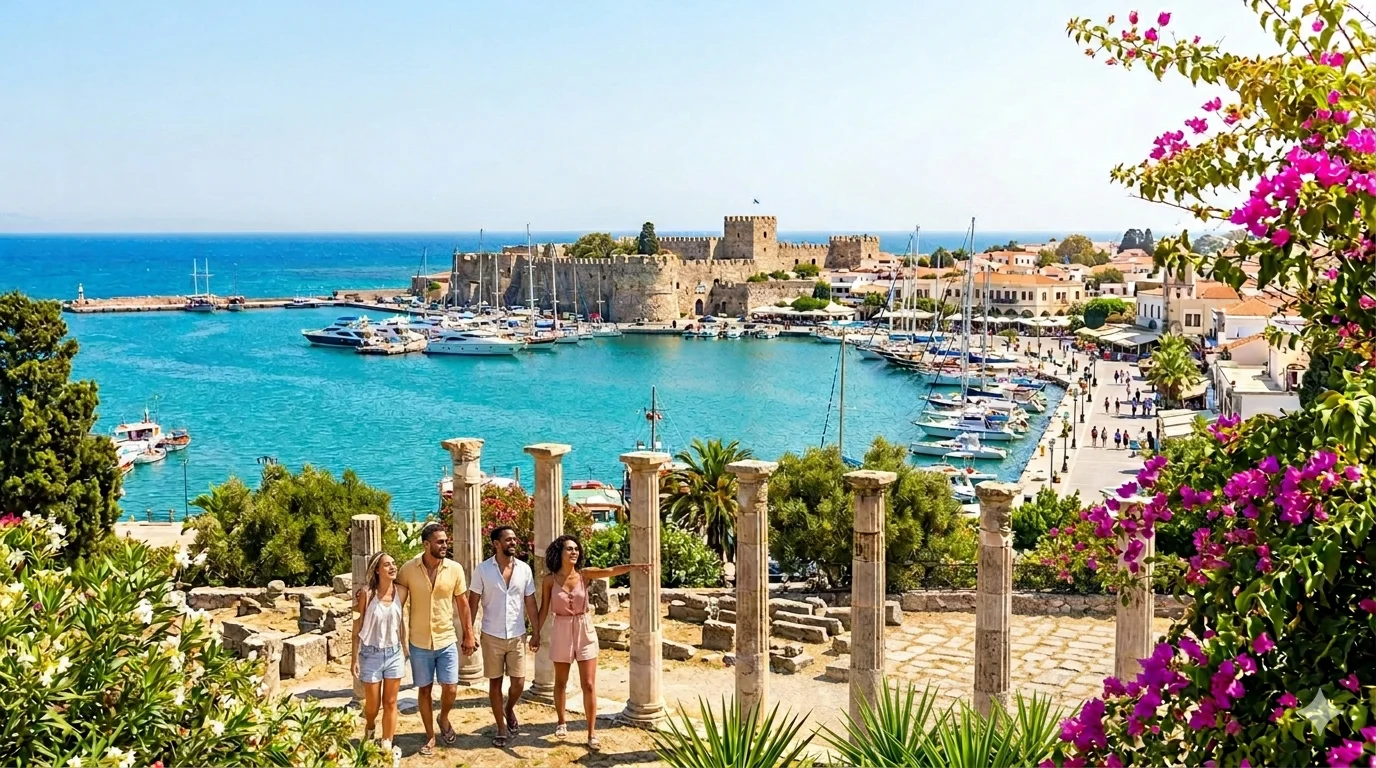
The old harbor of Kos is framed by the Castle of the Knights — a 15th-century fortification built by the Knights Hospitaller that incorporates ancient marble in its walls as building material. From the castle, the walk south into the old town passes the ancient agora, the Roman Odeon, the Casa Romana (a restored Roman villa with original mosaics), the Ottoman Defterdar Mosque, and the plane tree under which Hippocrates allegedly taught medicine — all within a 15-minute radius.

3

Nisyros Day Trip: the volcano next door

One of the great underrated excursions of the Greek islands. Nisyros is a volcanic island 22 km southwest of Kos, with an active caldera at its centre that visitors can walk into — standing on the grey-yellow crater floor, surrounded by steaming vents and sulphurous formations, with the medieval village of Mandraki visible on the clifftop above. Day trip boats depart from Kardamena and Kos Town, typically including 2–3 hours on the island.

4

Kefalos & the southwest peninsula

The village of Kefalos sits on a promontory at the southwestern tip of the island, above a long arc of beach that ranks among the most visually dramatic in the Dodecanese. The area includes Agios Stefanos beach — where the ruins of an early Byzantine basilica stand directly on the sand, with the islet of Kastri and its tiny chapel visible a few hundred metres offshore.

5

Zia: the mountain village at golden hour

Zia is a small village on the slopes of Mount Dikaios — the only significant elevation on an otherwise flat island — and has become famous specifically for its sunset views over the western coast and the islands of Kalymnos and Pserimos. The view is genuinely excellent and the tavernas are competent, but arrive by 18:00 in summer to secure a table.

6

Therme: where hot springs meet the Aegean

On the northeastern coast beyond Kos Town, geothermal springs emerge directly at the waterline and flow into the sea, creating natural warm pools in the rocks accessible for free at any time. The site is informal and atmospheric — there are no facilities, no entrance fee and no organization — but it is one of those genuinely surprising natural experiences that feels out of place on a beach holiday island. Go at dawn or dusk.

7

Kalymnos Day Trip: the island of sponge divers

Kalymnos is 45 minutes by ferry from Kos Town and offers a completely different island character: a dramatic, mountainous landscape, a strong tradition of sponge diving (with a dedicated museum in the port town of Pothia), and a rock-climbing scene that has made the island internationally known among climbers. A day trip here adds significant texture to a Kos-based stay without requiring an overnight.

Kos

Top Beaches

💡 Secret: The beaches of the southwest coast — particularly around Kefalos Bay — see a fraction of the visitors that crowd Tigkaki and Marmari, yet offer equally good water quality and often better natural settings. A car or scooter is required; the reward is significant.

Tigkaki

The most popular organized beach on the island, approximately 12 km west of Kos Town along the flat coast. Long, sandy and well-served by sun loungers, beach bars and water sports facilities. The cycle path from town makes it genuinely accessible without a vehicle. Best visited early morning or late afternoon in July–August.

Marmari

Adjacent to Tigkaki and with a similar character, Marmari is slightly quieter and has a long reputation for windsurfing and kitesurfing conditions. The steady Meltemi winds of July and August that frustrate other beach-goers are exactly what the windsurfing community comes for.

Paradise Beach (Bubble Beach)

A small, sheltered cove near Kardamena on the south coast, named for the natural CO₂ bubbles that rise from the seabed and can be felt underfoot in shallow water — another expression of the volcanic geology active across this part of the Dodecanese.

Agios Stefanos (Kefalos)

One of the most photogenic beach settings in the Dodecanese: white sand, pale turquoise water, the Byzantine basilica ruins on the shoreline, and the chapel islet of Kastri immediately offshore. The beach itself is calm and relatively uncrowded by Kos standards.

Agios Fokas & Therme

The east coast beyond Kos Town is rockier and less organised than the western resort beaches, but Agios Fokas has a raw quality and the nearby Therme springs make the stretch genuinely unique. The combination of a swim in open water followed by a soak in the natural thermal rocks is one of the more memorable physical experiences the island offers.

Kos

Local food & flavours

Kos Honey

The island produces some of the finest thyme honey in the Dodecanese, shaped by the wild herbs of Mount Dikaios. It appears in everything from breakfast to dessert and is the right souvenir to take home.

Fresh Fish in Kefalos and Mastichari

The fishing harbors of Kefalos (southwest) and Mastichari (northwest) have tavernas where the daily catch is often displayed at the door. The cooking is simple: grilled, with olive oil and lemon.

Mezes in Kos Town and Platani

The village of Platani — between Kos Town and the Asklepion — has a small cluster of restaurants that reflect the island's Ottoman heritage with dishes rarely found elsewhere in the Dodecanese: slow-cooked meats, chickpea stews and yogurt-based preparations.

Loukoumades and Street Sweets

The Kos Town market area near the ancient agora has several spots serving fresh loukoumades — deep-fried dough balls with honey and cinnamon — that have been the default street snack across the Dodecanese for generations.

Kos

Practical Tips

1

Cycling is real here — use it

The flat terrain and the dedicated cycle path along the north coast are a genuine logistical advantage. A bike from the town rentals costs around €5–8 per day and puts Tigkaki, Marmari and the Asklepion within reach without dealing with parking or traffic.

2

Allocate one full cultural day to Kos Town

The Casa Romana, the agora, the Odeon, the Castle of the Knights and the plane tree area are all walkable from the port and deserve unhurried attention. Combining them with the evening harbor atmosphere gives the day a natural structure.

3

Book the Nisyros day trip in advance in July and August

Boats operate daily but fill quickly. The excursion typically departs early morning and returns by late afternoon — allowing a full Kos Town evening. Check departure ports (Kos Town and Kardamena both offer options).

4

Rent a scooter or car for one day specifically to explore the southwest peninsula

The road from the resort belt to Kefalos, Agios Stefanos and Kamari is one of the most scenic drives in the Dodecanese and reveals an island character entirely different from the organized beach corridor.

5

The Turkish coast is visible and very close

The Bodrum crossing is a genuine option for those with current documentation — the port is active and the crossing is straightforward. Check entry requirements and ferry schedules close to your dates.

Kos

Frequently Asked Questions

How many days do I need for Kos?

Three to four days cover the Asklepion, Kos Town, the main beaches and a day trip to Nisyros comfortably. Five to six days allow the southwest coast, a second island excursion (Kalymnos or Patmos) and a more unhurried pace throughout.

Do I need a car or scooter?

For Kos Town and the western beach corridor, a bicycle is genuinely sufficient and more enjoyable. For the southwest (Kefalos, Agios Stefanos, Kamari) and the interior villages (Zia, Asfendiou), a car or scooter is strongly recommended.

Is Kos good for families?

Yes — notably so. The flat terrain, calm sea on the western coast, organized beaches with facilities, the cycling paths, and the variety of historical sites suitable for older children make Kos one of the more family-adapted islands in the Dodecanese.

Can I visit Turkey from Kos?

The ferry crossing to Bodrum takes approximately 45 minutes and operates regularly in summer. Entry requirements and documentation rules vary. Always check current regulations before planning this as part of your itinerary.

Is the Asklepion worth visiting?

Consistently and significantly yes — it is one of the most historically important sites in the Aegean and is not adequately crowded for most of the season. The combination of the archaeological significance, the landscape setting and the view makes it one of the genuinely rewarding cultural stops in all of Greek island travel.