
Where to Stay in Kos
Kos — Dodecanese
Find the best places to stay in Kos — from the lively Old Town and the cosmopolitan strip of Psalidi to the family beaches of Tigaki, the quiet coves of Kefalos and the upscale resort bays of Kardamena. A complete guide to Kos hotels and areas.
Relaxing stays, beautiful views and authentic hospitality — organized in a clear and practical way.
Description
Choosing where to stay in Kos shapes your holiday more than on most Greek islands. Kos is long and narrow — about 45 kilometres from end to end — and the character of each area changes dramatically from east to west. The capital blends a medieval castle, an ancient agora, Ottoman mosques and a palm-lined harbour into a genuinely historic and walkable city. Twenty minutes west, the resort towns of Tigaki and Marmari offer clean, shallow beaches suited to families. Another 25 minutes further, Kardamena draws large all-inclusive hotels, organised beach clubs and a nightlife strip. At the far western tip, the Kefalos peninsula is the quietest and most scenically dramatic part of the island. This guide covers the six main areas for accommodation in Kos, with honest advice on who each one suits — and who it does not.
1. Kos Town — The Most Complete and Interesting Base on the Island
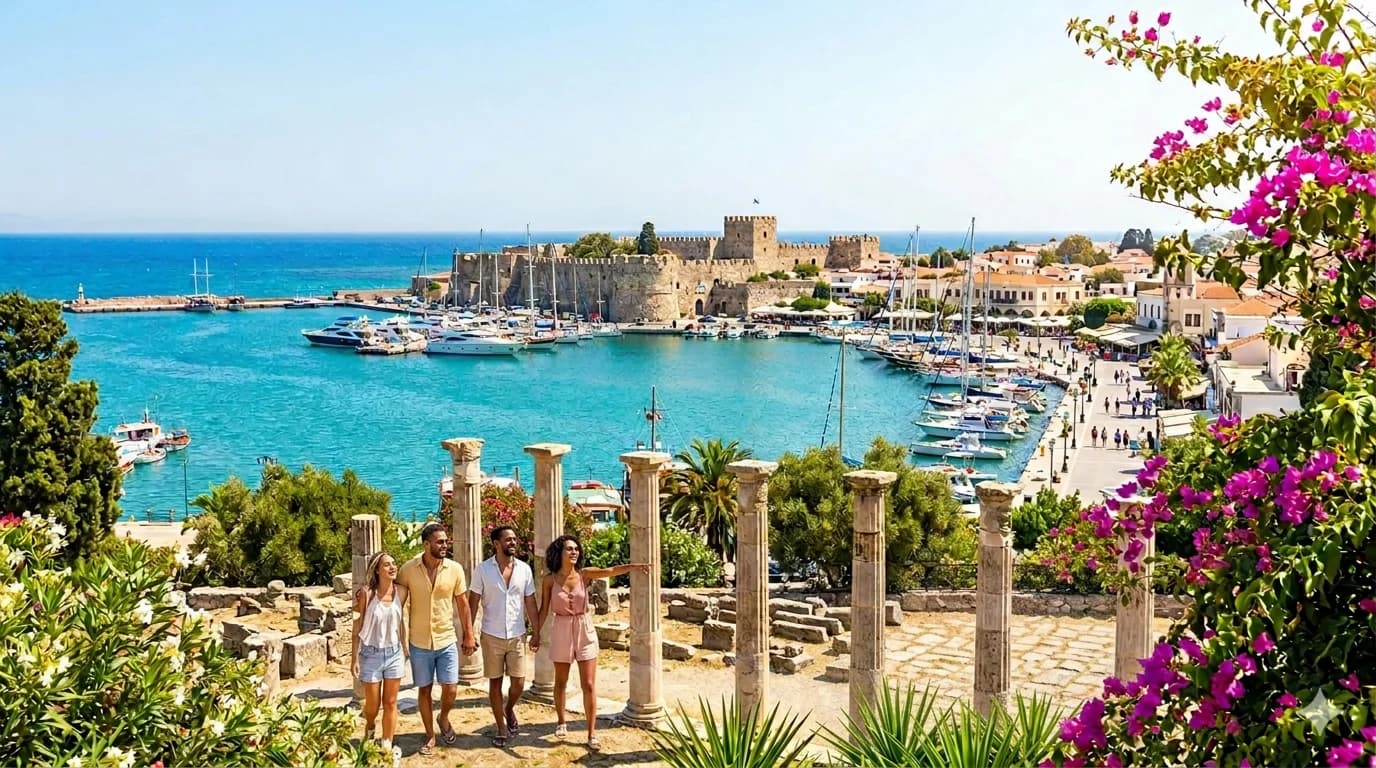
Kos Town is the capital and the most rewarding base for anyone who wants more from their holiday than sun and sand. The waterfront is anchored by the imposing Neratzia Castle — a 15th-century Knights Hospitaller fortress — and the ancient plane tree of Hippocrates, reputedly one of the oldest in Europe, shades the square just behind the port. The ancient agora, Hellenistic colonnades and the well-preserved Roman Odeon are all within a ten-minute walk of the centre. Two Ottoman mosques, a neoclassical market hall and Venetian-era buildings give the town a layered historical character that few Aegean island capitals can match.
The town is also thoroughly lively in the evenings. The main bar street — Nafklirou — runs just behind the harbour and fills every night in summer. Dining options are genuinely good by island standards: fresh fish tavernas at the old harbour, Italian restaurants on the pedestrian lanes, rooftop bars overlooking the castle. The beach immediately in front of the town (around Psalidi, running east) is sandy and easily walkable from central accommodation.
Kos Town is also the practical hub of the island. The ferry port connects to Bodrum in 30 minutes and to Rhodes, Kalymnos, Leros and the outer Dodecanese throughout the week. The airport is 26 km away. The Asklepion is 4 km from the centre — a 15-minute bike ride.
Accommodation style ranges from boutique hotels in restored Neo-Classical buildings near the castle to mid-range seafront hotels along the harbour and budget-friendly guesthouses behind the centre.
Honest note: Kos Town has a proper bar scene, and the area around Nafklirou Street is genuinely noisy until the early hours in peak season. If you want quiet evenings, book away from the nightlife streets or choose one of the beach areas further west. Kos Town is also not a beach destination — the nearest decent beach is a 15-minute bike ride west. For everyone else — couples, solo travellers, culturally curious visitors — Kos Town is the undisputed first choice.
2. Psalidi and Lambi — The Beach Resort Strip Closest to Town
Psalidi runs along the coast immediately east of Kos Town, continuing around the cape toward the Psalidi peninsula. Lambi is the equivalent strip running west of the town centre, toward the airport road. Together, these two areas form the main beach resort zone adjacent to the capital — long stretches of sandy beach, a concentration of mid-range and four-star hotels, and easy access to the town on foot or by bicycle.
Lambi is slightly closer to the centre (fifteen minutes on foot) and has a more local character — a few fish tavernas and waterfront cafés that cater to both tourists and residents. Psalidi is quieter and more resort-oriented, with several larger hotel complexes that have private beach facilities, pools and evening entertainment.
The main advantage of this zone is proximity to Kos Town without being inside the nightlife area. You are within easy reach of the ferry port, the ancient sites and the best restaurants, while waking up directly on the beach.
Accommodation style: Predominantly three- and four-star hotels with pools, some all-inclusive options, and well-maintained apartment complexes. Prices are moderate.
Honest note: This strip is heavily built-up and lacks the scenic drama of the west coast beaches. For first-time visitors, couples wanting a beach holiday with cultural access nearby, and anyone flying in and out of Kos Airport, this is a reliable and convenient base.
3. Tigaki — The Best Family Beach Base on the Island
Tigaki is a long, wide beach of fine white sand approximately 12 km west of Kos Town, backed by low dunes and a salt lake that is home to flamingos in spring and early summer. The water is shallow and calm — among the safest on the island for children. The beach extends for several kilometres without the rocky patches that characterise some of the east coast alternatives.
The village behind the beach is small but functional: a main street with tavernas, minimarkets and rental agencies. It is not glamorous, but genuinely pleasant and unpretentious. Kos Town is a 20-minute drive away. The cycle path reaches Tigaki directly, making it accessible without a car.
Tigaki also happens to be one of Europe's better windsurfing locations. The consistent summer winds attract board sports enthusiasts from across the continent, and several schools and hire centres operate on the beach.
Accommodation style: Mostly mid-range hotels and apartment studios. Several smaller family-run properties offer genuinely good value. No large five-star resorts.
Honest note: Tigaki is not the place to come if you want nightlife, sophisticated dining or architectural interest. The beach and the flamingos are the attraction. For families with young children, it is probably the single best base on the island.
4. Marmari — The Quieter, More Relaxed Alternative
Marmari sits just west of Tigaki and shares much of the same beach — a continuation of the same long sandy coastline — but with a noticeably quieter character. It is smaller, less developed and more local in feel. The main beach is wide and rarely crowded outside the peak August weeks. The windsurfing conditions here are even better than Tigaki, making Marmari a preferred base for serious board sports practitioners.
The village has a small harbour used by local fishing boats, a handful of tavernas and a modest range of shops. Kos Town is 25 minutes by car. There is limited nightlife, which is precisely what draws the visitors who choose Marmari over the livelier alternatives.
Accommodation style: Small hotels, studios and apartments. Properties tend toward the simple and the owner-run. Very few large organised complexes.
Honest note: Marmari is genuinely quiet — the right choice only for travellers who actively want that: couples, those on longer stays, or windsurfers here primarily for the water. For anyone who wants evening activity, restaurants with a view, or cultural interest within walking distance, it is the wrong base.
5. Kardamena — The Liveliest Resort Town and the All-Inclusive Centre
Kardamena is 30 km west of Kos Town and the island's largest purpose-built resort destination. It developed rapidly from a small fishing village into one of the most organised beach resort towns in the Dodecanese — a long sandy beach backed by a strip of hotels, bars, restaurants and beach clubs, with a nightlife scene that runs through the night in peak season.
The beach at Kardamena is undeniably good: wide, sandy, well-organised and facing south across calm, warm water. Several of the largest hotel complexes on the island are located here — properties with multiple pools, waterparks, animation teams and full all-inclusive programmes. For families or groups who want a self-contained holiday with minimal planning, Kardamena delivers that efficiently.
The harbour still launches boat trips to Nisyros with its active volcanic crater, directly south and visible from the beach.
Accommodation style: Large four- and five-star all-inclusive hotels dominate, alongside a full range of apartments, studios and mid-range hotels.
Honest note: Kardamena is not for everyone. The resort atmosphere is explicit — beach chairs at dawn, nightclubs at midnight. Visitors who choose it for a lively, beach-focused, hassle-free package holiday tend to find it excellent for exactly that. Visitors expecting authentic Greek life or quiet evenings tend to find it wrong.
6. Kefalos and the West — The Most Scenic and Authentic Part of the Island
The Kefalos peninsula at the western tip of Kos is as different from Kardamena as it is possible to be while remaining on the same island. The landscape becomes dramatically hilly — volcanic rock, scrubland and citrus groves tumbling toward a coastline of some of the most beautiful beaches in the Dodecanese. Agios Stefanos, Camel Beach, Kastri and the long sweep of Paradise Beach are all within the Kefalos bay, looking out to the small island of Kastri with its tiny Byzantine chapel.
The village of Kefalos itself sits on a hilltop above the bay — a genuinely traditional settlement with a windmill, an old castle ruin on the clifftop and a main street of local kafeneions where the menu is handwritten and changes daily. There are no large hotel complexes here. The handful of boutique properties, small hotels and rented rooms attract visitors who have already done the resort experience elsewhere.
Agios Stefanos beach, backed by the ruins of a 5th-century Early Christian basilica, is one of the most photographed locations in the Dodecanese.
Accommodation style: Small boutique hotels, traditional guesthouses, private villas. Limited availability — book early.
Honest note: The Kefalos area requires a car at all times. Kos Town is 40–45 minutes east. Services are limited — no supermarkets or pharmacies within easy walking distance. Evening options are the quietest on the island. For travellers who want natural beauty, genuine local character and the island's best beaches without crowds, Kefalos is the finest choice on the island.
Frequently Asked Questions
How many nights should I spend in Kos?+
Four to five nights is the comfortable minimum for a rounded experience — enough time to explore Kos Town properly, visit the Asklepion, reach the west coast beaches and take a day trip to Nisyros. A week allows you to slow down and explore the mountain villages of the interior.
Is Kos Town noisy at night?+
The area around Nafklirou Street and the central waterfront is busy until the early hours in July and August. Hotels on the harbour-facing and castle side are generally quieter than those in the bar district.
Can I take a day trip to Turkey from Kos?+
Yes. Regular ferries connect Kos Town to Bodrum in approximately 30 minutes, making it one of the easiest Greece-to-Turkey crossings in the Aegean. Check visa requirements for your nationality before travelling.
Is Kos good for families?+
Extremely. Tigaki and Psalidi offer the safest and most practical family beaches. Kardamena has the largest family-oriented all-inclusive hotels. The flat terrain makes it excellent for cycling with children.