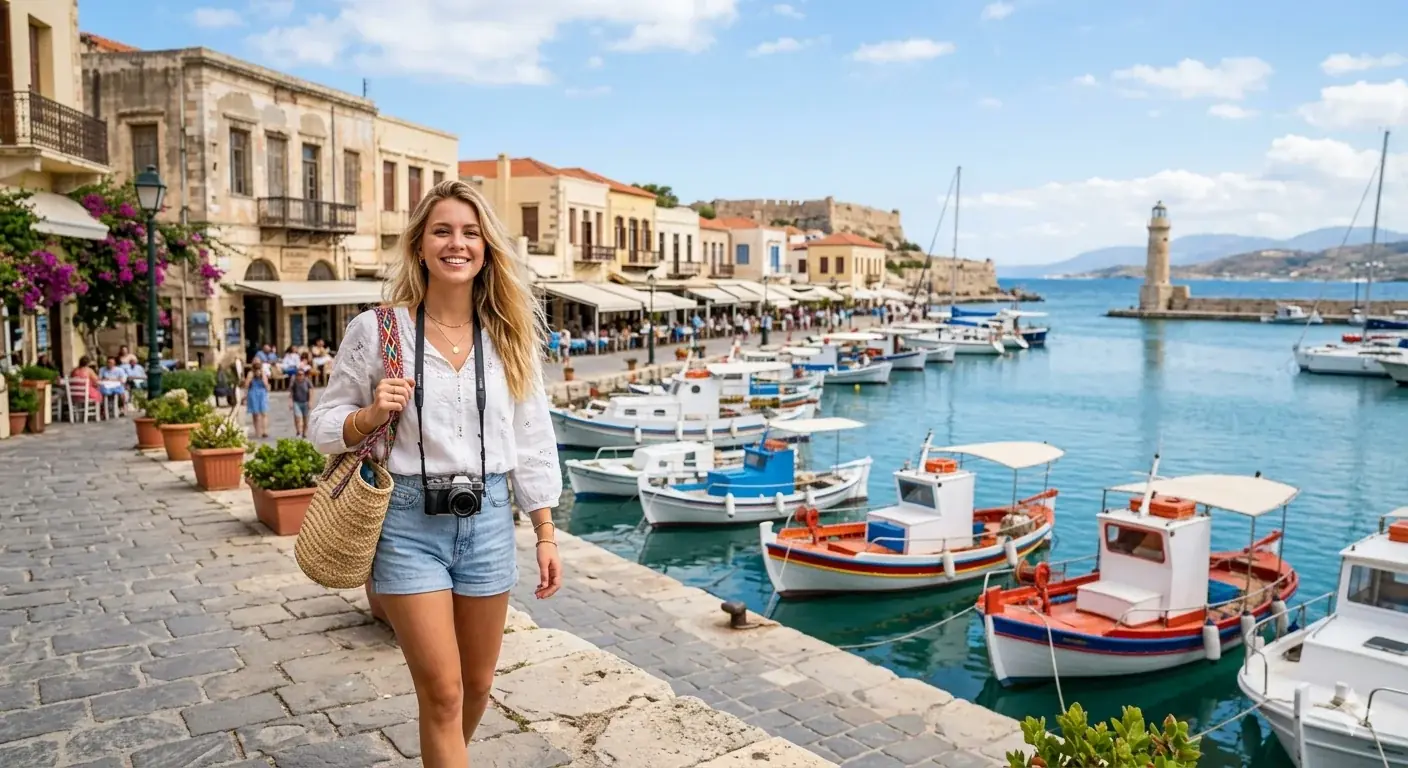
Destination Overview
Rethymno
Rethymno is the kind of city that makes you slow down. Not because there is nothing to do — there is plenty — but because every alley in the Old Town seems to ask for a second look, every archway carries a different century, and every café terrace feels like an invitation to stay a little longer than planned.
It is Crete's third-largest city, positioned in the heart of the island's northern coast, roughly halfway between Heraklion and Chania. In many ways that geography reflects its character: it shares the grandeur of both but has kept something they have largely lost — intimacy.
Architecturally, Rethymno is one of the best-preserved Venetian cities in the Mediterranean. The Republic of Venice controlled Crete from 1204 to 1669 and left behind fountains, loggia buildings, harbour fortifications, and a lighthouse that still stands. The Ottomans then added minarets, hammams, and a different kind of layered beauty. That double legacy is what makes walking the Old Town feel genuinely different from anywhere else in Greece.
Beyond the historic centre, Rethymno has a long sandy beach extending eastward from the harbour, excellent local food, and immediate access to some of Crete's most dramatic interior landscapes — the Amari Valley, the Psiloritis mountain range, and the iconic Preveli Gorge and beach. This is a destination that works at every pace.
Planning a wider trip around the island? Explore our full Crete Travel Guide for regional ideas, road trip inspiration, and more places to stay.
Rethymno
Why Visit Rethymno
Rethymno is the kind of city that makes you slow down. Not because there is nothing to do — there is plenty — but because every alley in the Old Town seems to ask for a second look, every archway carries a different century, and every café terrace feels like an invitation to stay a little longer than planned.
It is Crete's third-largest city, positioned in the heart of the island's northern coast, roughly halfway between Heraklion and Chania. In many ways that geography reflects its character: it shares the grandeur of both but has kept something they have largely lost — intimacy. The scale is human. The Old Town fits inside a 20-minute walk. The fortress on the hill is visible from everywhere. And the beach starts right where the harbour ends.
Architecturally, Rethymno is one of the best-preserved Venetian cities in the Mediterranean. The Republic of Venice controlled Crete from 1204 to 1669 — more than four centuries — and left behind fountains, loggia buildings, harbour fortifications, and a lighthouse that still stands. The Ottomans then added minarets, hammams, and a different kind of layered beauty.
Rethymno
Best Time to Visit Rethymno
**May & June** — Best overall. Warm enough to swim from mid-May, the city is lively but not packed. Ideal conditions for the Fortezza and day trips to Preveli.
**July & August** — Best for beach. The city beach and nearby Platanias are full. The Old Town hosts open-air concerts and the Renaissance Festival in August.
**September & October** — Hidden gem. Sea still warm until mid-October. The tourist wave has receded. Tavernas are quieter and the light turns golden.
**November – April** — Off-season. The city remains open and authentic. February–March brings the Rethymno Carnival — one of the largest in Greece.
Rethymno
How to Get to Rethymno
**By plane** — Fly into Chania (CHQ, ~60 km, 1 hour by car) or Heraklion (HER, ~80 km, 1h15min). Both have direct international flights from major European hubs.
**By car** — Car rental is strongly recommended for day trips to Preveli, Arkadi, and the Amari Valley. Pick up at either airport. The E75 coastal motorway is fast and well-maintained.
**By bus (KTEL)** — Frequent daily buses from Heraklion (~1.5 hours) and Chania (~1 hour). Good for inter-city routes but limits flexibility for reaching the interior.
**By ferry** — Overnight ferry connections to Piraeus (Athens) take 7–8 hours. Minoan Lines and ANEK operate seasonal routes.
Rethymno
Top Attractions & Experiences
Fortezza Castle
The largest Venetian fortress ever built, constructed between 1573 and 1587. It enclosed an entire city — a cathedral, barracks, cisterns, and governor's residence. The 360-degree views from the bastions take in the Old Town, harbour, and on clear days the White Mountains.
Old Town & Venetian Harbour
A UNESCO-listed area and one of the most complete surviving examples of Venetian urban planning. The Rimondi Fountain (1629), the Venetian Loggia, and narrow lanes with Ottoman-era wooden overhangs and carved stone doorways make this one of the finest old towns in the Mediterranean.
Arkadi Monastery
25 km southeast of Rethymno, the Monastery of Arkadi is one of the most emotionally charged sites in Greece. In 1866, hundreds of Cretan rebels chose to detonate their own gunpowder stores rather than surrender to Ottoman forces, shocking Europe and accelerating support for Cretan independence.
Preveli Gorge & Palm Beach
One of the most iconic landscapes in Crete. The Kourtaliotis Gorge descends through dramatic limestone cliffs to a lagoon fringed with native Cretan date palms. Accessible via a steep path from the Preveli Monastery car park or by boat from Plakias.
Amari Valley
The best introduction to Crete's interior. Traditional villages, Byzantine churches with medieval frescoes, olive oil and cherry production, and a way of life that feels genuinely apart from the coastal tourism economy.
Neratzes Mosque & Minaret
Originally a 13th-century church, converted to a mosque in 1657. The minaret is the tallest in Crete at 27 metres and is occasionally open for climbing — the view of the Old Town from the top is extraordinary.
Rethymno
Beaches, Coast & Swimming
Rethymno City Beach
Begins immediately east of the Venetian harbour and runs for kilometres. Sandy, shallow, and easily walkable from the Old Town. Near the harbour it has sunbeds and beach bars; further east it becomes free and less organized.
Preveli Beach (Palm Beach)
The most photographed beach in the region — a lagoon with native Cretan date palms opening to a sandy bay. Accessible by steep path or by boat from Plakias. Exceptionally beautiful.
Plakias
A relaxed south-coast village with a wide sandy bay and laid-back atmosphere. Good tavernas at the water's edge. Strong base for hiking the coastal paths between Plakias and Preveli.
Georgioupoli
20 km west of Rethymno, a small town at the mouth of the Almiros river with a long sandy beach and eucalyptus grove. Family-friendly and photogenic.
Rethymno
What to Eat in Rethymno
**Dakos** — The foundational Cretan dish: dried barley rusk soaked in olive oil, topped with tomato, mizithra cheese, olives, and oregano.
**Staka** — The sediment from rendered sheep's butter, fried until golden and served with eggs or bread. Rich and deeply savoury.
**Snails (Chochlioi Bourbouristi)** — Fried snails with rosemary and vinegar, associated with Rethymno's traditional tavernas.
**Kalitsounia** — Small fried or baked pastries filled with fresh mizithra and herbs. Found in every bakery in the Old Town.
**Local Wine & Tsikoudia** — Crete produces wine from Vidiano, Thrapsathiri, and Kotsifali grapes. Tsikoudia (Cretan raki) is offered gratis after every meal.
Rethymno
FAQ — Rethymno Essentials
Common questions for planning your trip to Rethymno.
How many days do you need in Rethymno?
A minimum of 3 nights — two full days in the city and one for a day trip to Preveli, Arkadi, or the Amari Valley. Four nights is the comfortable option if you want to explore the south coast.
Is Rethymno or Chania better?
Chania has a more polished harbour and proximity to its airport. Rethymno has a more intact Old Town, a better city beach, and arguably more authentic daily life. Chania is the obvious choice for first-time visitors; Rethymno rewards those who want depth over spectacle.
Do you need a car in Rethymno?
For the city itself, no — everything is walkable. For day trips to Preveli, Arkadi, Amari Valley, and Plakias, yes — public transport is infrequent and inflexible.
Is Rethymno good for families?
Yes — the city beach is long and shallow-entry, the Old Town is compact, and there are good family tavernas throughout. Plakias and Georgioupoli offer calm family-friendly beaches within easy day-trip range.
What is the closest airport to Rethymno?
Chania (CHQ) at ~60 km west (55–65 minutes by car). Heraklion (HER) is 80 km east (~1h15min). Chania is marginally more convenient for western Crete.
Is Rethymno open year-round?
Yes — supported by the university population. Many hotels close November–February but the Old Town retains cafés, restaurants, and shops year-round. The Carnival in February–March is a major draw.