
Where to Stay in Rethymno
Rethymno — Central Crete
Choosing where you sleep in Rethymno shapes everything — from waking to Venetian bell towers to stepping straight onto a long sandy beach at dawn. Find the best areas: Old Town for atmosphere, Harbour & Lighthouse for romance, City Beach strip for convenience, East Coast for family resorts, Plakias & South for escape, and inland villages for authentic Cretan life.
Relaxing stays, beautiful views and authentic hospitality — organized in a clear and practical way.
Description
Relaxing stays, beautiful views and authentic hospitality — organized in a clear and practical way.
1. Venetian Old Town: The historic heart — sleep inside history
Staying in the Old Town means waking up to the sound of the fountain rather than traffic, walking to the Fortezza before the day-trippers arrive, and finding that the light on the Venetian archways in the early morning looks exactly as it did in the watercolour illustrations of the 19th century. This is the experience that no hotel on the beach strip can replicate.
The Old Town's accommodation is predominantly boutique — restored Venetian buildings converted to small hotels, stone-vaulted guesthouses, and manor-style suites with wooden ceilings and private courtyards. The inventory is not large, so properties book out early. Prices reflect both the scarcity and the quality of the setting.
The practical trade-off: the Old Town is largely pedestrianised. You will not be able to park at your door, and you may carry luggage on cobblestones. The streets are also narrow and evening café life carries easily — lighter sleepers should look for properties set back from the main lanes. Rooms facing interior courtyards are consistently quieter than those on street-facing facades.
2. Venetian Harbour & Lighthouse: The waterfront zone — evenings on the water
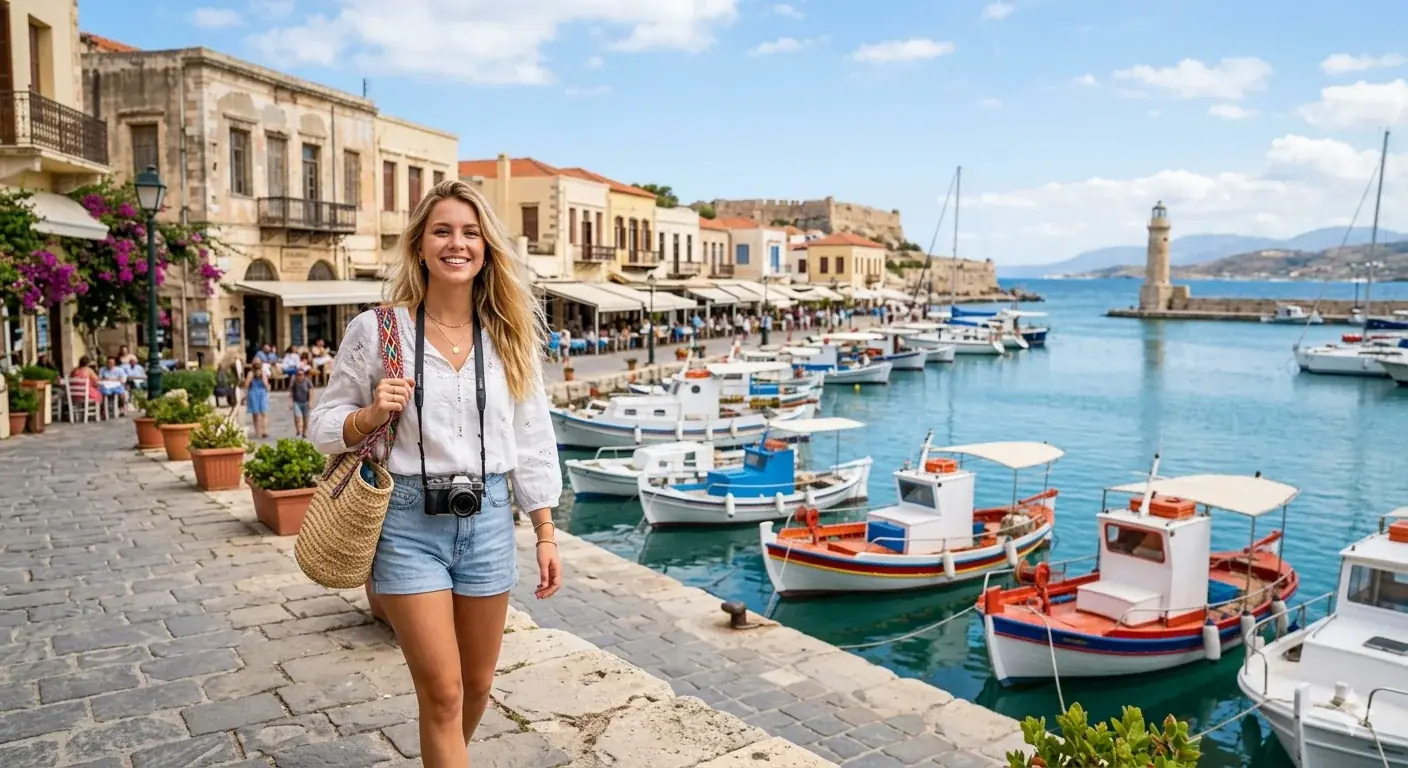
The area immediately around the Venetian Harbour and the lighthouse peninsula is one of the most photogenic small waterfronts in the whole of Crete. Hotels and apartments here command harbour views, and the strip of restaurants along the inner harbour offers the classic Rethymno evening: fresh fish, white wine, and the boats moving gently in the water behind your table.
The harbour area sits between the Old Town (2–3 minutes on foot) and the city beach (5 minutes the other way), making it the most centrally positioned accommodation zone in Rethymno. The Fortezza is 10 minutes on foot. For visitors who want access to everything without committing to the full Old Town immersion, this is consistently the best single answer.
3. City Beach Strip (Eleftheriou Venizelou): The central seafront — beach and city without a car
The city beach strip runs along Eleftheriou Venizelou avenue, directly east of the harbour, and is the most popular accommodation zone in Rethymno for a straightforward reason: it delivers both the city and the beach without requiring a car. The Old Town is a 5–8 minute walk in one direction; the sea is 30 seconds in the other. Hotels here range from mid-range family properties to boutique hotels and small apartment complexes.
The beach is organized with sunbeds and beach bars and is at its busiest from late June through August. For visitors on a 3–4 night schedule who want to explore the city, visit the Fortezza, do a day trip to Preveli or Arkadi, and swim every morning, this strip delivers all of that without any logistics.
4. East Coast — Platanias, Sfakaki & Panormo: Resorts, families and wide sandy beaches
Heading east from Rethymno along the E75, the coast opens up into a succession of sandy beaches and resort zones: Platanias (10 km), Sfakaki (14 km), Stavromenos (18 km), and Panormo (22 km). This is where Rethymno's large resort hotels are concentrated — properties with pools, kids' clubs, full-board options, and organized beach infrastructure that families with young children often need.
The beaches are wide, sandy, and gently shelving into calm, shallow water. Panormo, in particular, is a small fishing village with a genuinely charming harbour square and some of the best locally run tavernas within 25 km of Rethymno. Staying here gives a softer, more village-like experience than the resort complexes further west while being within easy driving distance of Rethymno's Old Town.
The main trade-off is distance from the city. Platanias and Sfakaki are 15–20 minutes by car from the Old Town. That changes the rhythm of the stay: you are based at the coast, and the city becomes something you visit deliberately. For families prioritising beach time, this is completely reasonable.
5. Plakias & the South Coast: The remote alternative — hikers, independents, and silence
Plakias sits on the south coast, 45 km from Rethymno over a mountain road that crosses the Kourtaliotis Gorge — one of the most dramatic drives in Crete. The village has a wide sandy bay, a relaxed local atmosphere, a handful of good tavernas by the water, and almost no nightlife. It is the antithesis of the resort east coast.
Staying here makes sense for walking the coastal trail to Preveli Palm Beach (2.5 hours), swimming in the uncommercialised coves of Damnoni and Ammoudi, and eating grilled fish at the harbour. The road to Rethymno takes 45–55 minutes through spectacular gorge scenery.
Accommodation ranges from small apartments and studios run by local families to a handful of well-regarded small hotels. There are no large resorts. For May, June, September, and October, Plakias is at its best.
6. Inland Villages — Margarites, Thronos, Anogia: The Crete that hasn't changed
A small number of traditional Cretan villages within the Rethymno region offer accommodation in restored stone houses and family guesthouses: Margarites (20 km south, known for ceramics), Thronos (35 km, overlooking the Amari Valley with a Byzantine mosaic in the village church), and Anogia (50 km, a high-mountain village at the foot of Psiloritis, famous for music, weaving, and fierce independence).
Staying here is a choice to experience a fundamentally different Crete. Mornings are cool and quiet. The coffee comes with the sound of goat bells. The family that runs the guesthouse likely also owns the olive grove you can see from the terrace. Rethymno is 30–50 minutes by car.
This works best for travellers staying a week or more who want to divide time between coast and interior, and who are comfortable driving mountain roads. Not practical for a short 2–3 night trip.
✓ Authentic Cretan village life, cool mountain air (ideal in peak summer), outstanding home-cooked food, very affordable, access to hiking trails and Psiloritis.
Frequently Asked Questions
Where is the best area to stay in Rethymno for a first visit?+
The Old Town or the Harbour area. These give you the authentic Rethymno — the Venetian architecture, evening passeggiata, the Fortezza, and the city beach a short walk away. If you are staying only 2–3 nights, choosing the city beach strip over the Old Town is an understandable but real compromise.
Is Rethymno or Chania a better base for western Crete?+
Chania is closer to its airport. Rethymno has a more intact Old Town and is the better base for Preveli, Arkadi, and the Amari Valley. For Samaria Gorge and Balos, Chania is more convenient. For a single base covering west and central Crete, Rethymno is arguably the more central and versatile choice.
Do I need a car in Rethymno?+
For the city itself, no — the Old Town, Fortezza, harbour and city beach are all walkable. For day trips to Preveli, Arkadi, the Amari Valley, and Plakias, yes — a car is strongly recommended. Pick up at Chania or Heraklion airport.
Is the Old Town noisy at night?+
Yes, the main lanes around the Rimondi Fountain can be lively with café noise until late. Choose properties set back from the main squares or with interior courtyards for quiet. The trade-off is worth it — the atmosphere of the Old Town in the evening is one of the main reasons to stay there.
What is the quietest area near Rethymno?+
Plakias on the south coast, or the inland villages of the Amari Valley. Both are 40–50 minutes by car and offer genuine peace. Panormo, 22 km east, is a quieter village alternative that remains connected to the coastal road.
When should I book accommodation in Rethymno?+
For July and August: Old Town boutique properties by January–February; east coast resorts by March–April. For June and September: 2–3 months ahead is sufficient. For May, October, and off-season, last-minute booking is possible. Many south coast and village properties close November–March.