
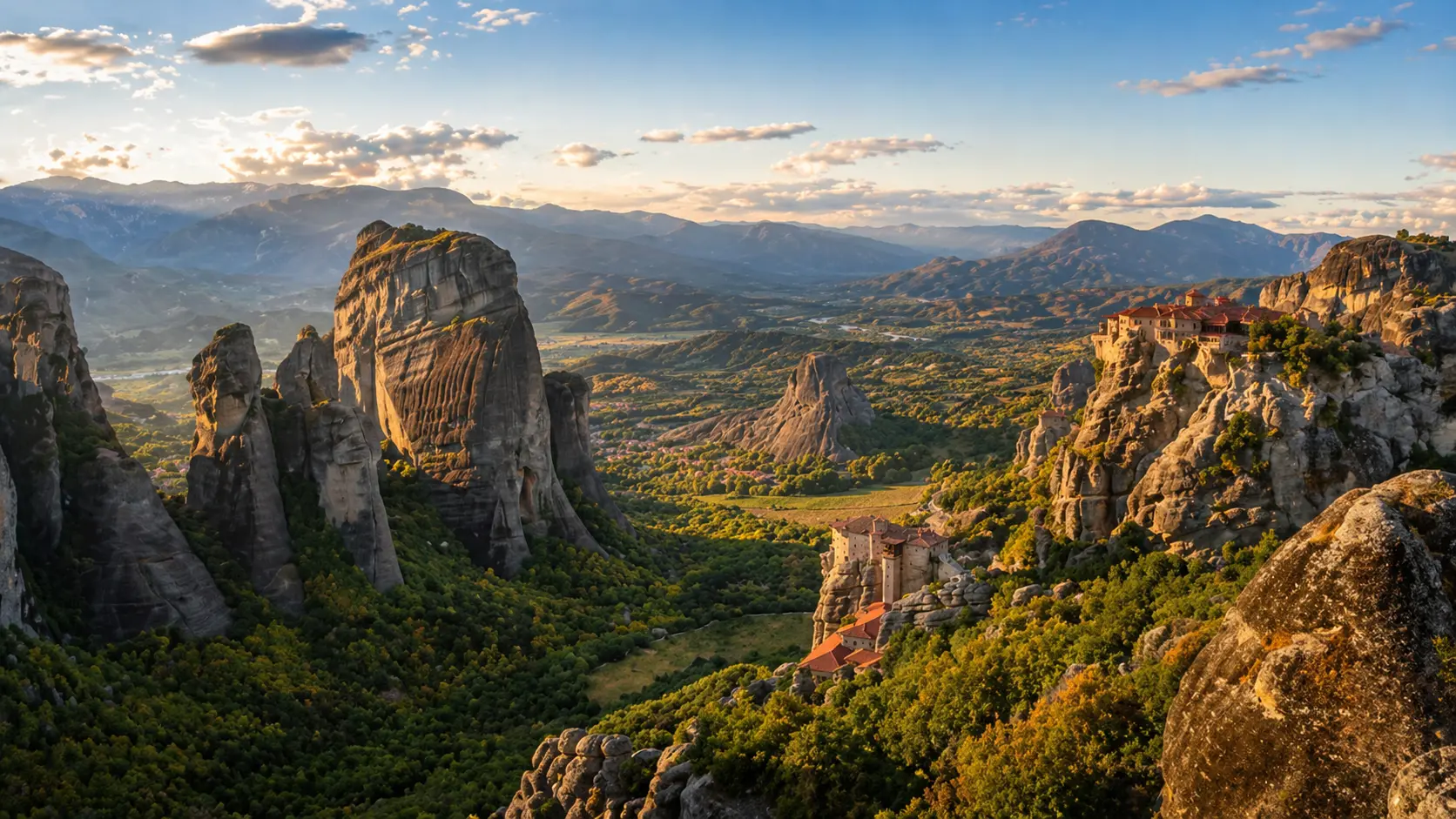
Where to Stay in Meteora
Meteora — Thessaly
Find the best places to stay in Meteora — from the practical base of Kalambaka and the atmospheric village of Kastraki nestled among the rocks, to the hidden monasteries, secret sunrise spots and day trips to Plastira Lake. The most complete guide to Meteora hotels and areas.
Relaxing stays, beautiful views and authentic hospitality — organized in a clear and practical way.
Description
Relaxing stays, breathtaking views and authentic hospitality — organized in a clear and practical way.
1. Kalambaka: The most practical base — and much more than a transit stop
Kalambaka is the main town of the region — a lively town of 12,000 inhabitants at the foot of the rocks, with a direct rail connection to Athens (about 4 hours) and Thessaloniki (about 3.5 hours), daily KTEL buses from Trikala, and the richest network of hotels, restaurants and services in the wider area. For a first-time visitor to Meteora, Kalambaka is the most logical choice: you arrive easily, find accommodation for every budget, and have restaurants open until late at night. The old town of Kalambaka, on the southeastern foothills of the rocks, is characteristically different from the centre — narrow streets, traditional courtyards, and the Early Christian Basilica of the Dormition of the Virgin (11th century), one of the most overlooked Byzantine monuments in Thessaly, with colourful mosaic floors and frescoes from the Macedonian dynasty era. Few tourists stop here — most rush towards the monasteries. Hotels in Kalambaka range from simple rooms in family-run guesthouses to fine boutique hotels with rock views from the terrace. A room with a northern or northwestern view gives direct visual contact with the rocks — a change that completely transforms the experience, especially at dawn when the mist settles in the valley. From the centre of Kalambaka, hiking trails begin towards the Monastery of Agia Triada and Agios Stefanos — worth avoiding the car for this route and doing it on foot at least once.
2. Kastraki: The most atmospheric village — built among the rocks
Kastraki is just 2 kilometres from Kalambaka, but the distance in experience is measured in entire worlds. It is a village literally built among the rocks — the first meteoric formations begin at its square, the cliffs rise vertically behind every house, and the monasteries are visible from most rooms without even getting out of bed. This makes staying in Kastraki a qualitatively different experience — you do not visit Meteora, you live inside it. The architecture is traditional Thessalian — stone houses, drystone walls, narrow cobblestone alleys and vegetable gardens. Hotels here are mainly small, family-run, with character — guesthouses and boutique rooms in renovated traditional buildings, many offering terraces with direct rock views. The Doupiani House at the northwestern edge of the village, right at the foot of the Doupiani rock, is one of the most beloved boutique hotels in the area. From Kastraki the most interesting hiking trails depart — including the path leading to the Great Meteoron Monastery through the pine forest, completely avoiding the asphalt road. The walk takes about 40 minutes at a moderate pace and is one of the most rewarding in the country. Hidden gem of Kastraki: at the northwestern edge of the village, the small chapel of Panagia Doupiani — the first church of the Meteora monastic complex — accessible by a simple 10-minute path from the edge of the village.
3. The Six Visit Monasteries: What to expect and where to go first
Of the thirty monasteries that historically operated in Meteora, only six are visitable today — and each has an entirely different character, different feel, different view. Great Meteoron: the largest and highest monastery at 613 metres, founded by Saint Athanasios in the 14th century, with an impressive museum of Byzantine icons and manuscripts. Entrance via 115 steps carved into the rock. Varlaam: next to the Great Meteoron, with exceptionally well-preserved 16th-century frescoes in the main church. Roussanou: the most visually striking monastery for photography — perched on a low, steep rock shaped like a blade, surrounded by air on all sides. A women's monastery, the nuns care for visitors with exceptional warmth. Agia Triada: internationally known as the location of the James Bond film For Your Eyes Only (1981), but worth far more than that fame — the hike from Kalambaka is one of the finest in Meteora. Agios Stefanos: the only monastery reached without stairs, crossing a bridge over a deep ravine. A women's monastery with an excellent museum of ecclesiastical embroidery. Agios Nikolaos Anapafsas: the smallest and quietest of the six, often overlooked by visitors rushing to the larger monasteries — a mistake, as it has some of the finest 16th-century frescoes in Meteora.
4. The Hidden Monasteries & The World Tourists Don't See
Beyond the six visitable monasteries, there are 15 abandoned, ruined or non-visitable monasteries — some of which can be approached and are among the most stunning hidden gems in all of Greece. Ypapantis Monastery: built in the 14th century inside a spacious sandstone cave at a height of 70 metres, now ruined but still visitable. It stands at the edge of a massive rock and offers a unique view of Kalambaka and Kastraki that cannot be seen from any of the six main monasteries. Agios Nikolaos Bantova (or Kofinas): 14th century, built at the root of a rock in Kastraki. A short hike reveals this nearly forgotten monastery, near which the openings of caves used by ascetics are still visible. Agios Georgios Mandilas: a small chapel built on a steep rock in Kastraki, non-visitable due to its position but clearly visible from below. The Skete of Stagon — Doupiani: the first monastic building of the entire complex, built in the 13th century. Its courtyard has a simple, stunning silence found nowhere else.
5. Sunrise, Sunset & Photography Spots That Don't Appear on Tourist Maps
Meteora changes completely depending on the light — and the most impressive moments are before 8 am and after 7 pm, when the tourist groups have left and the place returns to itself. Sunrise from Roussanou: the most beautiful sunrise in Meteora is seen not from the top but from the road just before Roussanou Monastery, where the rock begins to turn golden while the rest of the valley is still in shadow. Sunset Rock: the most famous sunset spot — a natural rise northwest of Agios Nikolaos Anapafsas, where Roussanou and the surrounding rocks ignite in orange and red. Hidden sunrise spot: a rocky rise east of the old town of Kalambaka offers a view of the rocks against the rising sun that does not appear in any tourist guide. The mist experience: in autumn and early spring, the valley often fills with low mist covering the plain while the rock tops and monasteries protrude above it — a sight many consider even more impressive than the summer sunset.
6. Day Trips: Trikala, Plastira Lake & Unknown Thessaly
Meteora is located at the geographical centre of one of the richest and least-known regions of Greece. Trikala (20 km): the capital of the prefecture, a lively city with a large student community, impressive Byzantine Fortress, the old Varousi district with neoclassical buildings and riverside square on the Lithaios river. Plastira Lake (45 km): one of the most impressive natural landscapes in mainland Greece — an artificial lake of 4,800 acres at 800 metres altitude, surrounded by fir forest, undeveloped shores and traditional mountain villages. The route from Kalambaka to Plastira Lake through mountainous Domokos is one of the finest mountain drives in central Greece. The villages of Neochori, Morfovouni and Leontari are among the best-preserved mountain villages in Thessaly. Trikala morning — Plastira midday — Meteora sunset can all be combined in a single day with a car.
Frequently Asked Questions
Kalambaka or Kastraki? Which is the better choice?+
For a first visit and easy access, Kalambaka is the most practical. For an experience you will remember, Kastraki is incomparably superior — you live literally among the rocks, the monasteries are visible from your room, and the hiking trails start from the square. The distance between them is just 2 kilometres, so the choice is purely a matter of atmosphere.
How many days do I need for Meteora?+
The minimum time to see the six monasteries is two days. But if you want to see what tourists don't — the hidden monasteries, the hiking trails, the sunrise, the Plastira Lake excursion — you need at least three nights. Many who come for two days regret not staying a third night.
Do I need a car in Meteora?+
For the six main monasteries there are tourist buses and taxis from Kalambaka, so a car is not essential. For the hidden monasteries, Plastira Lake, the sunrise spots early in the morning and the surrounding villages — a car makes all the difference.
What is the best time to visit Meteora?+
Spring (April—June) and autumn (September—November) are ideal. In April the trees blossom, the weather is cool and the crowds are few. Summer (July—August) is overwhelming with visitors. Winter — especially after snowfall — gives a magical, completely different image that few have seen.
Can I reach Meteora by train or bus?+
Yes. Kalambaka has a railway station with connections from Athens (change at Larissa or Palaiofarsala, total 4—4.5 hours) and Thessaloniki (3—3.5 hours). There are also KTEL buses from Athens, Thessaloniki and Trikala. From Kalambaka to the monasteries there are tourist buses (morning to midday in summer) and taxis.
What is the dress code for the monasteries?+
Strict and mandatory. Men: long trousers (no shorts). Women: skirt or dress below the knee, shoulders covered. Most monasteries provide wraps and skirts at the entrance free of charge or for a small fee — but it is better to bring your own out of respect.
Is Meteora worth visiting in winter?+
For most travelers, a winter visit is a revelation. The monasteries open with reduced hours but remain operational. Winter gives the rare opportunity to walk on almost empty trails, see the rocks covered in snow — one of the most majestic images in Greece — and sit in a taverna with a fireplace in Kastraki without crowds or rush. You need snow chains for the car if visiting after snowfall.