
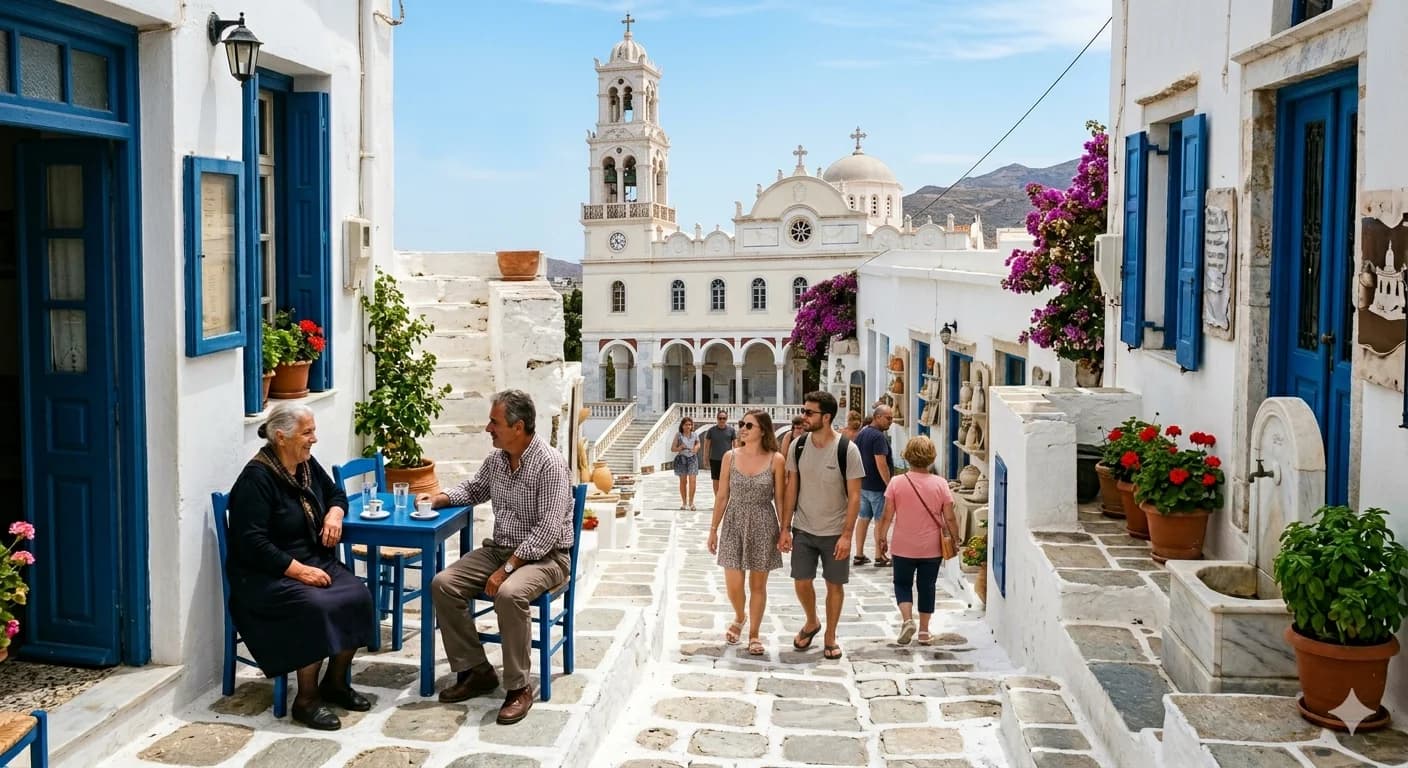
Where to Stay in Tinos
Tinos — Cyclades
A complete guide to the best areas and hotels in Tinos — from the port town and the marble village of Pyrgos to the north coast beaches, the hillside village of Kardiani and the quiet east coast.
Relaxing stays, beautiful views and authentic hospitality — organized in a clear and practical way.
Description
Unlike Mykonos or Santorini, Tinos has no large resort hotels, no international chains, and no beach-club infrastructure. What it has instead is an exceptionally well-developed stock of family-run guesthouses, boutique rooms in restored village houses, small hotels with genuine character, and — increasingly — design-conscious properties that understand the island's artistic identity. The accommodation here is honest, personal and often exceptional for its price. Booking in advance is essential for July and August; outside peak season, availability is generally good.
The island is approximately 30 kilometres long and requires a car to explore properly. The choice of base determines not just your daily convenience but the whole texture of the trip — whether you wake up to the sound of pilgrims climbing the marble ramp, to silence above a cliff-top bay, or to the smell of marble dust from a workshop fifty metres away.
1. Tinos Town — Port, Pilgrimage & the Best Evening Life on the Island
Tinos Town is the island's capital and the natural base for any first visit. The port area, the marble ramp rising to the Church of Panagia Evangelistria, the market street behind the waterfront, and the cluster of excellent tavernas and cafés all sit within easy walking distance of each other. Staying here puts you at the centre of everything that makes Tinos distinctive — the pilgrimage energy that runs through the town at all hours, the local food culture, the evening promenade along the waterfront, and the ferry connections to Mykonos, Syros and Piraeus.
Accommodation in Tinos Town ranges from simple well-run guesthouses close to the port to small boutique hotels with sea-view terraces, rooftop pools and rooms finished in local marble and stone. The best properties are concentrated in the quieter streets above the main market area and the lanes behind the church ramp, where the noise of the port does not carry.
Hotel picks: Ageri (simple, friendly, excellent value right near the port), Aeolis Tinos (boutique hotel with rooftop pool and sea views — the best address in town), Favie Eva (design-forward rooms with local marble details, quiet location above the church), Antama Suites (modern suites with kitchenettes, great for longer stays), Pelopas (traditional guesthouse with a lovely courtyard garden).
The town beach — Agios Fokas — is a fifteen-minute walk east of the port and provides decent swimming without needing a car. For more serious beach days, the east coast beaches of Porto and Agios Sostis are under 10 kilometres away. The town is the only base on the island where you can function comfortably without a rental vehicle — ferries, the Saturday market, restaurants and the church are all within walking distance.
The streets immediately behind and above the church — around Agias Anastasias and Evangelistrias lanes — are the quietest and most atmospheric in town. Properties here have views over the rooftops to the sea and are far enough from the port to sleep undisturbed.
Honest note: The waterfront and the area directly below the church ramp can be noisy in summer, particularly on the 15th of August and the surrounding weekends when the island receives tens of thousands of pilgrims. If you are visiting around that date, specify a room set back from the main street. The town does not have a beautiful beach immediately on its doorstep — if direct sand access from your hotel is your priority, base yourself further east at Porto instead.
2. Pyrgos — Marble Village, Art & the Most Culturally Rewarding Base
Pyrgos is the finest village on Tinos and one of the most beautiful in the Cyclades — built almost entirely from the island's distinctive grey-green marble, with fountains, doorframes, church steps and grave monuments all carved by hand. It sits in the north of the island at around 400 metres elevation, surrounded by vineyard terraces and dovecote-dotted hillsides, and it has produced more sculptors and marble craftsmen than any other village in Greece. The Museum of Marble Crafts is a fifteen-minute walk from the centre; the family workshops in the lanes are still active.
Staying in Pyrgos means waking up inside one of the island's most extraordinary living environments. The accommodation here is predominantly small — converted stone houses with original marble floors and beamed ceilings, rooms in family-run guesthouses where the owners are likely to be descended from the craftsmen whose work lines the streets. Quality is high and genuine. There are no large hotels, which is entirely consistent with the village's character.
Hotel picks: Pyrgos Houses (converted marble-worker's home, original floors, unbeatable atmosphere), The Lemon Tree (boutique rooms with Cycladic design, pool with village views), Marble Stories (luxury suites in a restored captain's house with marble bathroom details).
From Pyrgos, the north coast beach of Kolymbithra is a ten-minute drive — close enough to combine a morning at the beach with an afternoon at the Museum of Marble Crafts or a walk through the village lanes. The port town is 25 kilometres away and takes about 35 minutes on the winding mountain road, which is part of the pleasure of staying here rather than a constraint.
The cemetery above the village — a gallery of marble funerary sculpture unlike anything else in the islands — deserves at least 30 minutes. Walk up in the early morning before it gets warm.
Honest note: Pyrgos is not a beach base. The village is inland and elevated, and reaching the water requires a car. The accommodation stock is smaller than in Tinos Town — book early, particularly for July and August. Some properties close between October and April; verify opening dates. The village has good tavernas but limited nightlife and facilities — it is a base for people who want immersion in the island's culture, not entertainment.
3. North Coast & Kolymbithra — The Best Beaches and the Most Scenic Stays
The north coast of Tinos — stretching from Ormos Panormou in the west to the twin bays of Kolymbithra — contains the island's finest beaches and some of its most dramatically positioned accommodation. This is a different kind of stay from the port town: quieter, more nature-focused, with winding roads through terraced hillsides and panoramic views of the Aegean that extend to Mykonos on clear days.
Kolymbithra itself — a double bay with extraordinary turquoise water, distinctive granite rock formations and a reliable summer wind — is the most beautiful beach on the island. The larger bay has a taverna, sunbeds and some small accommodation options directly above the beach. The smaller bay immediately west is completely undeveloped. Staying within ten minutes of Kolymbithra gives you access to the best swimming on Tinos before the day visitors arrive from the port.
The village of Panormos on the northwest coast has a small working harbour with fishing boats, a handful of excellent fish tavernas and a genuinely local atmosphere that feels entirely removed from the pilgrimage energy of the port town.
Hotel picks: Mare Monte (small hotel directly above Kolymbithra, the best beachfront address on the north coast), Niriis (modern studios with panoramic sea views, excellent value), Mansion Tinos (boutique property in a restored mansion with pool and sea views).
Arrive at Kolymbithra before 10am to swim in the large bay before the beach fills. By midday in July and August it becomes busy. The smaller western bay stays quieter all day.
Honest note: The north coast is genuinely remote relative to Tinos Town — the port and the church are 25–35 minutes away by the mountain road. Facilities are limited: no pharmacies, limited ATMs, no large supermarkets. Bring essentials from the port town when you arrive. The roads to the best beaches can be narrow and require care, particularly after dark. This is a base for travellers who want natural beauty and proximity to the best beaches above all else — not for those who want convenience.
4. Kardiani & the Hillside Villages — Views, Silence & Boutique Character
Kardiani is considered by many to be the most beautiful village on Tinos — a terraced settlement of pale stone houses with shuttered windows and flower-filled courtyards, perched on a steep hillside on the north coast with views that sweep across the sea to Syros and Delos. It sits roughly midway between Tinos Town and Pyrgos, at an elevation that catches the breeze in summer and turns cinematic in the late afternoon light. The main plateia — a small square with a café and a church — is where village life concentrates in the evening.
Accommodation in Kardiani is limited but excellent in quality — a small number of converted village houses and boutique rooms, most with private terraces or balconies oriented toward the sea view. These are not hotel rooms; they are stays in living architecture, often run by families who have been in the village for generations.
Hotel picks: Villa Lithos (converted stone villa with private terrace and uninterrupted sea views — the most romantic stay on the island), Kardiani View (traditional village house with panoramic balcony, simple and authentic).
The surrounding villages — Dio Horia, Falatados, Steni — are within ten to twenty minutes by car and form a scenic circuit through the Catholic highland interior. The best traditional taverna on the island by many local accounts operates in Kardiani itself, serving food made from the village's own vegetables and local cheeses. North coast beaches are fifteen minutes away; the port is about 25 minutes.
Kardiani faces northwest and catches some of the most extraordinary sunset light on the island. Book a room with a west-facing terrace if available.
Honest note: Kardiani has almost no practical infrastructure — no supermarket, no ATM, no pharmacy. A car is non-negotiable for staying here. The accommodation stock is very small and fills quickly in peak season; book as early as possible. This is not a base for travellers who want nightlife, beach convenience or easy access to tourist facilities — it is for those who want the most atmospheric and quietly beautiful stay on the island.
5. Porto & the East Coast — Families, Sand & a Relaxed Beach Base
Porto — officially Agios Ioannis Porto — is a beach settlement on the east coast, about eight kilometres from Tinos Town, and the island's best base for a family beach holiday. The beach itself is long, sandy and gently shelving, with calm, shallow water that suits younger children well. Sunbeds and umbrellas are available at the organised section; the edges of the beach are less developed and quieter. Several tavernas and beach bars operate in summer with menus at reasonable prices.
Accommodation around Porto tends toward studios, apartments and small self-catering complexes — practical, well-priced and oriented toward longer stays where access to a kitchen makes sense.
Hotel picks: Tinos Bay Hotel (mid-range hotel with pool, family-friendly, steps from the beach), Porto Tinos (self-catering studios with kitchenettes, excellent value for families), Agios Romanos (peaceful apartments near the windsurfing beach, ideal for watersports lovers).
The beach of Agios Sostis, immediately north of Porto, is another excellent sandy option and one of the least crowded on the east coast. The small settlement of Kionia, between Porto and Tinos Town, sits near the archaeological site of the ancient sanctuary of Poseidon and Amphitrite.
The windsurfing school at Agios Romanos beach, just south of Porto, offers lessons and rental from June through September. Conditions here are consistent and well-suited to beginners.
Honest note: Porto and the east coast have the least character of any base on Tinos. The accommodation is functional rather than atmospheric, the landscape is flatter and less dramatic than the north or centre, and the proximity to Tinos Town means you are neither fully in the town nor in the proper countryside. For travellers whose priority is beach access for children combined with easy access to the port town, it is the most practical choice. For anyone seeking the island's deeper qualities — the villages, the marble, the dovecote landscape — it is the wrong base.
Frequently Asked Questions
Where should first-time visitors to Tinos stay?+
Tinos Town is the strongest first choice for most visitors — particularly those without a car or those visiting specifically for the Panagia Evangelistria. It puts you within walking distance of the church, the market, the waterfront and the best restaurants on the island. For first-timers who do have a car and want an experience beyond the port town, splitting a stay between Tinos Town (two nights) and Pyrgos or the north coast (one to two nights) gives a much fuller picture of what the island offers.
Do I need a rental car in Tinos?+
For Tinos Town itself, no — the port area, church and market street are all walkable, and Agios Fokas beach is a short walk from the centre. For everything else — Pyrgos, the dovecote villages, Kolymbithra, Volax, Kardiani and the north coast beaches — a car is essential. The island is approximately 30 kilometres long and the internal road network, while scenic, is not served by regular buses. Hire a car at the port on arrival; book in advance for July and August.
What is accommodation like in Tinos compared to Mykonos and Santorini?+
Tinos has no international hotel chains, no large resort properties and no infinity-pool hotels designed primarily for social media. What it has instead is a large and genuinely good stock of family-run guesthouses, small hotels with real character, and converted village houses where the materials — marble floors, stone walls, hand-plastered ceilings — are local and authentic. Quality-to-price is significantly better than on Mykonos or Santorini. The most atmospheric stays are in Pyrgos and Kardiani. The most convenient are in Tinos Town.
When should I book accommodation in Tinos?+
For July and August — and especially for the week around the 15th of August — book as early as possible. The island fills entirely for the Feast of the Dormition and accommodation at any level is extremely limited in those days. For June and September, booking one to two months ahead is comfortable for most areas. For the very small properties in Kardiani and the boutique rooms in Pyrgos, book early regardless of dates — the stock is limited year-round.
Is Tinos good for a romantic trip?+
Exceptionally so — particularly if you base yourself in Kardiani or Pyrgos rather than the port town. Kardiani in particular offers the combination of sea views, stone architecture, excellent food, near-total quiet and the kind of unhurried pace that makes a couple feel like they have found a place entirely their own. September is the ideal month: warm sea, empty beaches, outstanding light, and restaurants operating at their best.
How far is Tinos from Mykonos?+
Approximately 25 minutes by high-speed ferry — one of the shortest inter-island connections in the Cyclades. This proximity makes Tinos an excellent base for a day trip to Mykonos (or vice versa), and it is also the jumping-off point for excursion boats to Delos, the sacred ancient island at the centre of the Cyclades.
Is Tinos good outside summer?+
Unusually good by Cycladic standards. Tinos Town functions year-round as a living community, and the church draws pilgrims in all seasons — particularly for the Feast of the Annunciation on the 25th of March, which is also Greek Independence Day and generates a significant moving national celebration. The marble workshops in Pyrgos operate throughout the year. The tavernas in Kardiani and the village food shops are open in spring and autumn. May, June, September and October are all excellent. Winter visits are possible and genuinely rewarding.