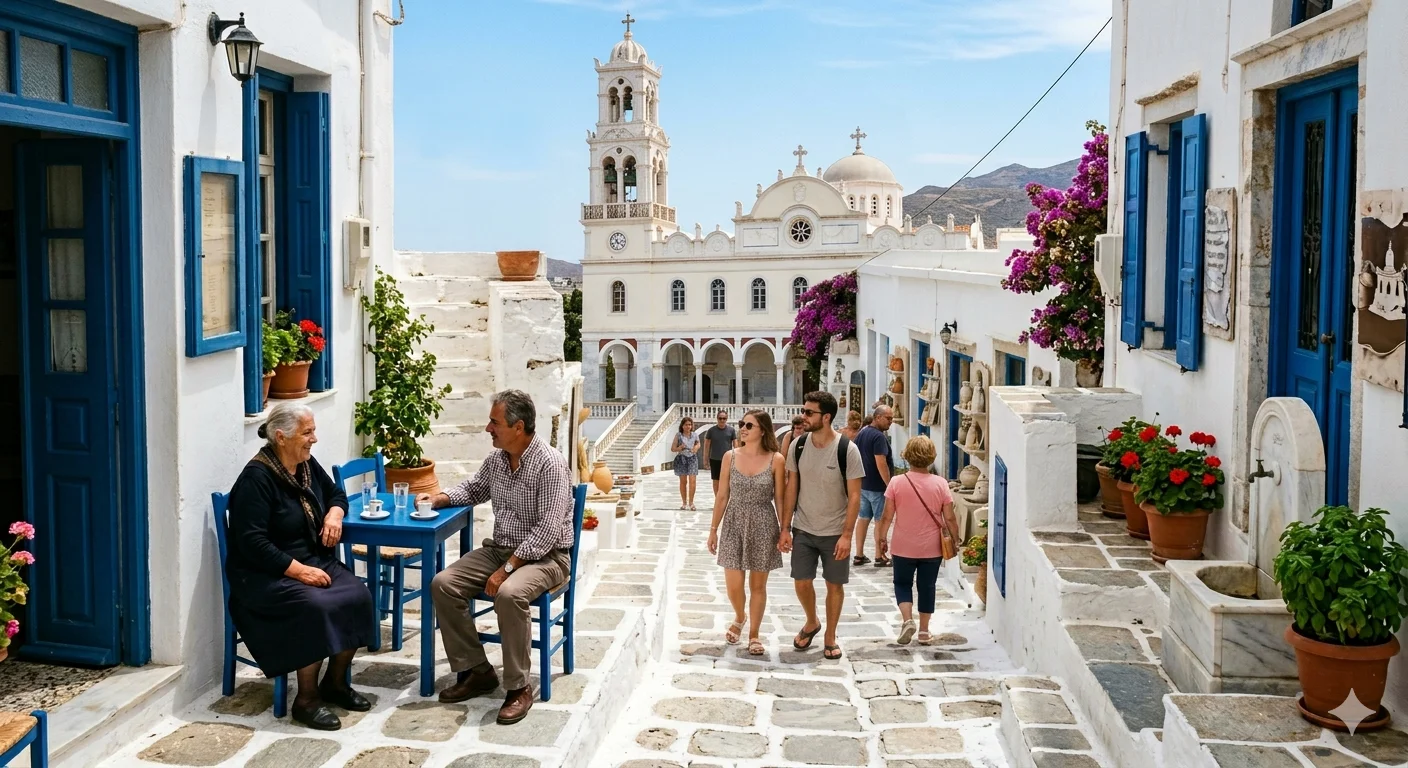
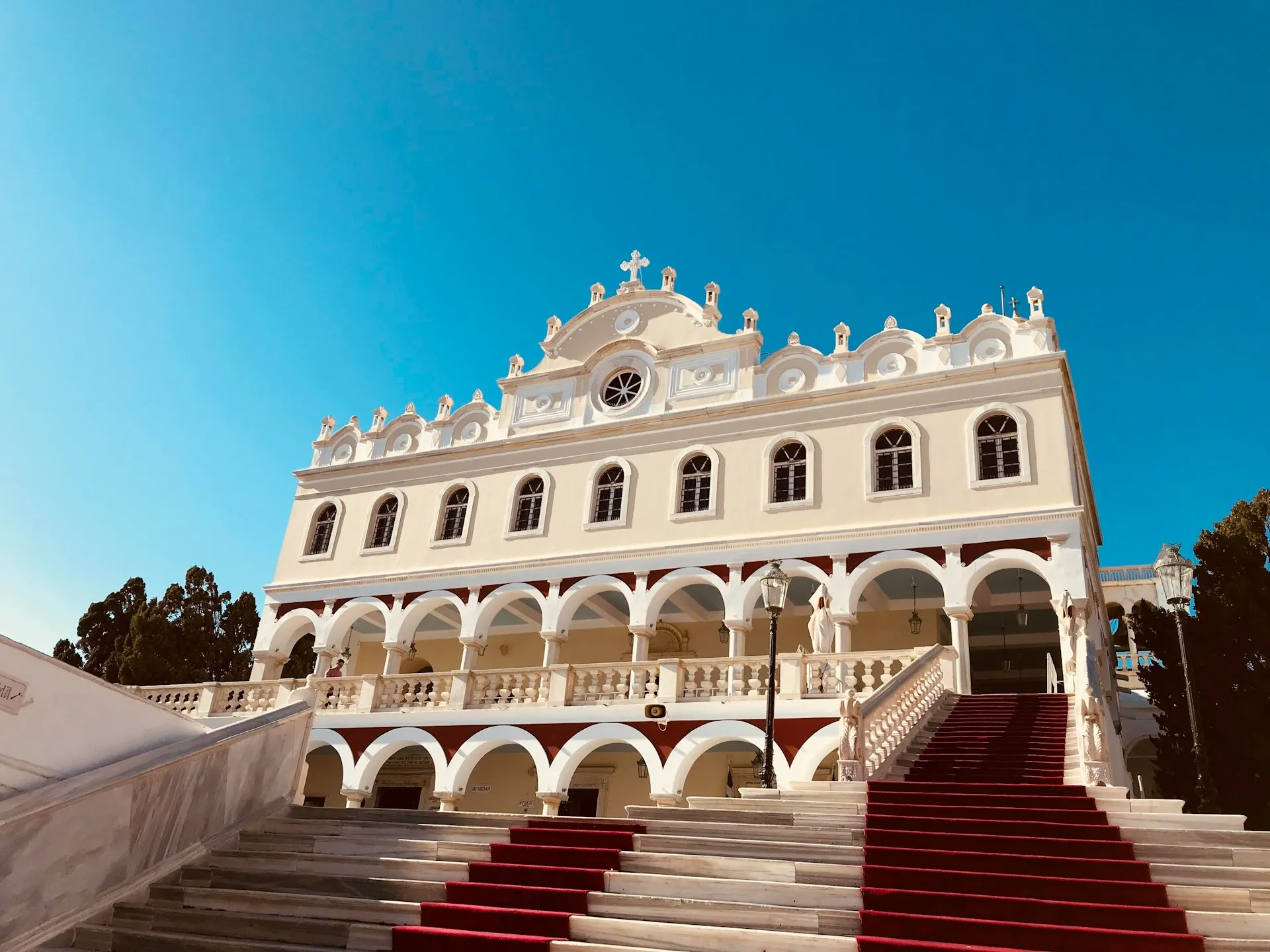
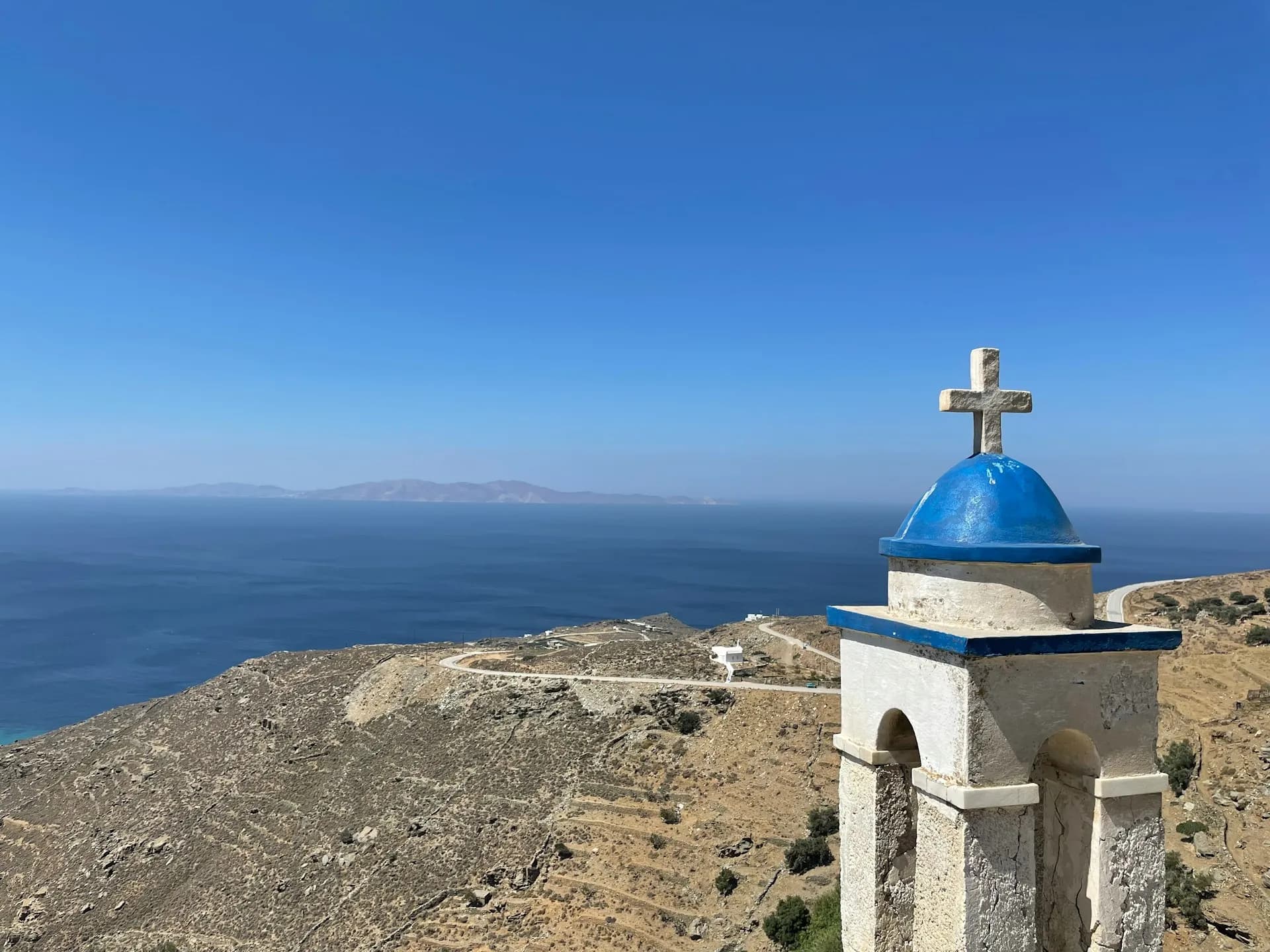
Tinos sits at the heart of the Cyclades, visible from Mykonos to its east and from Syros to its west, yet it inhabits an entirely different world from either. It is the most spiritually significant island in Greece — the Church of Panagia Evangelistria holds the sacred icon of the Virgin Mary, and on the 15th of August every year, thousands of faithful pilgrims travel by sea from across the country to climb the long marble ramp from the port to the church on their knees. The island's religious identity is not a tourist performance; it is a living, breathing practice.
But Tinos is also, simultaneously, one of the most artistically rich destinations in the Aegean. The village of Pyrgos in the north has produced more marble sculptors than anywhere else in Greece — the craft school here trained many of the country's finest artists, and the tradition continues today in family workshops where you can watch marble being cut and shaped by hand. The island's signature architectural feature — the ornate Venetian-era dovecotes, scattered across the hillsides like white stone lacework — is unlike anything else in the Cyclades.
None of this has been packaged for mass tourism. Tinos has no international hotel chains, no beach clubs playing commercial music until four in the morning, and no self-conscious effort to be the next Mykonos. The food here — built on exceptional local products including the island's famous artichokes, cured meats, loukoumades and fresh cheese — is considered by serious food travellers to be the best in the Cyclades.
Tinos sits at the heart of the Cyclades, visible from Mykonos to its east and from Syros to its west, yet it inhabits an entirely different world from either. It is the most spiritually significant island in Greece — the Church of Panagia Evangelistria holds the sacred icon of the Virgin Mary, and on the 15th of August every year, thousands of faithful pilgrims travel by sea from across the country to climb the long marble ramp from the port to the church on their knees. The island's religious identity is not a tourist performance; it is a living, breathing practice.
But Tinos is also, simultaneously, one of the most artistically rich destinations in the Aegean. The village of Pyrgos in the north has produced more marble sculptors than anywhere else in Greece — the craft school here trained many of the country's finest artists, and the tradition continues today in family workshops where you can watch marble being cut and shaped by hand. None of this has been packaged for mass tourism. Tinos has no international hotel chains, no beach clubs, and no self-conscious effort to be the next Mykonos. The food here is considered by serious food travellers to be the best in the Cyclades.
Tinos
Why Visit Tinos
**1. The Panagia Evangelistria is the most important religious site in modern Greece**
The Church of the Annunciation holds the sacred icon of the Virgin Mary, discovered in 1823 following a vision reported by Nun Pelagia. It draws over a million visitors a year — believers, curious travellers and historians alike. The atmosphere on the 15th of August is unlike anything else in the Aegean.
**2. Pyrgos is the marble-carving capital of Greece**
Pyrgos in the north has been producing marble sculptors for centuries. The Museum of Marble Crafts is one of the best-designed museums in Greece, and the family workshops allow you to watch the craft at close hand.
**3. The Venetian dovecotes are unique to Tinos**
Over a thousand ornate stone dovecotes are scattered across the hillsides — narrow towers with geometric decorative patterns. The finest concentrations are around Tarampados and Ktikados.
**4. Volax is one of the most surreal landscapes in the Greek islands**
The village sits at the centre of a natural amphitheatre filled with enormous rounded granite boulders — the landscape feels otherworldly.
**5. The food culture is the finest in the Cyclades**
Tinos produces exceptional local ingredients: giant artichokes, graviera cheese, cured sausages, loukoumades. The restaurant scene is serious without being pretentious.
**6. Fifty-plus villages reward exploration**
Tinos has more inhabited villages than most other Cycladic islands combined. Hiring a car and driving from village to village is one of the finest things you can do in the Cyclades.
Tinos
Best Time to Visit Tinos
**April – May — Green, uncrowded, ideal for village exploration**
The island is green and the weather is mild. Easter on Tinos, with both Catholic and Orthodox populations celebrating, is a particularly special time.
**June — Perfect balance**
Warm enough for beach days, uncrowded, everything open. One of the best months in the entire Cyclades calendar.
**July – August — Peak season and lively**
The 15th of August is extraordinary to witness but extremely crowded — plan far in advance. The beaches are busy but the island absorbs summer visitors well.
**September — Arguably the finest month**
The sea is at its warmest, crowds thin after mid-month, and the light over the dovecotes and marble villages is exceptional.
**October – November — Quiet, authentic**
Excellent for cultural visits and food exploration. The countryside and marble workshops are at their most atmospheric.
**Winter — A living island year-round**
Tinos is one of the few Cycladic islands worth visiting in winter for a quiet, genuinely Greek experience.
Tinos
How to Get to Tinos
**By ferry from Piraeus** — 4–5 hours on conventional ferries, 2.5–3 hours on high-speed catamarans.
**By ferry from Rafina** — From the port closer to Athens airport, about 2.5 hours on high-speed services.
**From Mykonos** — 25 minutes by high-speed ferry. The contrast between the two islands is part of the experience.
**From Syros** — 35 minutes. Combine Tinos and Syros for the most culturally rich Cyclades trip.
💡 Secret: Tinos is an excellent base for island hopping — Mykonos, Syros, Delos and Naxos are all within easy reach.
**Getting around** — A car is essential for exploring the interior. Rental cars are available at the port. Book in advance for July and August.
Tinos
Top Attractions in Tinos
1
Church of Panagia Evangelistria (Our Lady of Tinos)
The most important religious site in modern Greece. The church stands at the top of the long marble-paved Leoforos Megalocharis that rises from the port. Built in gleaming white marble in the early 19th century, it holds the sacred icon of the Virgin Mary in an elaborately decorated silver frame. The underground chapel marks the exact site where the icon was discovered in 1823. The ex-voto collection — offerings of gold, silver and jewellery left by the faithful over two centuries — is one of the most remarkable collections of popular religious art in Greece.
💡 Secret: Remove your shoes before entering the inner sanctuary. The atmosphere inside is one of profound silence and devotion regardless of your beliefs. Visit on a weekday morning in June or September for a quiet experience.
2
Pyrgos — Marble Village & Museum of Marble Crafts
Pyrgos is a village of exceptional quality — built almost entirely in marble. The Museum of Marble Crafts is one of the most thoughtfully designed museums in Greece, telling the story of Tinian marble from quarry to finished work. The Yannoulis Chalepas Museum celebrates the island's most celebrated sculptor. Family workshops sell original work at prices that bear no relation to the quality.
💡 Secret: The cemetery above the village is not morbid — it is a gallery of extraordinary marble sculpture. Allow 30 minutes here.
3
Volax — The Boulder Village
Volax sits at the centre of a natural amphitheatre filled with enormous rounded granite boulders — geological formations deposited by ancient volcanic activity. The village is inhabited year-round and its tiny amphitheatre hosts summer cultural events. The landscape feels otherworldly, unlike anything else in the Cyclades.
💡 Secret: Take the path behind the village to walk among the boulders — it takes 20 minutes and requires no special equipment.
4
Xombourgo — The Medieval Fortress
The dramatic granite rock of Xombourgo rises to 640 metres and was the site of the island's Venetian capital. The ruins of fortress walls, Catholic churches and Orthodox chapels cover the summit. The walk up from Komi takes about 40 minutes.
💡 Secret: Go in the morning when the air is clear. The views of Mykonos, Syros and Delos from the top are among the finest in the Cyclades.
5
The Dovecote Villages — Tarampados, Ktikados
The central plateau has the highest concentration of the island's famous dovecotes — narrow stone towers with intricate geometric decorative panels. The landscape of terraced hillsides, dovecotes, small stone chapels and ancient walls is unlike anywhere else in the Greek islands.
💡 Secret: The drive through the central plateau at dusk, with dovecotes against the fading light, is unforgettable.
6
Kardiani & the Catholic North Villages
The northern part of Tinos has a distinct character shaped by Catholic heritage. Kardiani, perched on a steep hillside above the north coast with views over Syros, is considered by many to be the most beautiful village on the island.
💡 Secret: Kardiani has one of the best traditional tavernas on the island — arrive at lunchtime and ask what is cooking.
7
Tinos Town & the Marble Ramp
Tinos Town has a pleasant, unhurried waterfront with good seafood restaurants and cafés. The long marble-paved Leoforos Megalocharis rises from the port to the church. On the 15th of August, pilgrims crawl the entire length on their knees.
💡 Secret: The best loukoumades on the island are served at a small traditional stall just off the main street — locals queue from mid-morning.
Tinos island, Greece
Tinos
Best Beaches in Tinos
Kolymbithra
A double-coved beach on the north coast with extraordinarily clear turquoise water and dramatic rock formations. The larger cove has a taverna and sunbeds; the smaller is wilder and quieter. One of the finest beaches in the Cyclades.
Porto
A long sandy beach on the east coast with shallow, calm water and good facilities. The most family-friendly beach on the island with several tavernas nearby.
Agios Fokas
The closest beach to Tinos Town — long stretch of sand and pebble, partially organised with sunbeds and clear calm water. Good for a half-day from the port without needing a car.
Livada
A small, quiet cove near Panormos on the northwest coast. Deep translucent blue water, rarely crowded. One of the most beautiful and least visited swimming spots.
Agios Romanos
Broad sandy beach on the south coast with reliable summer winds and a windsurfing school. Less scenic than Kolymbithra but consistently good for board sports.
Pachia Ammos
Isolated sandy cove on the northwest coast reached by a narrow unpaved track. Fine soft sand and water of exceptional clarity. No facilities — bring everything you need.
Tinos
Food in Tinos — What to Eat
💡 Food secret: The Saturday morning farmers' market in Tinos Town is the best opportunity to buy local products directly from producers.
**Tinian Artichokes** — PDO product, considered the finest in Greece. Smaller, denser and more intensely flavoured than the mainland variety.
**Loukoumades** — Tinos is famous throughout Greece for its light, crisp honey-drenched doughnuts. A well-known stall in Tinos Town has been serving them for generations.
**Graviera & Fresh Cheese** — Excellent hard cheese aged in caves, and fresh soft white cheese used in savoury pies.
**Syglino** — Cured pork preserved with orange peel, spices and herbs. Smoky, aromatic and deeply flavoured.
**Fresh Aegean Seafood** — Grilled octopus, red mullet, sea bream and sea bass from the island's fishing fleet.
**Thyme Honey & Capers** — Aromatic honey and briny capers make perfect edible souvenirs.
Tinos Town, Greece
Tinos
FAQ — Tinos Essentials
Is Tinos worth visiting if I have been to Mykonos or Santorini?
Absolutely — and it is a fundamentally different experience. While Mykonos and Santorini are defined by beach clubs and caldera sunsets, Tinos offers depth: religious and cultural significance, marble craftsmanship, extraordinary interior landscape, the finest local food in the archipelago. Tinos is not a replacement but an essential counterpoint.
How do I get from Tinos to Mykonos or Delos?
High-speed ferries connect Tinos to Mykonos in approximately 25 minutes. From Mykonos, excursion boats run to Delos daily. Tinos is an excellent base for a Delos day trip combined with a Mykonos evening.
What is the Museum of Marble Crafts?
One of the finest museums in the Greek islands — housed in a beautifully restored factory building, telling the full story of Tinian marble. Original machinery, working demonstrations and finished works. Allow 90 minutes minimum.
What are the dovecotes and why are they unique?
Ornate stone towers built during the Venetian period to house domestic pigeons. The extraordinary decorative elaboration of their facades — intricate geometric patterns — is unique to Tinos. Over a thousand survive as protected architectural heritage.
Is Tinos good in winter?
Better than almost any other Cycladic island. Tinos has a genuine year-round population. Tavernas, cafés, food shops and the church all operate. The marble workshops in Pyrgos are active year-round. A winter weekend offers cultural richness that summer-only islands cannot match.
How does Tinos compare to Syros?
They complement each other perfectly. Syros is urban — a neoclassical city with an opera house. Tinos is rural — villages, marble, dovecotes and pilgrimage. Both have exceptional food cultures. The 35-minute ferry connection makes combining them easy.
How many days do I need in Tinos?
Three days is the minimum for the church, Pyrgos, Volax and a beach. Five days allows you to explore the interior villages, visit the north coast, eat well and slow down. Tinos rewards extended stays more than almost any other Cycladic island.