
Beaches Near Patras & the Aetolian Shore: What's Really Worth Your Time on the Gulf of Patras
The honest guide to beaches near Patras, Greece — from Kalogria's long sandy shores to Nafpaktos's Venetian harbour and Messolonghi's wild lagoon. What's worth your time on both sides of the Gulf of Patras.
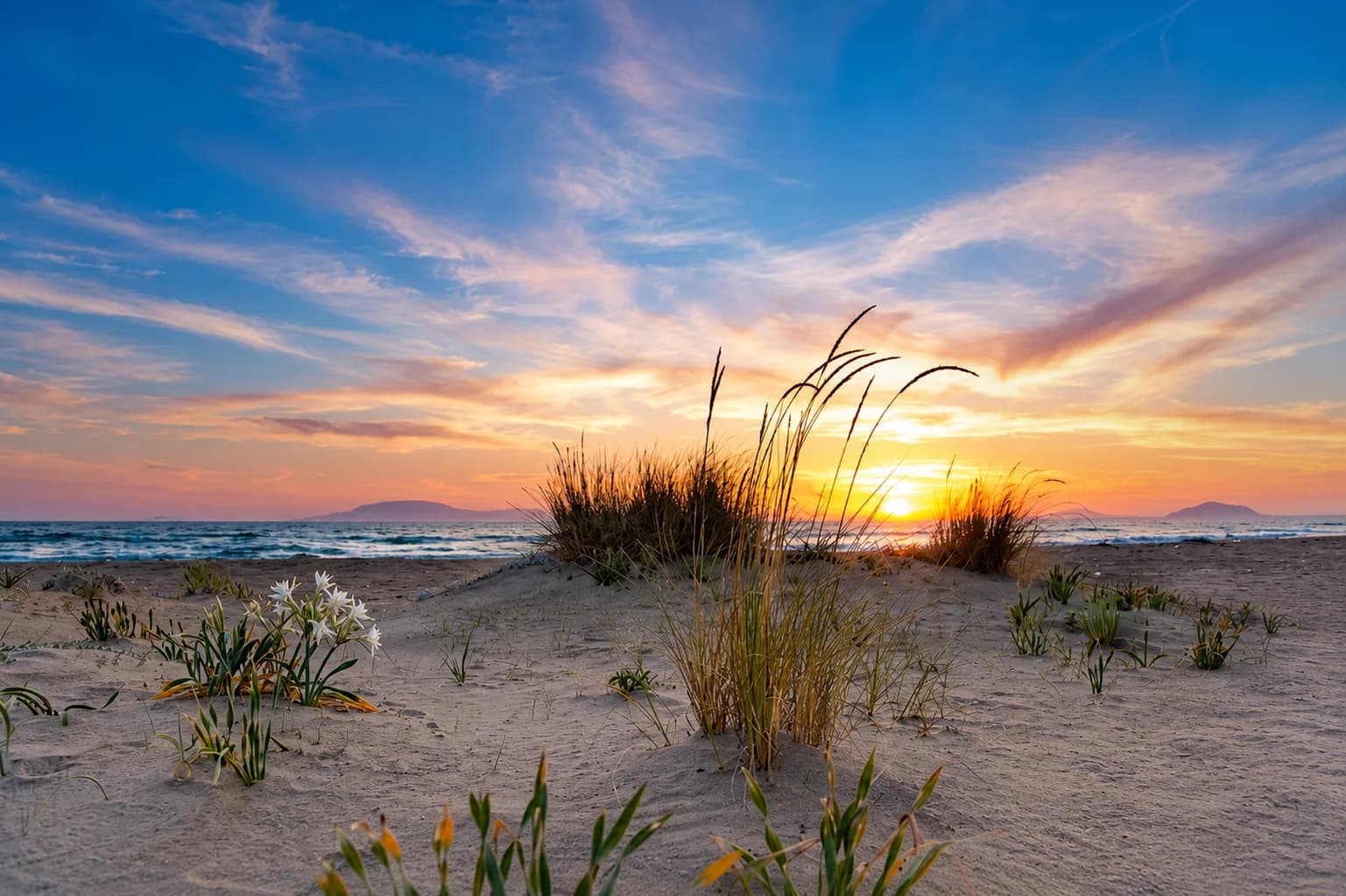
Most travelers pass through Patras on their way to a ferry. That's understandable — Greece's third-largest city has been a gateway port for centuries. But the region surrounding the Gulf of Patras holds some genuinely underrated scenery: a 12-kilometer beach backed by pine forest, one of the most beautiful small Venetian harbors in Greece, a lagoon that hosts 300 bird species, and a string of coastal villages that see a fraction of the tourist traffic they deserve.
Quick Facts
Best beach near Patras: Kalogria (~35 km west)
Best town across the water: Nafpaktos (Lepanto) — 23 km via bridge
Bridge toll (Rio–Antirrion): €15.90 for a passenger car (2025)
Best season: May–June or September–October
Day trip range from Patras: Nafpaktos 45 min / Messolonghi 1.5 hr / Galaxidi 2 hr
About Patras Itself: Set Your Expectations Right
Patras is a working Greek city — lively, slightly chaotic, full of neoclassical architecture and a decent food scene, host to one of the largest carnival celebrations in Europe every February. What it is not is a beach destination. The city waterfront stretches along a busy road, and the swimming here is functional at best.
📝Honest Note: If you're in Patras primarily for the beach, you'll need to drive. The city's own waterfront is narrow, rocky in parts, and sits close to traffic. It does the job for a local morning swim — nothing more. The good news is that proper beaches are 30–40 minutes away by car, and the opposite coastline across the Gulf is an easy day trip with genuinely more to offer.
That said, Patras is an excellent base. It's well-connected — regular intercity buses from Athens (about 3 hours), ferry connections from Italy and the Ionian islands, and a position on the road system that makes both the Peloponnese and western mainland Greece easily accessible.
The Best Beaches Near Patras
Kalogria — The One Worth Making an Effort For
About 35 kilometers west of Patras, Kalogria is where locals have been going for generations, and the reason is simple: it's long, wide, sandy, and backed by a proper pine forest that's part of the Strofylia Wetland Biosphere Reserve. The water is shallow for a good distance out — excellent for families and anyone who prefers to walk rather than drop suddenly into depth.
The beach runs for approximately 12 kilometers. Most of it is undeveloped by Greek island standards, which is both its appeal and its practical limitation — facilities are concentrated in two or three areas and get thinner as you move along the sand. Behind the dunes, the Kotychi Lagoon is worth a walk around if you're interested in birdwatching: flamingos, herons, and migratory species appear here seasonally.
📝Honest Note: Kalogria gets busy in August, especially on weekends when Patras empties itself onto the beach. Weekday visits in July or early September are considerably more relaxed.
Araxos Peninsula & Kato Achaia
Just north of Kalogria, the Araxos Peninsula stretches into the Gulf of Patras. The area is home to Araxos National Airport — the main gateway for visitors to the western Peloponnese and the Ionian islands. Beyond the airport, the peninsula has long stretches of quiet, undeveloped coastline with clear water and far fewer crowds than the more established beaches. Kato Achaia itself is an unpretentious town with a pleasant waterfront and decent fish tavernas.
⏭️Honest Skip: Swimming is not allowed at the Patras city waterfront promenade or near the port — it's prohibited and the water quality is poor. For a quick swim near the city center, your closest options are Plaz beach, Psachopyrgos to the east, Vrachneika, or Alissos to the west. For a proper beach day, head to Kalogria (35 km west) or cross the bridge to the opposite coastline.
The Rio–Antirrion Bridge: A Crossing Worth Doing Slowly
The Charilaos Trikoupis Bridge connecting Rio (just north of Patras) to Antirrion in Aetolia-Acarnania is one of the longest cable-stayed bridges in Europe at 2.2 kilometers. It opened in 2004, replacing a ferry crossing that had operated for centuries across this narrow strait.
Driving across it is genuinely impressive. The bridge rises high above the water, and on a clear day you can see south toward the open Corinthian Gulf and north into the mountains of central Greece. The crossing takes about 10 minutes. The toll is €15.90 for a regular passenger car.
🤫Secret Note: If you're crossing for the first time, slow down (within reason) as you approach the Antirrion side going north — the view back toward the mountains above Patras is the better angle. On the return crossing, the descent toward Rio with the Peloponnese hills rising behind gives you a sense of just how dramatically this bridge spans what was once an impassable geographic boundary. Greeks call it simply "η γέφυρα" — the bridge — with no further specification needed.
Nafpaktos (Lepanto): The Small Town That Outshines Most Greek Islands
Let's be direct: Nafpaktos is one of the best small coastal towns in Greece. It doesn't have the fame of Nafplio or the scenery budget of Santorini, but on a clear morning with the Venetian harbor full of fishing boats and the castle walls rising above orange trees on the hillside, it is absolutely beautiful — and almost entirely free of the crowds that would mob a comparable spot in the Cyclades.
The town's historical weight is considerable. In October 1571, the Battle of Lepanto was fought just off this coast — the largest naval engagement of the 16th century, in which the Holy League (Spain, Venice, the Papal States) defeated the Ottoman fleet and changed the course of Mediterranean history. Miguel de Cervantes, who would later write Don Quixote, fought in that battle and was wounded in his left hand. He called the battle "the greatest occasion that the centuries have seen." There's a statue of him in the harbor square today.
The harbor itself is Venetian in origin — a semicircular port enclosed by two towers, with the town climbing up the hillside behind in layers of whitewashed houses, Byzantine churches, and Ottoman-era buildings. The Venetians built well here: the castle above the town is in better condition than most medieval fortifications in Greece, with intact perimeter walls you can walk along for views out over the gulf.
Lord Byron passed through the region in the early 1820s on his way to Messolonghi, and Nafpaktos carries that romantic, history-saturated atmosphere that western Greece has in abundance and that fewer visitors think to look for.
Nafpaktos Beaches
The beaches immediately around the town are good without being spectacular. Psani beach sits close to the harbor — partly rocky, partly organized with loungers. Gribovo, a few kilometers west of the center, is sandy and considerably more relaxed for a long afternoon.
East of Nafpaktos, the coastline toward Itea and Galaxidi hides several smaller beaches worth the drive. Monastiraki, Chiliadou, Marathias, and Paralia Sergoula are all quieter alternatives to the town beaches — some pebbly, some sandy, all surrounded by olive groves and far less developed. If you're spending more than one day in the area, these are where you swim.
🤫Secret Note: The harbor at Nafpaktos is most alive between 6 and 9pm, when locals come down for the evening volta. The tavernas on the waterfront are genuinely good (try the local fresh fish rather than the tourist menus), and the view of the harbor at dusk — boats swaying, the castle lit above, reflections on the water — is better than you might expect from a town that appears in almost no mainstream travel guides. Book dinner here rather than skipping back to Patras.
Messolonghi: For the History-Minded
Messolonghi is 46 kilometers east of Patras along the coast road. It is not conventionally pretty — the town is flat, the surrounding lagoon pale and vast, and the landscape carries a melancholy openness that takes some adjustment. But if you know what happened here, Messolonghi is one of the most emotionally resonant places in modern Greek history.
Lord Byron arrived here in January 1824, committed to the Greek cause of independence from Ottoman rule. He spent three months organising troops, spending considerable personal wealth on the Greek cause, and writing some of his last poetry in the city. He died of fever in April 1824, aged 36, before firing a single shot in battle. The Greeks went into national mourning. His heart is buried in the Garden of Heroes (Κήπος των Ηρώων) at the edge of town — a park that also commemorates the fighters who died during two devastating Ottoman sieges of the city in the 1820s.
The lagoon itself — one of the largest wetlands in the Mediterranean — is a UNESCO-recognised biosphere reserve and hosts over 300 bird species. Salt production has happened here for centuries, and the strange, flat landscape of salt flats, shallow channels, and elevated walkways above the water makes for an unusual and photogenic walk if you go in the right light (early morning or late afternoon).
📝Honest Note: Messolonghi is not a typical beach destination — it has some small beaches along the lagoon, but that's not the main draw. What it does have is some of the best tavernas in western Greece, serving fresh fish and local specialties at prices you won't find on the islands. The town center is modest, and much of its appeal comes from knowing the history first. But for anyone interested in Byron, the Greek War of Independence, or simply exceptional seafood in an unpretentious setting — it's genuinely worthwhile and sees almost no foreign tourists.
Galaxidi: The Quiet Neoclassical Village
Further east along the Aetolian coast — roughly 70 kilometers from Nafpaktos, or about 90 minutes from Patras — Galaxidi sits on a small peninsula in the Gulf of Corinth. In the 19th century it was a prosperous merchant shipbuilding town, and that prosperity is still visible in the handsome neoclassical architecture lining the harbor and the back streets.
Galaxidi is small enough to walk completely in an afternoon. The maritime museum dedicated to the town's shipbuilding past is worth an hour. Swimming off the rocks near the harbor is better than it looks. And the tavernas here are a lot better than they have any right to be in a village this size — try the fresh fish at one of the old buildings on the inner harbor.
It's the kind of place that rewards low expectations and slow movement. It also makes a logical stopping point if you're combining this coastline with a visit to Delphi, which is about 60 kilometers north into the mountains.
🤫Secret Note: Galaxidi has a small but excellent tradition of carnival celebrations (Clean Monday / Καθαρή Δευτέρα), where locals throw flour and coloured powder at each other in one of Greece's more chaotic and photogenic traditions. If your timing aligns, this is worth planning around.
Getting There: Day Trips from Patras
By car: Nafpaktos is 23 kilometers from Patras — about 25 minutes including the bridge. Messolonghi is around 46 kilometers, roughly 45 minutes. Galaxidi adds another 45 minutes beyond Nafpaktos. Kalogria beach goes the other direction — 35 kilometers west, about 40 minutes.
By public transport: Buses from Patras to Nafpaktos run but are infrequent, and connections onward to Messolonghi or Galaxidi require careful planning and patience. For anything beyond a single-destination day trip, public transport is not practical.
By taxi or private transfer: For travelers who want to cover Nafpaktos, Messolonghi, and possibly Galaxidi in a single day — or who simply don't want to navigate the bridge toll, unfamiliar roads, and limited parking — a private taxi from Patras is the most practical option. The distances between stops make this kind of touring considerably easier with a driver who knows the routes.
Taxi Express Patras: Private taxi and excursion services from Patras covering the Gulf of Patras corridor — including Nafpaktos, Messolonghi, Galaxidi, and connections to Delphi and Ancient Olympia. A reliable option for travelers who want to cover this coastline without renting a car. Visit website →
Practical Information
Before You Go
Getting to Patras from Athens: KTEL intercity buses, ~3 hours. Also accessible by train (slower but scenic along the Corinthian coast).
Ferry connections to Patras: Italy (Ancona, Venice, Bari, Brindisi); Ionian islands (Corfu, Kefalonia, Ithaca, Zakynthos).
Bridge toll (2025): €15.90 passenger car (one way). Payment by card accepted.
Accommodation: Patras has a full range of hotels for port stays. For the Aetolian side, staying in Nafpaktos itself is worthwhile — there are good small hotels near the harbor.
Best months: May–June or September–October. The region is noticeably cooler than the Aegean islands and the beaches are rarely crowded outside August.
Nafpaktos to Athens: ~230 km, about 2.5 hours by car. Combines naturally with a Delphi visit (70 km north of Nafpaktos).
Kalogria to Patras: 35 km west, signposted via Kato Achaia. Follow signs for Lagana village to reach the beach.
Why This Coastline Gets Overlooked (And Why That's an Opportunity)
Greece has built its tourism infrastructure almost entirely around the islands — and for obvious reasons. The Cyclades are spectacular, the Ionian islands are beautiful, and the ferry network makes island hopping easy and intuitive. A coastline like the Gulf of Patras, which requires a car, some prior reading, and a willingness to go somewhere without much tourist infrastructure, simply doesn't fit the template.
What it has instead: history that runs genuinely deep (Lepanto, Byron, the War of Independence), a Venetian harbor that would be world-famous if it were on an island, beaches that are long and uncrowded, and a general atmosphere of going somewhere that other travelers haven't already photographed to death.
Patras and the wider Gulf of Patras region are worth visiting on their own — you don't need ten days in Greece to justify the trip. Whether you're stopping through on a ferry crossing, planning a weekend away from Athens, or looking for an alternative to the well-trodden island circuit, this coastline offers real depth. Most people who make it here come back.
*This guide is part of GoGreeceNow's coverage of western Greece. For more destination guides, see our pages on Greek destinations and our travel blog. Have a tip or update? Let us know.*
Explore Related Content
Continue planning your trip with these guides and listings.