
Traditional Greek Food You Must Try: A Traveller's Guide
From moussaka to souvlaki, from creamy tzatziki to honey-drenched baklava — here are the essential Greek dishes every traveller should taste, with tips on where and how to order them.
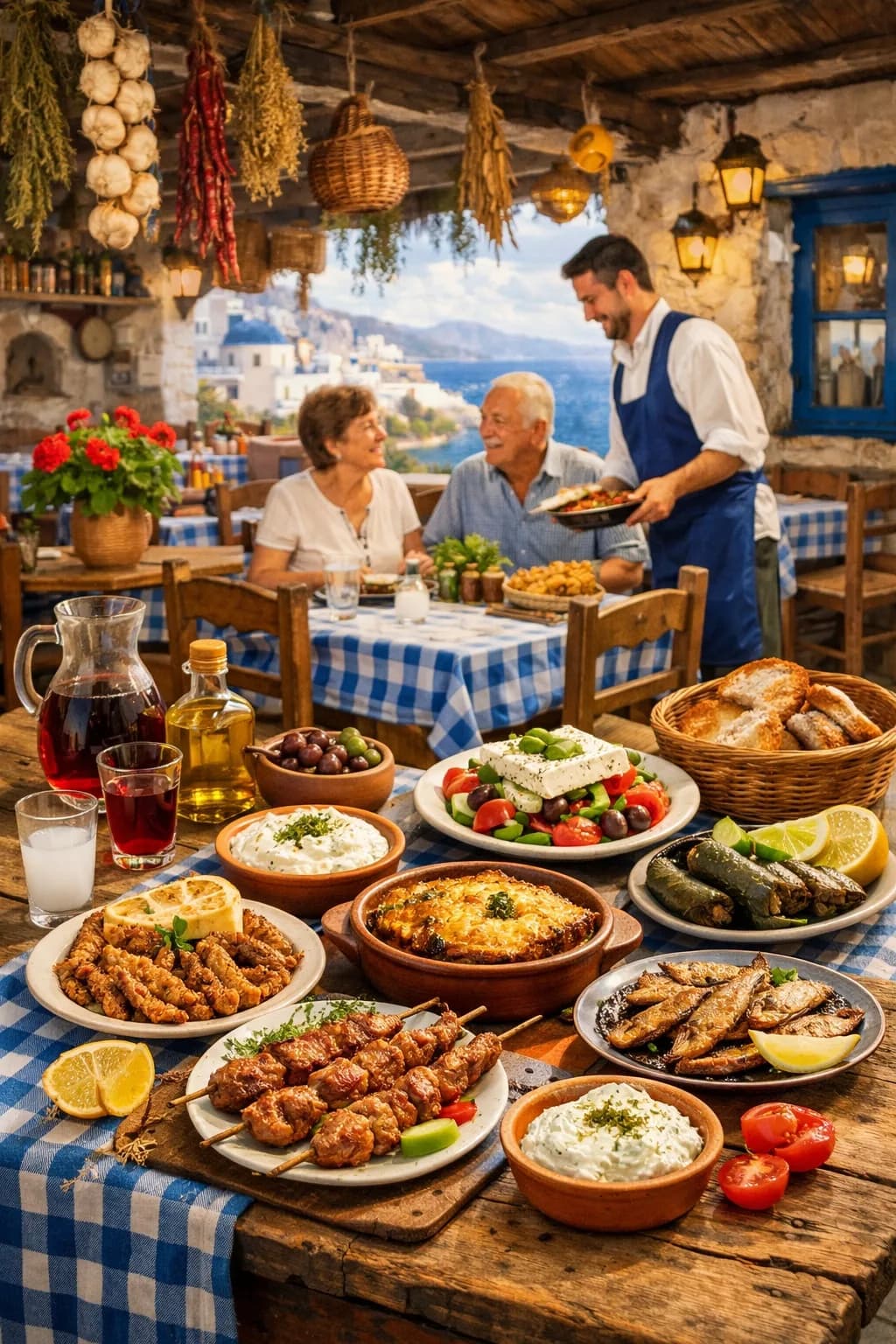
Greek food is one of the greatest pleasures of travelling to Greece — and for many visitors, it becomes one of the main reasons to return. The cuisine is based on fresh, high-quality ingredients: extra virgin olive oil, ripe tomatoes, wild herbs, fresh fish, and locally produced cheeses. The beauty of Greek food lies in its simplicity — a few perfect ingredients combined with skill and tradition.
This guide covers the dishes you simply must try, how to order them, and what to look for in a good taverna.
Moussaka
The undisputed queen of Greek cuisine. Moussaka is a rich, layered casserole of fried eggplant, sautéed minced meat (usually beef or lamb), and a creamy béchamel sauce, baked until golden brown. Each family and every taverna has its own version — some add potatoes, others use zucchini, and regional variations include Cretan moussaka with local cheese.
**Where to try it**: Look for a taverna that serves it fresh rather than pre-prepared. If a taverna offers moussaka only at lunch, that is a good sign — it means they make it fresh each morning.
**Price**: €8–14 for a generous portion as a main dish.
Souvlaki
Greece's most beloved street food. Souvlaki is grilled meat on a skewer — typically pork or chicken — served with warm pita bread, fresh tomato, chopped onion, and creamy tzatziki. It can be eaten as kalamaki (just the skewers) or wrapped in pita as a souvlaki wrap (known as souvlaki me pita).
**Where to try it**: The best souvlaki is found at small, family-run grill houses, not at tourist-oriented restaurants. Look for places where locals queue during lunch hour.
**Price**: €2.50–4 for a pita wrap, €7–12 for a platter with sides.
Greek Salad (Horiatiki)
Do not call it a "Greek salad" in Greece — it is called horiatiki, meaning "village salad." The authentic version contains no lettuce. Instead, it is a simple combination of ripe tomatoes, cucumber, green bell pepper, red onion, Kalamata olives, and a generous slab of feta cheese, all dressed with extra virgin olive oil and dried oregano.
**The feta question**: In Greece, feta is a protected designation of origin product made from sheep's milk or a mixture with up to 30% goat's milk. It has a creamy, slightly tangy flavour that bears little resemblance to the rubbery white cheese sold as "feta" outside Greece.
**Price**: €6–10 as a starter, easily enough for two people to share.
Tzatziki
A creamy, refreshing dip made from strained yogurt, grated cucumber, garlic, olive oil, and dill or mint. Tzatziki is served as a meze (appetiser) with bread, as a sauce for souvlaki and gyros, or alongside grilled meats and fried vegetables. The best tzatziki is made fresh daily — the yogurt should be thick, the cucumber finely grated, and the garlic present but not overwhelming.
Gyros
Often confused with souvlaki outside Greece, gyros is different: the meat (pork or chicken) is stacked on a vertical rotisserie and shaved off as it cooks, giving it crispy edges and tender interior. It is served in the same way as souvlaki — wrapped in pita with tomato, onion, tzatziki, and fries.
**Gyros vs Souvlaki**: The main difference is how the meat is cooked. Souvlaki is grilled on skewers; gyros is cooked on a vertical spit. Both are delicious, but gyros tends to be slightly cheaper and faster to serve.
Dolmades
Dolmades are grape leaves stuffed with rice and fresh herbs — dill, mint, parsley. Some versions include minced meat. They are served as an appetiser, often with a side of yogurt or lemon. In tavernas, they are served cold or at room temperature and make an excellent starter to share.
Spanakopita and Tyropita
The iconic Greek pies. Spanakopita is a spinach and feta cheese pie wrapped in crispy phyllo pastry. Tyropita is a cheese pie made with feta or a mixture of cheeses. Both are available everywhere — from bakeries (fournos) for a quick breakfast or snack, to tavernas as a starter. A good spanakopita has flaky, buttery phyllo and a filling that is savoury, creamy, and well-seasoned.
**Price**: €2.50–5 from a bakery, €5–8 in a taverna.
Calamari
Fried calamari (kalamarakia tiganita) is a staple of Greek seaside dining. Fresh squid is cleaned, cut into rings, lightly floured, and fried until golden and tender. The key is freshness — calamari should be tender, not rubbery. Good tavernas near the sea serve exceptionally fresh calamari.
Baklava
For dessert, baklava is the most famous Greek sweet. Layers of paper-thin phyllo pastry are brushed with butter, filled with chopped walnuts or pistachios, baked until golden, and soaked in aromatic honey syrup. It is sweet, sticky, and utterly delicious. Other Greek desserts worth trying include galaktoboureko (custard pie in phyllo), kataifi (shredded pastry with nuts and honey), and loukoumades (honey puffs).
Ouzo, Raki, and Wine
No Greek meal is complete without local spirits. Ouzo is the most famous — an anise-flavoured liqueur that turns milky white when water is added. It is traditionally sipped slowly with mezedes (small dishes). Raki (or tsikoudia in Crete) is a stronger, grape-based spirit served after meals as a digestive.
Greek wine is underrated internationally but excellent. The wine regions of Santorini (Assyrtiko), Nemea (Agiorgitiko), and Naoussa (Xinomavro) produce world-class wines. Most tavernas serve house wine by the kilo or half-kilo — ask for xylo (barrel wine) for the most authentic experience.
How to Order Like a Local
Finding the Best Tavernas
The best advice for finding excellent Greek food is simple: avoid restaurants with laminated menus with photos, aggressive touts outside, and locations on the main tourist square. Instead, walk one or two streets away from the waterfront in any Greek town — that is where the locals eat. A taverna full of Greek customers, with a daily changing menu written on a blackboard, is almost always a good choice.
Pro tip: Look for tavernas displaying a sign saying "Ποιότητα" (Quality) or "Σπιτικό" (Home-made). These words signal a commitment to fresh ingredients and traditional recipes.
Explore Related Content
Continue planning your trip with these guides and listings.