Andros
Cyclades

Andros

Andros is the northernmost and second-largest island of the Cyclades — radically different from every other island in the group, with year-round flowing rivers, waterfalls, springs, green valleys shaded by plane trees, 300+ kilometres of certified hiking trails, a neoclassical capital built on 19th-century maritime shipping wealth, and the Goulandris Museum of Modern Art, one of the finest small museums in the Mediterranean.

300km hiking trails — Best of Europe

Goulandris Museum of Modern Art

Neoclassical Chora of the sea captains

Pithara waterfalls & Menites springs

Achla beach — river meets the sea

Fourtalia — island's signature omelette

Travel Guide

Where to Stay in Andros

Beach Guide

Best Beaches in Andros

Activities

Things to Do in Andros

Destination Overview

Andros

Every other Cycladic island plays by the same geological rules: barren limestone mountains, scarce water, vegetation that clings on until July then browns and crisps. Andros declines to participate. Its northerly position and mountain spine intercept moisture from the Aegean winds, producing an island of genuine year-round rivers, waterfalls, springs, and green valleys shaded by plane trees where freshwater pools invite swimming without a beach in sight. The difference from Mykonos, visible across the strait 25 kilometres away, could scarcely be more complete.

Andros

Why visit Andros

A landscape that contradicts every expectation of the Cyclades

Andros is wet. Not occasionally, not in the winter months only, but genuinely and persistently wet — with springs that flow year-round, rivers that fill their banks through summer, plane-tree valleys that stay green into September, and waterfalls that run from the mountains to the sea through gorges dense with vegetation. The Menites springs in the island's centre are known as the Springs of Dionysus, because according to local legend, wine once flowed from the lion-head spouts that channel spring water into the village canal system. The Pithara waterfalls near Apikia cascade through a green canyon within an hour's walk of the island's spa village. None of this is supposed to exist in the Cyclades. Andros didn't get the memo.

300km of certified hiking trails — the best trail network in the Greek islands

The Andros Routes network was built by volunteers who restored abandoned mule tracks between the island's villages over more than two decades. The result is over 300 kilometres of marked, maintained trails that have earned the 'Leading Quality Trails – Best of Europe' certification — a European Ramblers' Association standard that recognises trail safety, signposting, infrastructure and scenic quality. The flagship Route 1 crosses the entire island from Gavrio to Korthi, approximately 100 kilometres end to end. Day hikes range from a beginner walk through the plane trees of the Dipotamata valley to serious mountain crossings via the island's highest peak. No other Greek island has trail infrastructure of this standard and this scale.

Andros Chora: neoclassical architecture built by men who owned ships

Andros's capital sits on a narrow ridge between two bays on the island's eastern coast — a pedestrianised Cycladic town with a fundamental architectural difference from every other capital in the group. The mansions lining its marble lanes were built by 19th-century captains and shipowners who amassed fortunes in maritime trade and brought the money home in the form of imposing neoclassical and Venetian-influenced buildings. The marble fountain at the central square, the arcaded lanes, the grand facades that line the pedestrian axis from the port to the Tourlitis lighthouse at the cape — all of it reflects a prosperity that the island's economy no longer fully maintains but whose physical evidence is extraordinary, and extraordinarily well preserved.

The Goulandris Museum of Modern Art: world-class art on a Cycladic island

Founded by the Basil and Elise Goulandris Foundation — one of Greece's most significant shipping families — the Museum of Modern Art in Chora houses a permanent collection of modern Greek art (including the works of Andros-born sculptor Michalis Tombros) and rotates international exhibitions of genuine ambition. Past temporary shows have featured Picasso, Matisse and Klee. For a small island with a permanent population of around 10,000, the museum's existence and quality are simply remarkable — it is one of the finest small museums in the Mediterranean.

Villages that work — and a built environment that shows it

Andros has more functioning inland villages per square kilometre than any other Cycladic island, and they feel different from the village-museums of more touristed islands. Menites, with its flowing springs and plane trees, has two good tavernas and a population that still tends the orchards. Stenies, perched above the sea on the road north of Chora, has neoclassical mansions so intact that the lane feels like a 19th-century stage set — without the staginess. Vourkoti, the island's highest inhabited point, often sits in cloud and gives access to wild trails toward Achla beach.

Two hours from Athens — and genuinely unlike Athens's other escapes

Andros is the first stop for ferries from Rafina, the port closest to Athens and to Athens International Airport. The crossing takes two hours. For Athenians, Andros has functioned for generations as the weekend and summer destination of choice for a particular stratum of the city — educated, cultured, interested in the outdoors — which is part of why the island's museum and trail network exist at the quality they do. For international visitors, the two-hour ferry from a port 30 minutes from the airport makes Andros the most accessible serious Cycladic destination, bypassing the Piraeus ferry network entirely.

Andros

Best time to visit Andros

💡 💡 The hiker's window: April and May are when Andros's rivers are at their fullest, the Pithara waterfalls run at maximum volume, the wildflowers cover the valley trails, and the plane-tree shade is at its most welcome. The Andros Routes network is perfectly positioned for spring hiking — the temperatures are ideal, the landscape is at peak green, and the Chora tavernas are open without the summer density.

April – May

Best for hiking. Rivers full, waterfalls at peak, wildflowers across the trails, and comfortable temperatures for the longer routes. Sea not quite warm enough for sustained swimming, but natural river pools at Dipotamata are an alternative.

June

Perhaps the ideal month overall — warm enough for daily beach swimming, sea water rising to comfortable temperature, hiking still pleasant in the mornings, and the island operating fully without August's density. The Goulandris Museum's summer exhibition typically opens in June.

July – August

Peak season — Athenian families fill the island and it is busier than many visitors expect. Beaches are animated, the International Andros Festival runs at the Chora open-air theatre, and the Meltemi wind keeps the temperatures bearable. Hike in early mornings; beaches afternoons. Book well ahead.

September

Consistently recommended by those who know the island. Sea still warm (25°C+), crowds thinning rapidly, the Chora and the villages reverting to their own pace. The light on the neoclassical buildings in September is exceptional. The last of the summer exhibitions at the Goulandris typically runs into early September.

Andros island landscape, Cyclades, Greece
Andros, Cyclades, Greece

Andros

Top attractions & experiences in Andros

Andros Chora — the marble capital of the seafarers

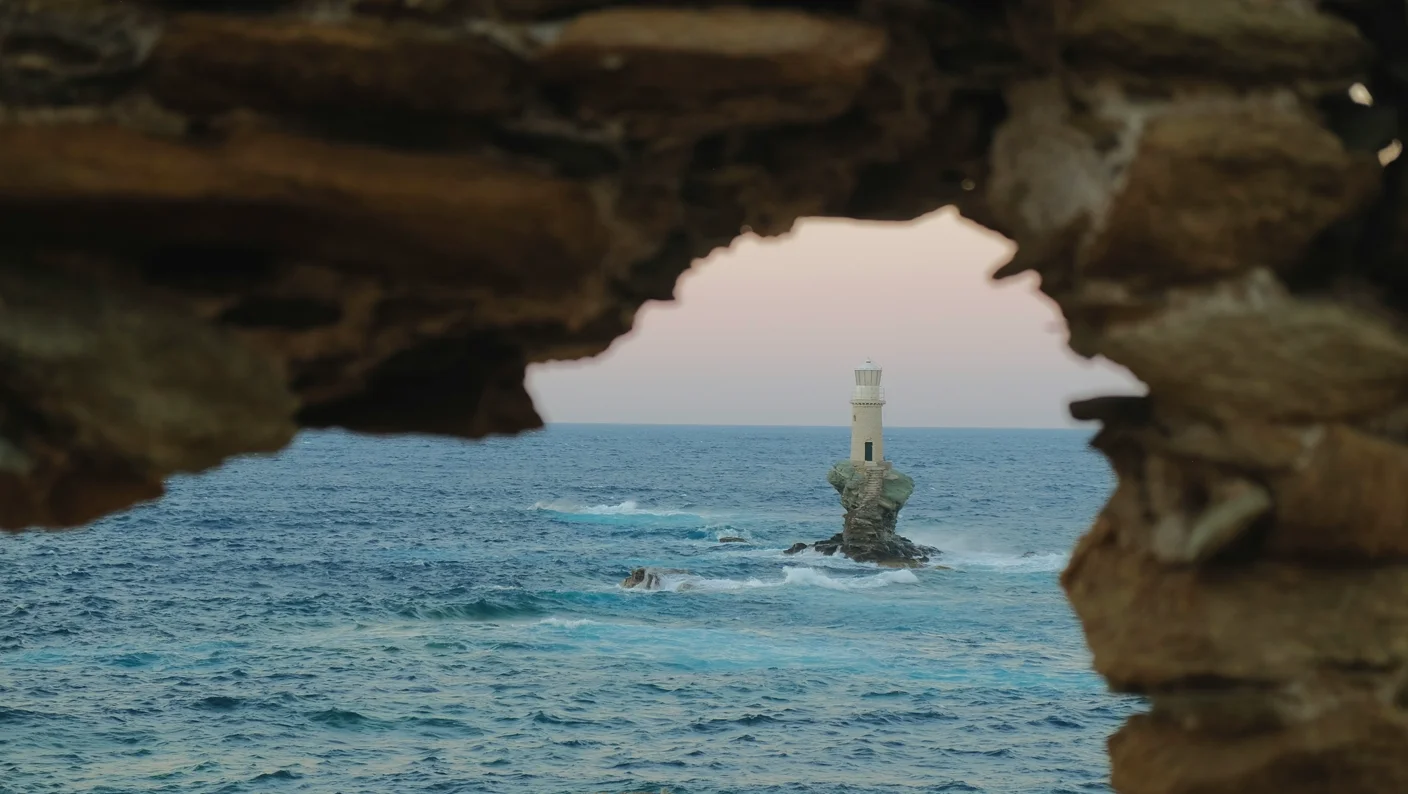
Walking Andros Chora is walking through the physical evidence of accumulated maritime wealth — a pedestrianised sequence of marble-paved lanes, imposing neoclassical mansions, arcaded passages and the central square where the marble fountain marks what feels like the centre of a much larger town. The Tourlitis lighthouse, built on a sea stack just off the cape, is the island's visual signature: a white tower on a rock, accessible by a footbridge, visible from the lanes above. Walk the main pedestrian axis from Neimporio beach to the lighthouse point at dusk, when the light on the stone facades takes on qualities that the midday sun doesn't permit.

Goulandris Museum of Modern Art

Two wings: the Old Wing, with a permanent collection of modern Greek art including the sculptures of Michalis Tombros and canvases from the Greek avant-garde of the 20th century; and the New Wing, which hosts the rotating international exhibitions that have made the museum's summer programme one of the most anticipated cultural events in the Aegean. The architecture of the museum is itself notable — both buildings are restrained and beautifully integrated into the Chora's urban fabric. The museum is open in summer (June–September) with extended evening hours that allow post-dinner visits on summer nights.

The Springs of Dionysus at Menites

In the village of Menites in the island's green centre, spring water flows from lion-head stone spouts into a canal system that still channels water through the village orchards. The legend that wine once flowed here — giving the springs their name, after Dionysus, god of wine — is mythological, but the springs themselves are entirely real and still functional. Sitting at one of the two village tavernas under the plane trees, hearing the water while it runs past the tables, is one of those small Cycladic experiences that is impossible to find anywhere else in the Aegean.

Pithara Waterfalls near Apikia

A 30-40 minute walk from the spa village of Apikia (following Route 2a of the Andros Routes network) leads to the Pithara waterfalls — a cascade into a natural pool, surrounded by dense green vegetation of the kind that should not exist on a Cycladic island in July. The pool is swimmable, the shade is genuine, and the contrast with the dry limestone hillsides visible from the ferry on arrival is startling. Spring and early summer bring the highest water volume; the falls are accessible but reduced by September.

Tis Grias To Pidima — the rock that jumped

Northeast of Chora, accessible by a coastal path over the headland from Paraporti beach (approximately 30 minutes on foot), the beach of Tis Grias To Pidima takes its name from a rock formation jutting from the turquoise water. The legend: during a pirate raid, an old woman betrayed the villagers, then, consumed by guilt, leaped from the cliff and was turned to stone. The beach is not easily accessible by car, which keeps it quieter than it deserves to be; the sea here is some of the clearest on the island's eastern coast, and the rock formation is genuinely dramatic from water level.

Paleopolis — the ancient sunken capital

The ancient capital of Andros sits on a steep slope near the village of Paleopolis, partly visible on land and partly submerged offshore. The archaeological museum in the village holds finds from the site. The most distinctive experience here is snorkelling directly over the submerged harbour ruins — stone quays, building foundations, and the outlines of a city that once extended into what is now the sea. The combination of land excavation and underwater archaeology in a single visit is unusual in the Cyclades and rewards those who bring a mask and fins alongside their site map.

Andros

Best hikes — the Andros Routes network

💡 💡 Trail resource: Detailed trail maps for all Andros Routes are available at the Explore Andros office in the Fresco café in Chora, and downloadable from the androstrails.gr website. The network is among the best documented hiking systems in Greece; every numbered route has a map, difficulty rating, distance and elevation profile.

🟢 Easy — Menites Springs to Chora (Route 1 section)

A 6km walk through the island's agricultural heart — spring-fed orchards, plane trees, stone bridges and the approach to Chora through the upper lanes. One of the finest introductions to Andros's landscape combination available as a single walk.

🟢 Easy — Chora to Paraporti and Grias To Pidima

A coastal path beginning in the Chora and rounding the northern headland to the legendary beach. Return via the same path with the light behind you in the afternoon. Approximately 3km each way.

🟡 Moderate — Apikia to Pithara Waterfalls (Route 2a)

Starting from the spa village of Apikia, this trail follows the river upstream to the Pithara cascade. The ascent is gradual; the waterfalls and natural pool at the end fully reward the effort. Best in spring and early summer.

🟡 Moderate — Dipotamata Valley circuit (Route 8)

A 7km river-valley route through the Dipotamata gorge on the island's southeastern coast — one of the most biodiverse valleys in the Cyclades, with rare alder forests, streams and medieval bridge crossings. Suitable for those comfortable on uneven terrain.

🔴 Demanding — Vourkoti to Achla Beach (Route 5)

Beginning at the island's highest village, the trail descends through mist and plane-tree forest toward the extraordinary Achla beach where a river meets the sea. A half-day commitment with significant descent; arrange a boat back or return the same way.

🔴 Full Day — The Andros Route (Route 1 — cross-island)

Approximately 100km connecting Gavrio port in the northwest to Korthi in the southeast. Usually completed over 3–5 days with overnight stops in village guesthouses. The premier long-distance hike in the Cyclades; detailed maps and accommodation lists available at Explore Andros.

Andros

Best beaches in Andros

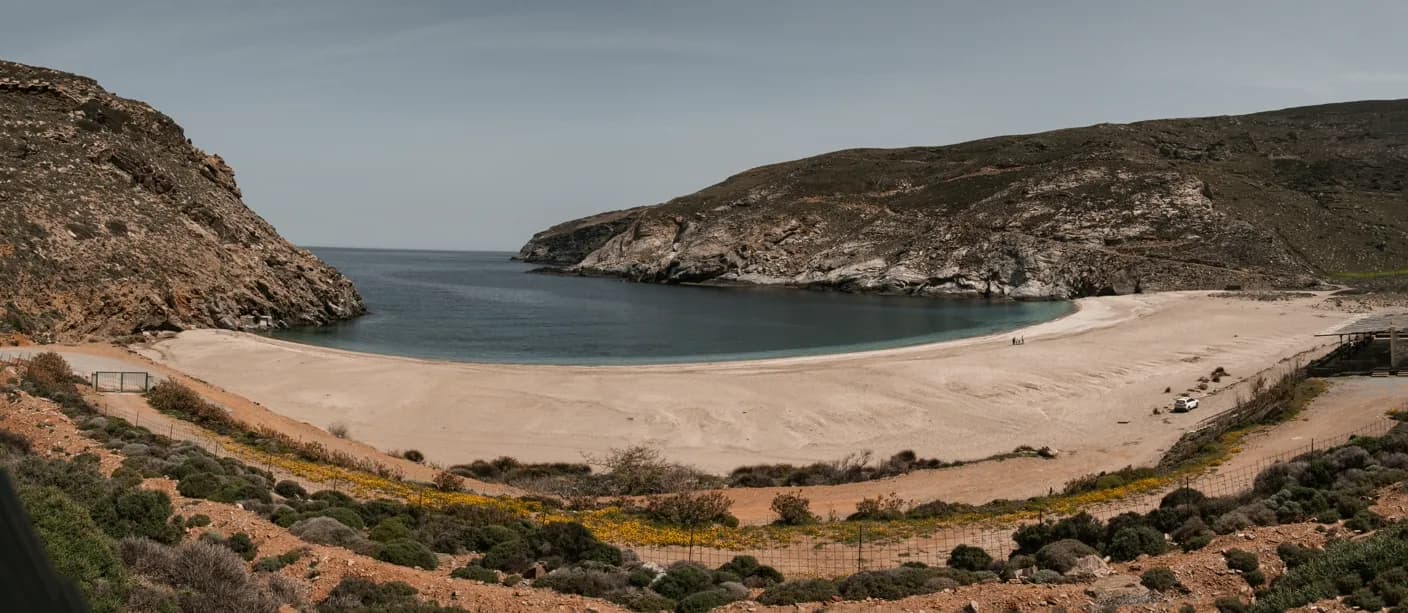
💡 💡 Andros beach character: Many of Andros's best beaches are accessed by walking (the finest often require a trail approach) or by rough tracks. The combination of a spectacular beach with a moderate walk to reach it is consistent across the island's eastern coast — expect pebble and coarse sand rather than the fine white sand of the Cyclades' famous beaches, but water clarity that rivals any in the Aegean.

Achla

Widely considered the finest beach on the island — a secluded bay on the northeastern coast where a river flows into the sea through a small delta of white pebbles and plane trees. Accessible by boat from Batsi or Chora (seasonal), by a very rough 4WD track, or by the trail from Vourkoti. No facilities; bring everything. The combination of river, forest, pebbles and turquoise sea is genuinely unlike any other beach in the Cyclades.

Tis Grias To Pidima

Northeast of Chora, reached by coastal path over the headland. The legendary rock formation jutting from the water gives the beach its name and its visual drama. Clear water, moderate pebble, no organised infrastructure. Best visited in the morning before the walk back to the Chora in the shade of the headland path.

Paraporti

The beach immediately below Chora — a wide pebble bay with good swimming, visible from the lanes above. Organised in season (seasonal café, some sunbeds), walkable from Chora in 10-15 minutes. The view back up at the neoclassical buildings of the capital from water level is one of Andros's most distinctive perspectives.

Batsi Beach

The island's most organised and family-friendly beach — wide sandy arc in the protected bay of Batsi village, with full beach services, watersports, tavernas above the sand and easy bus access from Gavrio and Chora. The most conventional beach holiday experience on the island; excellent for families and those who want amenities with their swimming.

Agios Petros

A long sandy beach north of Gavrio, easily accessible and usually less busy than Batsi. The site of the ancient Agios Petros tower — a Hellenistic circular tower dating to approximately the 3rd century BC, one of the best-preserved such structures in the Cyclades — gives the beach a layer of archaeology that most don't have.

Fellos

A shingle beach north of Gavrio with deep, clear water, wind exposure from the northwest (making it ideal for windsurfers), and a genuine feeling of remoteness despite its relative accessibility. The taverna at Fellos, To Steki Tou Andrea, under the pine trees above the beach, is one of the island's most reliably good for simple grilled fish.

Andros

Local food & drink

Fourtalia — Andros omelette

The island's signature dish and the one unavailable anywhere else. A thick, tortilla-style omelette made with eggs, potatoes and slices of the island's local pork sausage (loukaniko), fried in olive oil and served in traditional kafeneions. Found nowhere else in the Cyclades. Order it at any traditional village kafeneion for the most authentic version.

Andros local wine

The island has a small but growing fine-wine scene, with several producers reviving indigenous grape varieties suited to Andros's relatively cool and wet microclimate. The Empeirikia winery near Apikia produces limited-batch labels that are rarely found outside the island. Ask at the Chora wine bars for current local producers.

Local cheeses & honey

Andros produces a fresh local cheese — chloro — and a peppery hard cheese that appear on meze plates in the island's tavernas. The mountain honey, produced from bees that work the thyme and wildflower-rich upper slopes, has a complex flavour specific to the island's high-altitude flora. Buy directly from producers at the Saturday market in Chora.

Fish at Neimporio beach & Korthi

Ta Binelikia and Nona's near Neimporio beach in Chora are the island's most consistently recommended seafood tavernas — tables directly above the water, daily-caught fish simply prepared, and a setting that the capital's position on its peninsula ridge delivers at every table. Korthi in the island's south also has excellent waterfront seafood at more accessible prices.

Sariza mineral water from Apikia

Commercially bottled from the Sariza spring in Apikia since the early 20th century, this is one of Greece's most widely recognised mineral waters — served in Athenian restaurants and available across the country. Drinking it at the source, in the village that still hears the spring flowing through its lanes, is the best possible context for what is essentially very good water.

The bakeries

Multiple travel writers who know the island well cite Andros's bakeries as among the best in the Cyclades — a consequence of the island's agricultural self-sufficiency and a baking culture that was never entirely replaced by industrial production. Tyropita (cheese pie), koulouria and the local Easter bread (tsoureki with island-specific spicing) are worth seeking specifically. Just walk in the direction of the smell.

Andros

Practical tips

Ferries depart from Rafina, not Piraeus

This is non-negotiable and the single most important logistical fact about getting to Andros. From Athens city centre, Rafina is approximately 45 minutes by KTEL bus (from Pedion Areos) or 30-40 minutes by taxi. From the airport, approximately 30 minutes by taxi.

Rent a car from Gavrio on arrival

The island's best beaches, trailheads and villages require independent transport, and the bus network, while functional for the Gavrio-Batsi-Chora corridor, does not reach the hiking routes or the remoter coasts. Rental agencies at the port fill their inventory on arrival day in August.

Download trail maps before you arrive

The Andros Routes are well-marked on the ground, but having the offline map on your phone prevents confusion at junctions in the interior where mobile signal is absent. The androstrails.gr website has downloadable GPX files for each numbered route.

The Meltemi wind is stronger on Andros

Particularly on the northern and northeastern coasts and at the beaches facing north. Achla and Fellos can be choppy when the Meltemi is at full strength; the eastern coast beaches (Paraporti, Neimporio) and the western side (near Batsi) are more sheltered. Plan beach days around the forecast.

Check Goulandris Museum summer hours

The museum keeps summer hours — typically open from June through September, including evening openings that allow visits after dinner. Check the current programme at goulandris.gr before your trip; the international exhibition changes annually.

Explore Chora early morning or late evening

The narrow pedestrian lanes in July-August can be congested at midday; the same streets at 8am or 9pm are a different experience — quieter, cooler, and with the quality of light that gives the neoclassical facades their best appearance.

Andros

FAQ

What makes Andros different from other Cycladic islands?

Andros is wetter, greener and more mountainous than any other island in the Cyclades — a consequence of its northerly position and high terrain that captures Aegean moisture. It has year-round flowing rivers, waterfalls, springs, and green valleys entirely foreign to the typical Cycladic landscape. Add the shipping-wealth neoclassical architecture of Chora, the internationally significant Goulandris Museum of Modern Art, and 300+ kilometres of certified hiking trails rated 'Best of Europe' by the European Ramblers' Association, and you have an island that looks and functions radically differently from Mykonos, Santorini or Paros.

How do you get to Andros?

Ferries depart from Rafina port — not Piraeus. Rafina is approximately 25km east of central Athens and 30 minutes from Athens International Airport by taxi. The crossing to Gavrio (Andros's port) takes approximately 2 hours on a fast ferry. This makes Andros one of the most airport-accessible Cycladic islands: fly to Athens, taxi to Rafina, 2 hours to Andros.

Is Andros good for hiking?

Andros is the hiking capital of the Cyclades. The Andros Routes network covers over 300 kilometres of restored, marked trails certified as 'Leading Quality Trails – Best of Europe' by the European Ramblers' Association. The network links villages, rivers, waterfalls, stone bridges, monasteries and remote beaches across the entire island. Day hikes range from beginner walks through plane-tree valleys to full-day mountain crossings.

When is the best time to visit Andros?

May and June for hiking (rivers full, waterfalls at peak, temperatures comfortable) and June for the ideal combination of hiking and beach swimming. September is consistently excellent — warm sea, thinning crowds, and the island's best autumn light. July-August for the International Andros Festival, full beach operations and peak Athenian energy.

What is fourtalia?

Fourtalia is the signature dish of Andros — a thick omelette made with eggs, potatoes and local pork sausage, cooked in olive oil and served in traditional kafeneions across the island. It is specific to Andros and reflects the island's historical agricultural self-sufficiency — unlike its drier Cycladic neighbours, Andros had the water supply and fertile soil to maintain pork production and potato cultivation across many centuries.

How many days do I need in Andros?

Five to six days is the recommended minimum: one day for Chora and the museum, one for the inland villages and springs, one or two for hiking (the Apikia-Pithara trail and the Grias To Pidima coastal path are priority choices), one for a beach day at Achla or Batsi, and one for the archaeological sites. A dedicated hiker aiming to complete significant sections of the Andros Routes network would benefit from a week to ten days.